
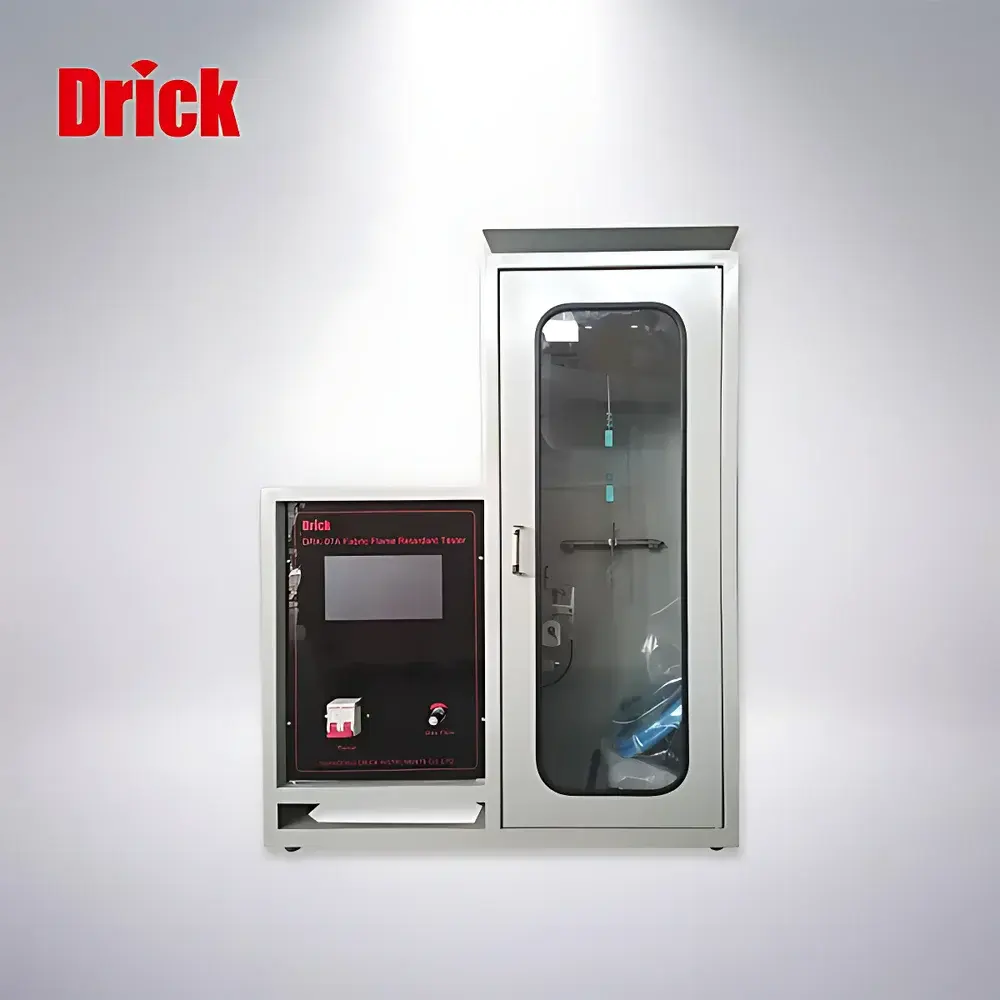
Drick DRK-07A Medical Protective Clothing Flame Resistance Tester
| Brand | Drick |
|---|---|
| Model | DRK-07A |
| Origin | Shandong, China |
| Manufacturer Type | Direct Manufacturer |
| Power Supply | 220 V ±10%, 50 Hz, <100 W |
| Operating Temperature | −10 °C to 30 °C |
| Relative Humidity | ≤85% RH |
| Touchscreen | 7-inch TFT, 800×480 resolution, RS232 interface, 1 GB storage, FPGA-driven hardware architecture |
| Flame Application Time Accuracy | ±0.1 s |
| Bunsen Burner Tilt Range | 0–45° |
| Gas Options | Propane/butane mixture (Condition A per GB/T 5455–2014) or ≥97% purity methane (Condition B) |
| Instrument Weight | ~40 kg |
| Sample Dimensions (Condition A) | 300 mm × 89 mm, 10 specimens (5 warp + 5 weft) |
| Sample Dimensions (Condition B) | 300 mm × 89 mm, 5 specimens (3 warp + 2 weft) |
| Compliance | ASTM F6413, GB/T 13489–2008, ISO 1210–1996, GB 19082–2009 (Medical Protective Clothing) |
Overview
The Drick DRK-07A Medical Protective Clothing Flame Resistance Tester is a precision-engineered vertical flame test apparatus designed for quantitative evaluation of ignition resistance, afterflame time, afterglow (smoldering) time, and char length in medical protective textiles and coated fabrics. It operates on the principle of controlled vertical flame exposure—per ASTM F6413 and GB/T 5455–2014—where a standardized Bunsen burner flame is applied to the bottom edge of a vertically clamped specimen for a defined duration. The instrument measures critical fire response parameters including Ta (flame application time), T1 (afterflame time), and T2 (afterglow time), enabling objective classification of flame propagation behavior under regulated thermal stress. Its mechanical and control architecture is optimized for repeatability in regulated laboratory environments, supporting compliance-driven quality assurance workflows in PPE manufacturing, regulatory testing labs, and hospital procurement verification protocols.
Key Features
- 7-inch industrial-grade touchscreen HMI with FPGA-accelerated rendering, enabling zero-boot latency and deterministic real-time response during flame timing sequences
- Programmable Bunsen burner with ±0.1 s flame-on timing accuracy and adjustable tilt (0–45°) to accommodate non-planar or layered fabric geometries
- Integrated high-voltage automatic ignition system with configurable multi-pulse ignition cycles (e.g., three attempts) to ensure consistent flame initiation across gas types and ambient conditions
- Dual-condition sample conditioning support: Condition A (standard atmosphere per GB/T 6529) and Condition B (105 ±3 °C drying per GB/T 5455–2014), each with distinct specimen count and orientation requirements
- Low-power embedded controller architecture (ARM Cortex-M3 + FPGA co-processing) with dynamic power management—automatically entering standby mode during idle intervals without compromising data integrity
- RS232 serial interface for external logging systems or LIMS integration; supports ASCII-based command protocol for automated test sequencing and audit trail generation
Sample Compatibility & Compliance
The DRK-07A accommodates woven, knitted, laminated, and coated textile substrates—including seam-integrated medical gowns, surgical drapes, and isolation apparel—as specified in GB 19082–2009. Specimen preparation strictly follows standardized dimensional and orientation rules: 300 mm × 89 mm strips, cut at least 100 mm from fabric selvage, with warp and weft specimens drawn from independent yarn sets to eliminate bias. Notably, Condition A (ambient equilibration) and Condition B (oven-dried) yield non-interchangeable datasets due to moisture-content-dependent pyrolysis kinetics; users must declare the conditioning method in all test reports. Regulatory alignment includes full technical conformance with ASTM F6413 (vertical flame test for textile PPE), GB/T 13489–2008 (rubber-coated fabrics), and ISO 1210–1996 (plastic vertical burning). While not certified to UL 94 or NFPA 2112 out-of-the-box, its mechanical and procedural fidelity enables method adaptation under qualified validation protocols.
Software & Data Management
On-device firmware implements deterministic real-time event logging: each test cycle records Ta, T1, T2, char length, and operator-defined metadata (e.g., specimen ID, condition flag, date/time stamp). All entries are stored in non-volatile memory with timestamped file naming (e.g., “TEST_20240522_142301.csv”) and support export via USB mass storage or RS232 dump. Audit-ready functionality includes immutable session logs, no manual edit capability post-test, and traceable user actions (e.g., “Save”, “Ignite”, “Stop”)—consistent with GLP-aligned documentation practices. For laboratories operating under FDA 21 CFR Part 11 or ISO/IEC 17025, optional PC-based companion software (sold separately) provides electronic signature support, role-based access control, and PDF report generation with embedded digital signatures and hash-verified data integrity checks.
Applications
- Pre-market validation of disposable and reusable medical gowns per GB 19082–2009 Clause 5.7 (Flame Resistance)
- Batch release testing for ISO 13485-certified PPE manufacturers requiring documented flame performance consistency
- Root-cause analysis of coating delamination or fiber melt-back phenomena during flame exposure
- Comparative assessment of flame-retardant finish durability after simulated laundering (per AATCC TM135 or ISO 6330)
- Research into synergistic flame inhibition mechanisms in halogen-free FR systems (e.g., phosphorus-nitrogen intumescents)
- Third-party certification testing for CE marking under PPE Regulation (EU) 2016/425 Annex II, where vertical flame performance is a mandatory requirement for Category III garments
FAQ
What gas types are compatible with the DRK-07A, and how are they selected?
The instrument supports two standardized gas configurations: Condition A uses industrial propane, butane, or their mixture (per GB/T 5455–2014); Condition B requires ≥97% purity methane. Gas selection is determined by test standard requirements—not instrument capability—and must be documented in the test report.
Can the DRK-07A be used for non-medical textiles such as workwear or upholstery?
Yes—its mechanical design and flame geometry comply with ASTM D6413 and ISO 1210, making it suitable for any vertically oriented textile or thin polymer sheet. However, reporting must reference the applicable standard and conditioning method to ensure result validity.
Is calibration traceable to national standards?
The DRK-07A does not require periodic calibration of flame timing or burner geometry; these are fixed mechanical parameters verified during factory acceptance testing. Users should perform daily operational checks using reference specimens with known performance (e.g., calibrated cotton control fabric) and document results per internal SOPs.
Does the instrument meet electromagnetic compatibility (EMC) requirements for EU markets?
The DRK-07A complies with IEC 61326-1:2013 (industrial EMC) and has been tested for radiated/conducted emissions and electrostatic discharge immunity. CE marking documentation is available upon request for end-users completing EU Declaration of Conformity.
How is data integrity ensured during power interruption?
All active test data is written to flash memory in atomic operations; partial writes are rejected. Power-loss recovery resumes the HMI interface without data corruption, though incomplete tests must be re-run—consistent with ISO/IEC 17025 clause 7.7.1 on result validity assurance.





