
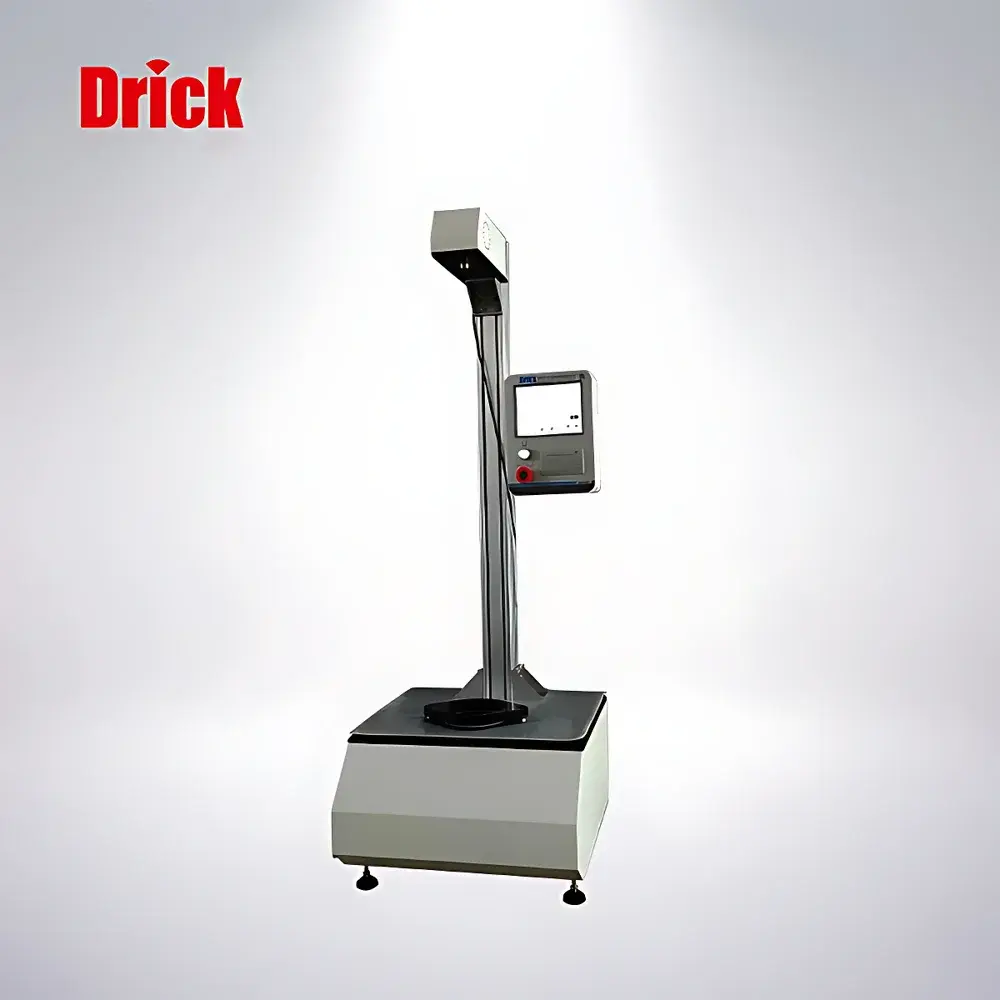
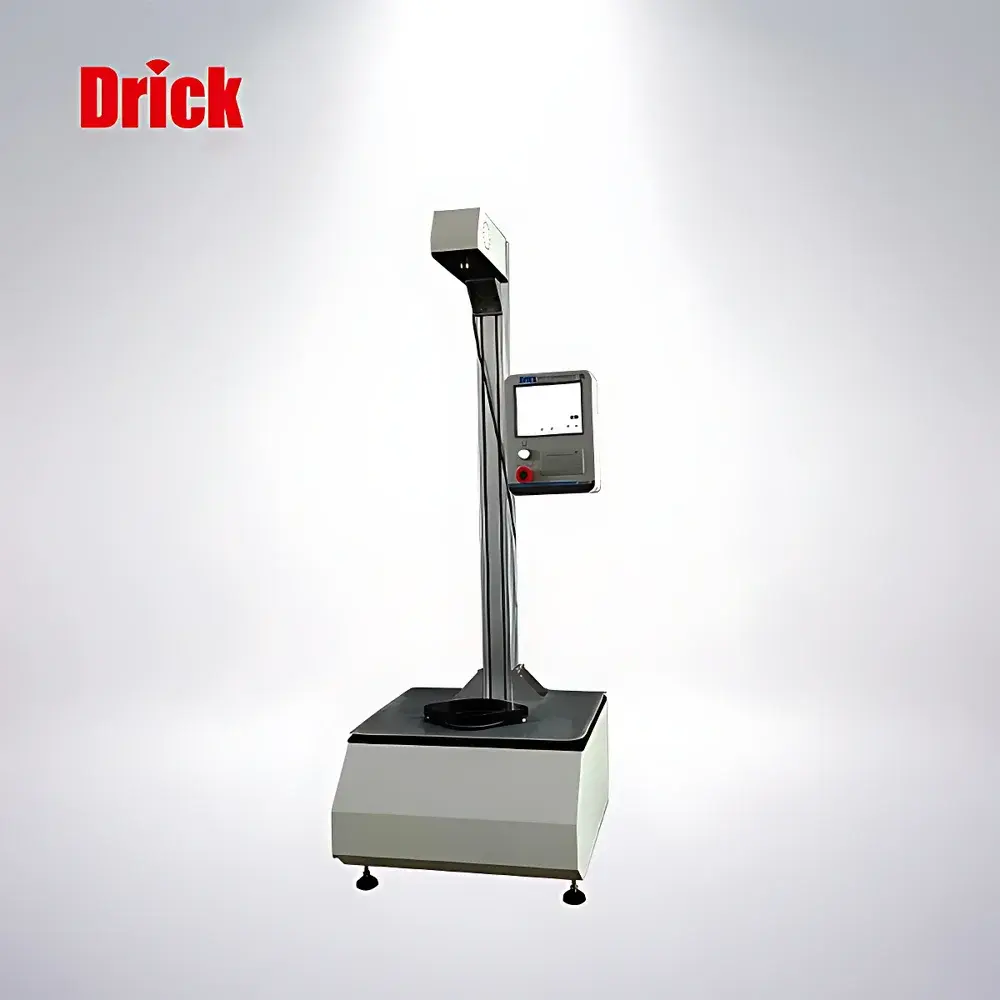
Drick DRK135 A-Method Dart Impact Tester for Plastic Films
| Brand | Drick |
|---|---|
| Origin | Shandong, China |
| Manufacturer Type | Direct Manufacturer |
| Country of Origin | China |
| Model | DRK135 |
| Test Methods | ASTM D1709 A-Method, GB/T 9639-2008 A-Method, ISO 7765-1:1994 A-Method |
| Dart Head Diameter | 38.1 ± 0.13 mm (ASTM), 38 ± 1 mm (GB/ISO) |
| Dart Head Material | Polished aluminum or phenolic resin (low-density, hardness-matched) |
| Drop Height | 0.66 ± 0.01 m |
| Mass Range (A-Method) | 50–2000 g |
| Energy Resolution | 0.1 J |
| Mass Resolution | 0.1 g |
| Specimen Clamping | Pneumatic |
| Specimen Size | ≥150 mm × 150 mm |
| Power Supply | AC 220 V ± 5%, 50 Hz |
| Net Weight | ~65 kg |
| Compliance | ASTM D1709, GB/T 9639-2008, ISO 7765-1, JIS K7124 |
Overview
The Drick DRK135 A-Method Dart Impact Tester is a precision-engineered instrument designed to quantify the impact resistance of thin polymeric materials using standardized free-fall dart methodology. It operates on the principle of gravitational energy transfer: a calibrated dart is dropped from a fixed height onto a horizontally clamped specimen, and the critical mass at which 50% of test specimens fail (i.e., puncture or tear) is determined via the staircase (up-and-down) testing protocol. This method directly yields both impact mass (g) and impact energy (J), enabling objective comparison of toughness across film grades, laminates, and coated substrates. The DRK135 implements the A-method per ASTM D1709, GB/T 9639-2008, and ISO 7765-1, with a nominal drop height of 0.66 m and a 38.1 mm diameter aluminum or phenolic dart head—optimized for materials exhibiting moderate to high ductility, such as LDPE stretch films, BOPP packaging layers, and metallized PET laminates.
Key Features
- Simultaneous dual-mode compliance: Fully supports both ASTM/GB/ISO A-method and optional B-method configurations via modular dart head and height adjustment (B-method kit available as accessory).
- Pneumatic specimen clamping system ensures uniform, repeatable tension across the 150 mm × 150 mm test area—minimizing edge effects and eliminating manual tightening variability.
- Intelligent staircase algorithm embedded in firmware automates mass increment/decrement logic per ASTM D1709 Annex A1: mass is adjusted by Δm (user-defined, typically 10–50 g) based on pass/fail outcome of each individual specimen, converging efficiently toward the 50% failure endpoint.
- Integrated LCD interface displays real-time test sequence number, current dart mass, pass/fail status, cumulative failure count (N), and final calculated impact mass and energy—no external PC required for basic operation.
- Rugged steel frame with vibration-dampened base and guided vertical drop column guarantees positional repeatability and eliminates lateral drift during impact, critical for inter-laboratory reproducibility.
Sample Compatibility & Compliance
The DRK135 is validated for use with plastic films, foils, laminates, and paper-based packaging substrates ≤1.0 mm thickness. Typical applications include polyethylene (PE) cling film, polypropylene (PP) oriented films, polyester (PET) sheeting, aluminum foil, aluminum-plastic composites, and multi-layer food pouches. Its mechanical design and control logic conform strictly to the procedural requirements of ASTM D1709 (Standard Test Method for Impact Resistance of Plastic Film by the Free-Falling Dart Method), GB/T 9639-2008 (Plastic Film and Sheet—Dart Drop Impact Resistance), ISO 7765-1:1994 (Plastics—Film and Sheeting—Determination of Impact Resistance—Part 1: Free-Falling Dart Method, Type A), and JIS K7124. While not an electronic data-integrity system per se, the instrument’s deterministic test sequence, non-volatile result storage, and traceable mass calibration support GLP-aligned documentation practices when paired with laboratory SOPs.
Software & Data Management
The base configuration includes a built-in thermal microprinter for immediate hard-copy output of test parameters, specimen IDs, mass steps, and final impact values. For enhanced data governance, optional PC software (sold separately) enables full audit trail capture—including timestamped operator ID, calibration history, raw staircase data points, and statistical summaries (mean, SD, CV%). Export formats include CSV and PDF, facilitating integration into LIMS environments. When used in regulated settings (e.g., contract packaging QA labs), the software supports user-level access controls and optional 21 CFR Part 11-compliant electronic signatures—subject to local validation protocols.
Applications
- Quality assurance of rollstock prior to converting operations (e.g., bag-making, pouch lamination)
- Comparative evaluation of resin formulations, additive packages (e.g., impact modifiers), and extrusion process parameters
- Validation of seal integrity and heat-seal layer performance under dynamic impact loading
- Supplier qualification and incoming inspection of flexible packaging materials per ISO 22000 or BRCGS Packaging standards
- Research into structure–property relationships of nanocomposite films and biodegradable polymers
FAQ
What standards does the DRK135 A-Method tester fully satisfy?
It meets the mechanical, procedural, and reporting requirements of ASTM D1709 (A-Method), GB/T 9639-2008 (A-Method), ISO 7765-1:1994 (Type A), and JIS K7124.
Can the same instrument perform both A-Method and B-Method tests?
Yes—B-Method functionality requires the optional B-Method dart head (50.8 mm stainless steel) and height calibration kit; both methods are selectable via front-panel menu after hardware installation.
How is the 50% failure point determined statistically?
Using the up-and-down staircase method per ASTM D1709 Annex A1: after 20 initial specimens, if failures (N) ≠ 10, additional specimens are tested until either N = 10 (failures) or (20 − N) = 10 (non-failures), then the median impact mass is calculated from the final 20 valid results.
Is pneumatic clamping mandatory, or can manual clamps be used?
Pneumatic actuation is integral to the DRK135’s design—no manual clamp option exists—to ensure consistent clamping force (≥0.4 MPa) and eliminate operator-induced variability.
Does the instrument require annual recalibration?
Yes: annual verification of drop height (±0.01 m), dart mass (±0.1 g), and pneumatic pressure is recommended; certified traceable weights and digital calipers are supplied with calibration documentation.





