
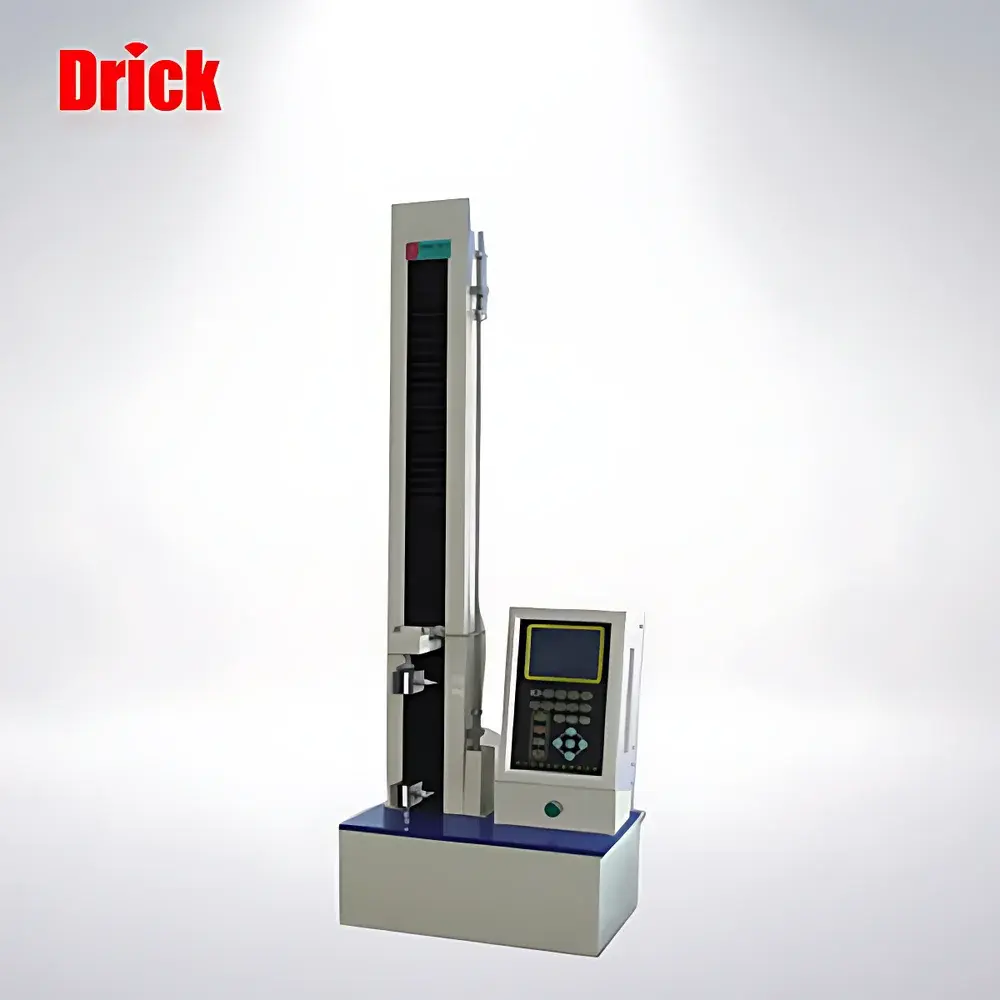
Drick LDS Series Electronic Tensile Testing Machine for Rubber and Plastics
| Brand | Drick |
|---|---|
| Model | LDS Series |
| Origin | Shandong, China |
| Manufacturer Type | Direct Manufacturer |
| Instrument Type | Electronic Tensile Testing Machine |
| Max Test Load | 1.5 kN |
| Force Accuracy Class | Class 1 (per ISO 7500-1 / ASTM E4) |
| Load Resolution | 1/100,000 of Full Scale |
| Speed Range | 1–500 mm/min |
| Vertical Test Space | 700 mm |
| Displacement Resolution | Not specified |
| Power Supply | 0.4 kW, 220 V AC |
| Dimensions (L×W×H) | 520 × 260 × 2050 mm |
| Weight | 70 kg |
| Compliance | GB/T 17200, GB/T 13022, GB/T 1040, GB/T 6344, GB/T 7753, GB/T 6654, GB/T 453, GB/T 528 |
Overview
The Drick LDS Series Electronic Tensile Testing Machine is a microprocessor-controlled universal testing system engineered for precise mechanical characterization of polymeric and elastomeric materials under uniaxial tension. Based on the fundamental principles of Hooke’s law and stress–strain continuum mechanics, the instrument applies controlled tensile force via a high-stiffness load frame, precision-ground ball screw drive, and closed-loop DC servo motor system. Designed in strict accordance with GB/T 17200—General Requirements for Electronic Universal Testing Machines—and aligned with international metrological standards including ISO 7500-1 (static calibration of force-proving instruments) and ASTM E4 (verification of force-measuring systems), the LDS platform delivers repeatable, traceable mechanical data for quality control, R&D validation, and regulatory documentation workflows in polymer processing, packaging, and adhesive manufacturing environments.
Key Features
- Microcontroller-based real-time control architecture with automatic return-to-origin function after test completion
- 320 × 240 pixel monochrome LCD interface with full Chinese menu navigation and parameter input flexibility (sample width, thickness, gauge length, test speed)
- High-resolution force measurement system compliant with Class 1 accuracy per ISO 7500-1, supported by 1/100,000 full-scale load resolution
- Adjustable crosshead speed range from 1 to 500 mm/min, enabling both quasi-static and moderate-rate deformation protocols
- Integrated force–displacement curve acquisition and on-screen visualization with real-time scaling and zoom capability
- Non-volatile memory storage for up to six complete test records—including raw curves, peak values, and derived metrics—with recall and comparative overlay functions
- Overload protection circuitry and power-loss parameter retention to ensure data integrity during unexpected interruptions
- Low-noise DC servo drive and hardened lead-screw transmission for stable, vibration-minimized operation over extended duty cycles
Sample Compatibility & Compliance
The LDS Series accommodates a broad spectrum of flexible and semi-rigid specimens, including vulcanized rubber compounds, thermoplastic elastomers (TPE), polyolefin films, laminated pouches, pressure-sensitive adhesives (PSAs), nonwovens, coated papers, and elastomeric composites. Its modular gripping configuration supports standardized test geometries per multiple national and industry-specific methods: GB/T 1040 (plastics tensile properties), GB/T 13022 (thin plastic films), GB/T 6344 (flexible cellular materials), GB/T 7753 (adhesive tape peel strength), GB/T 6654 (adhesive shear resistance), GB/T 453 (paper tensile strength), and GB/T 528 (vulcanized rubber elongation at break). All mechanical outputs—including tensile strength (MPa or kN/m), elongation at break (%), modulus at specified strain, tear resistance (kN/m), and peel adhesion (N/25 mm)—are calculated and reported in conformance with documented test protocols and GLP-aligned recordkeeping practices.
Software & Data Management
While the base LDS model operates via embedded firmware without external PC dependency, optional USB-enabled data export allows transfer of ASCII-formatted test reports and CSV-compatible curve datasets. When paired with the optional thermal inkjet printer, users generate A4-format hardcopy reports containing statistical summaries (mean, SD, CV%) across up to six replicate tests, along with annotated force–displacement plots. The system supports audit-ready documentation through timestamped result logs and user-defined ID fields. Though not natively 21 CFR Part 11 compliant, the LDS platform can be integrated into validated laboratory information management systems (LIMS) where electronic signatures and change-control tracking are managed at the enterprise level.
Applications
- Quality assurance of extruded rubber profiles and injection-molded plastic components
- Evaluation of seal integrity and hot-tack performance in flexible packaging films
- Characterization of adhesive bond strength in medical device assembly substrates
- Validation of tensile durability in automotive interior trim materials
- Comparative analysis of biodegradable film formulations under controlled humidity conditions
- Regulatory submission support for ISO 10993-12 cytotoxicity screening sample preparation verification
FAQ
What standards does the LDS Series comply with?
The instrument meets GB/T 17200 for general electronic tensile testers and implements test procedures defined in GB/T 1040, GB/T 13022, GB/T 7753, and other referenced Chinese national standards.
Is calibration certification included with delivery?
A factory calibration report traceable to national metrology institutes is provided; users are advised to perform periodic verification per ISO/IEC 17025 requirements.
Can the LDS machine perform compression or flexural tests?
No—the LDS Series is optimized exclusively for uniaxial tensile, peel, and tear configurations; compression or three-point bend fixtures require alternative platforms.
What is the maximum specimen thickness the standard grips accommodate?
Standard pneumatic or manual wedge grips accept specimens up to 10 mm thick; custom jaw inserts are available upon request for thicker or irregular cross-sections.
Does the system support multi-language UI beyond Chinese?
The embedded interface is Chinese-only; however, exported data files are language-neutral and fully compatible with English-language analysis software such as OriginLab or MATLAB.
Related Products



