
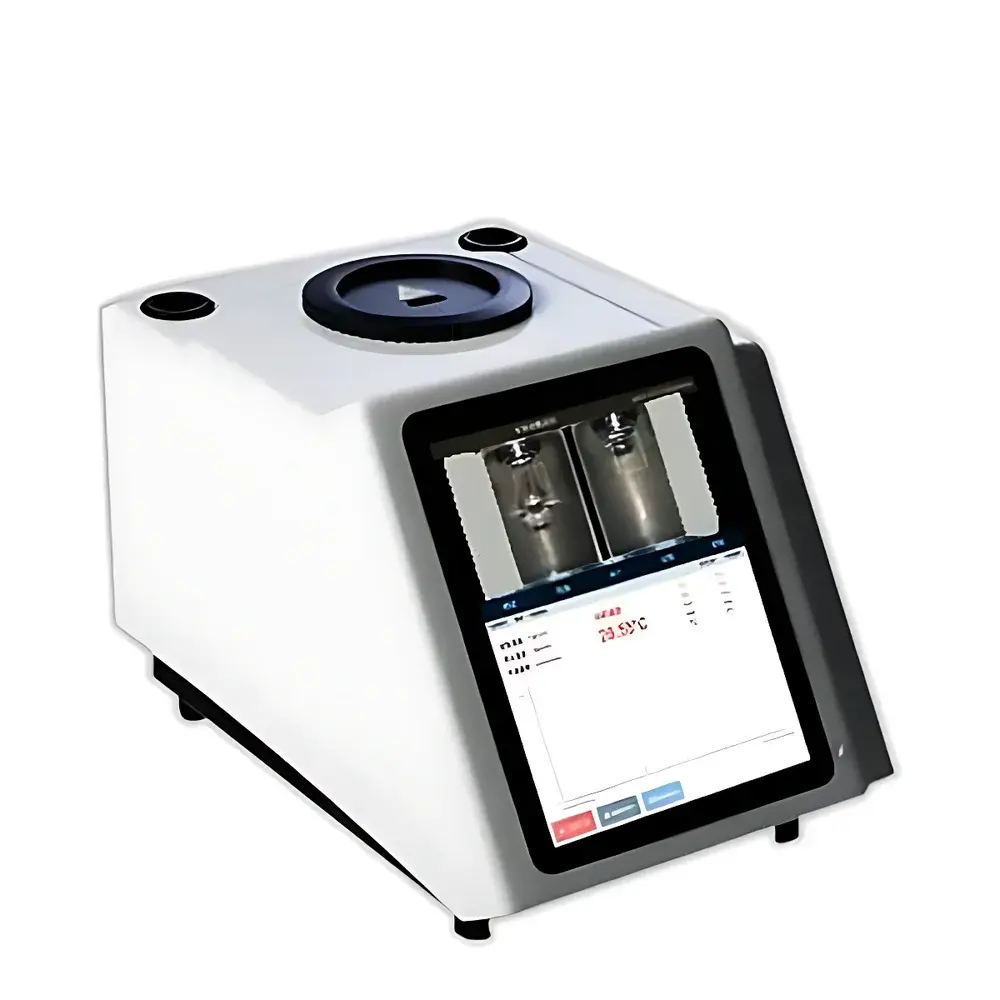
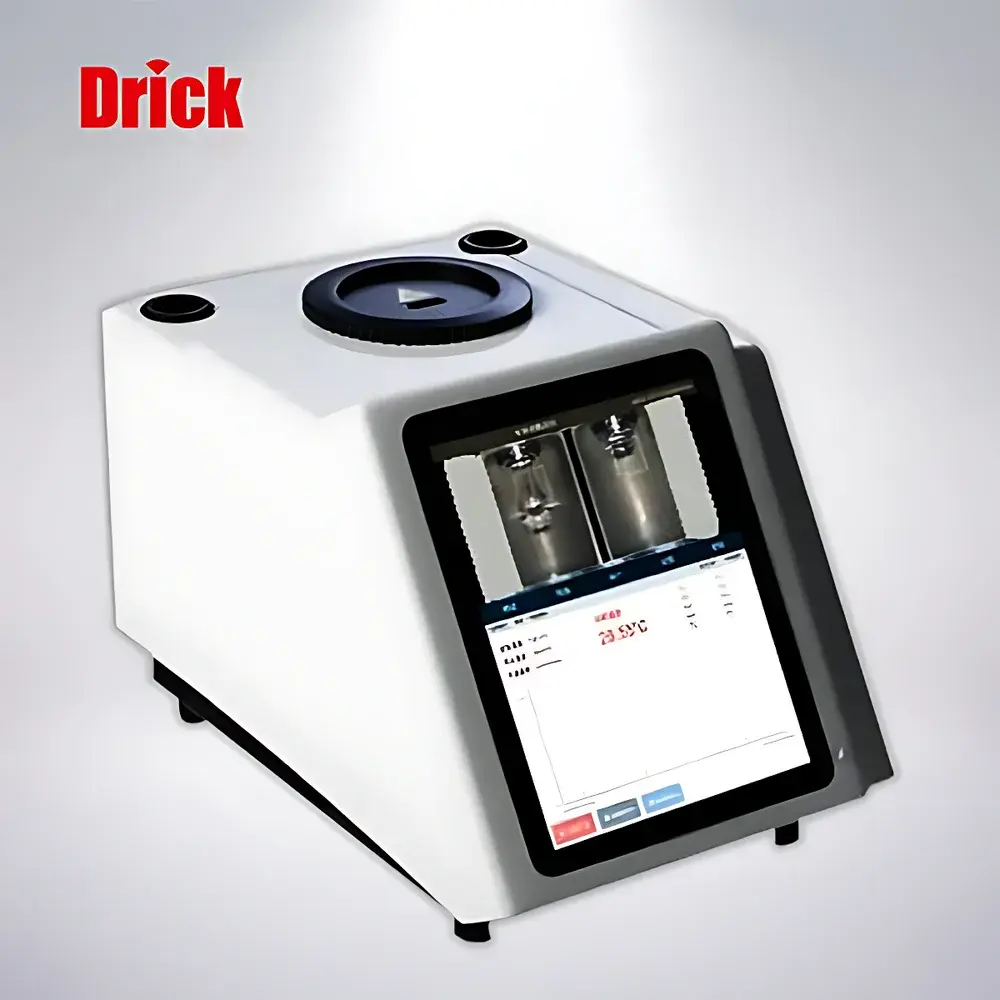
Drick DRK-QD350 Video-Based Dropping Point & Softening Point Tester (Cup Method)
| Brand | Drick |
|---|---|
| Origin | Shandong, China |
| Manufacturer Type | Direct Manufacturer |
| Country of Origin | China |
| Model | DRK-QD350 |
| Temperature Range | Ambient to 400 °C |
| Heating Rate | 0.1–20 °C/min (200-step infinitely adjustable) |
| Temperature Repeatability | ±0.1 °C at 0.1 °C/min |
| Temperature Accuracy | ±0.3 °C (<250 °C) |
| Capillary Tube Dimensions | OD φ1.5 mm, ID φ1.3 mm |
| Sample Capacity | 3 samples per batch |
Overview
The Drick DRK-QD350 Video-Based Dropping Point & Softening Point Tester (Cup Method) is a fully automated thermal transition analyzer engineered for precise determination of dropping point and softening point in semi-solid and thermoplastic materials. It operates on the standardized cup method—compliant with ASTM D3204, D3461, D3104, DIN 51801, ISO 2176, and GB/T 2294–2019—where a defined sample volume is loaded into a standardized metal cup, heated under controlled ramp conditions, and optically monitored until the first drop falls or the material deforms to a specified endpoint. Integrated high-resolution video imaging (1080p, real-time streaming) enables continuous visual observation of morphological changes—including sagging, flow initiation, and droplet detachment—eliminating subjective endpoint interpretation. The system employs a PID-controlled dual-zone heating block with active ambient compensation, ensuring thermal uniformity across the cup holder and minimizing axial temperature gradients that compromise reproducibility.
Key Features
- Real-time HD video capture (10.4″ color TFT display) with frame-by-frame playback and timestamped event marking for traceable endpoint validation
- Triple-sample batch processing capability (3 independent cup positions), enabling parallel testing without cross-contamination or thermal interference
- 200-step infinitely adjustable heating rate (0.1–20 °C/min), programmable per method to match material-specific thermal response profiles
- Comprehensive GLP/GMP compliance architecture: 4-tier user permission management (200 users), audit trail with immutable timestamps, electronic signature support, and 21 CFR Part 11–compliant data integrity controls
- Onboard 64 GB non-volatile storage with MD5-verified file export (PDF, Excel), USB/RS232/Ethernet connectivity, and dual-mode printing (WIFI + serial)
- Temperature accuracy certified to ±0.3 °C below 250 °C and ±0.5 °C above 250 °C, validated per ISO/IEC 17025 traceable calibration protocols
Sample Compatibility & Compliance
The DRK-QD350 accommodates a broad spectrum of thermally sensitive organic and polymeric matrices, including petroleum waxes, bituminous binders, greases, pharmaceutical ointments, hot-melt adhesives, and synthetic resins. Its standardized cup geometry (conforming to ASTM D3204 and ISO 2176) ensures interlaboratory comparability and regulatory acceptance. All test methods are preloaded per pharmacopeial and industrial standards—including USP , EP 2.2.17, and Chinese Pharmacopoeia 2020 Edition—and support method locking to prevent unauthorized parameter modification. The instrument meets IEC 61000-4 electromagnetic compatibility requirements and is CE-marked for operation within EU regulatory frameworks.
Software & Data Management
The embedded Windows-based operating system hosts a dedicated thermal analysis suite supporting up to 100 customizable test protocols. Each protocol defines heating profile, video trigger thresholds, endpoint criteria (e.g., “first droplet breakaway” or “cup rim contact”), and reporting templates. All raw video streams, thermal curves, and metadata are stored with cryptographic hash verification (MD5). Exported reports include full audit trail logs, operator ID, calibration status, environmental conditions, and digital signatures—all compliant with FDA 21 CFR Part 11 Subpart B requirements for electronic records and signatures. Remote monitoring via Ethernet enables integration into centralized LIMS environments.
Applications
This instrument serves critical quality control and R&D functions across regulated and industrial sectors. In pharmaceutical manufacturing, it verifies consistency of topical bases (e.g., petrolatum, lanolin derivatives) per USP monographs. In asphalt and road construction, it quantifies temperature-dependent deformation behavior of paving binders per ASTM D36 and EN 1427. Polymer laboratories use it to characterize thermal stability of thermoplastic elastomers and hot-melt formulations. Chemical suppliers rely on its repeatability for specification release testing of industrial greases and lubricating compounds per NLGI classification standards.
FAQ
What standards does the DRK-QD350 comply with for pharmaceutical applications?
It supports USP , EP 2.2.17, and Chinese Pharmacopoeia 2020 Edition Chapter 0612, with full 21 CFR Part 11 compliance for electronic records and signatures.
Can the instrument validate temperature accuracy in-house?
Yes—it accepts NIST-traceable PT100 reference probes and supports user-executed calibration verification per ISO 17025 Annex A.3 procedures.
Is video recording mandatory for every test?
No—video capture is configurable per method; users may disable it for routine QC runs while retaining full thermal data logging.
How is sample cross-contamination prevented during multi-sample runs?
Each cup position features independent thermal zoning and mechanical isolation; cups are disposable or autoclavable per ASTM D3204 Annex A1.
Does the system support networked data backup?
Yes—via Ethernet interface, it integrates with SMB/CIFS file servers or cloud-based LIMS platforms using TLS 1.2–encrypted transfers.



