
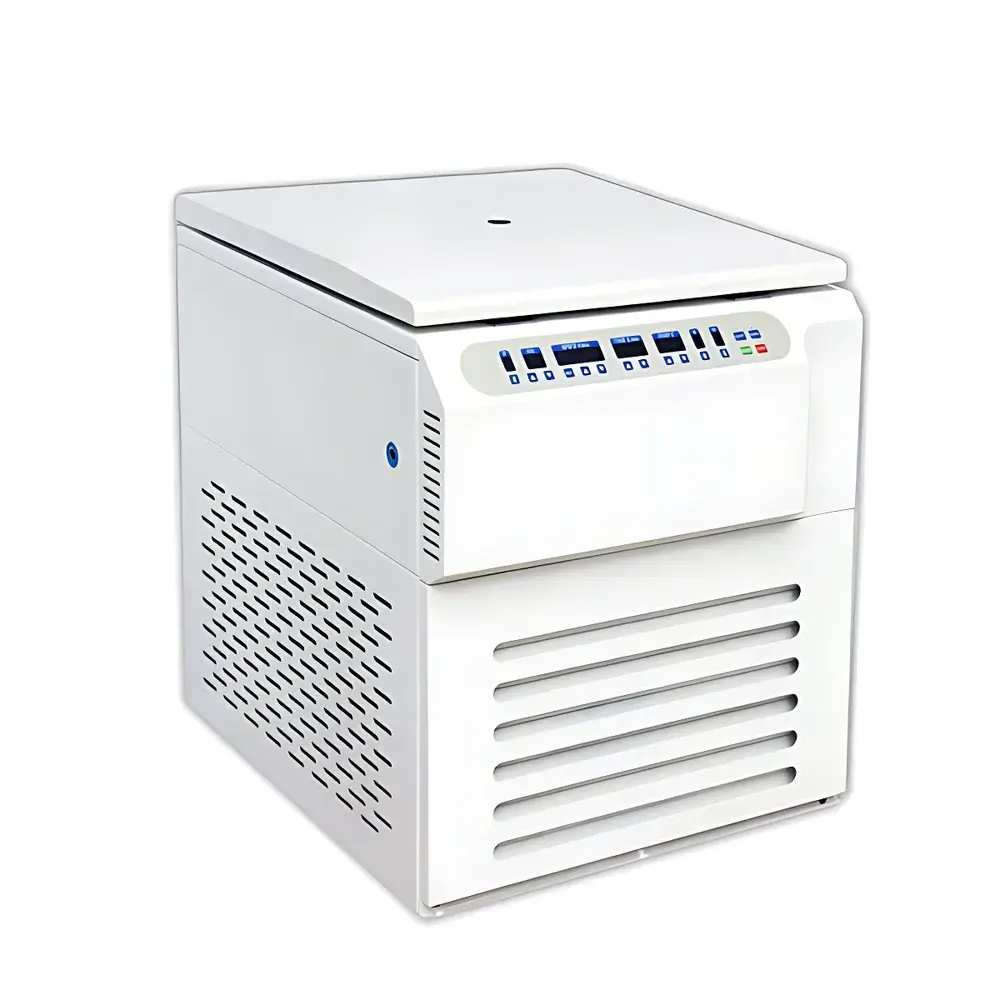
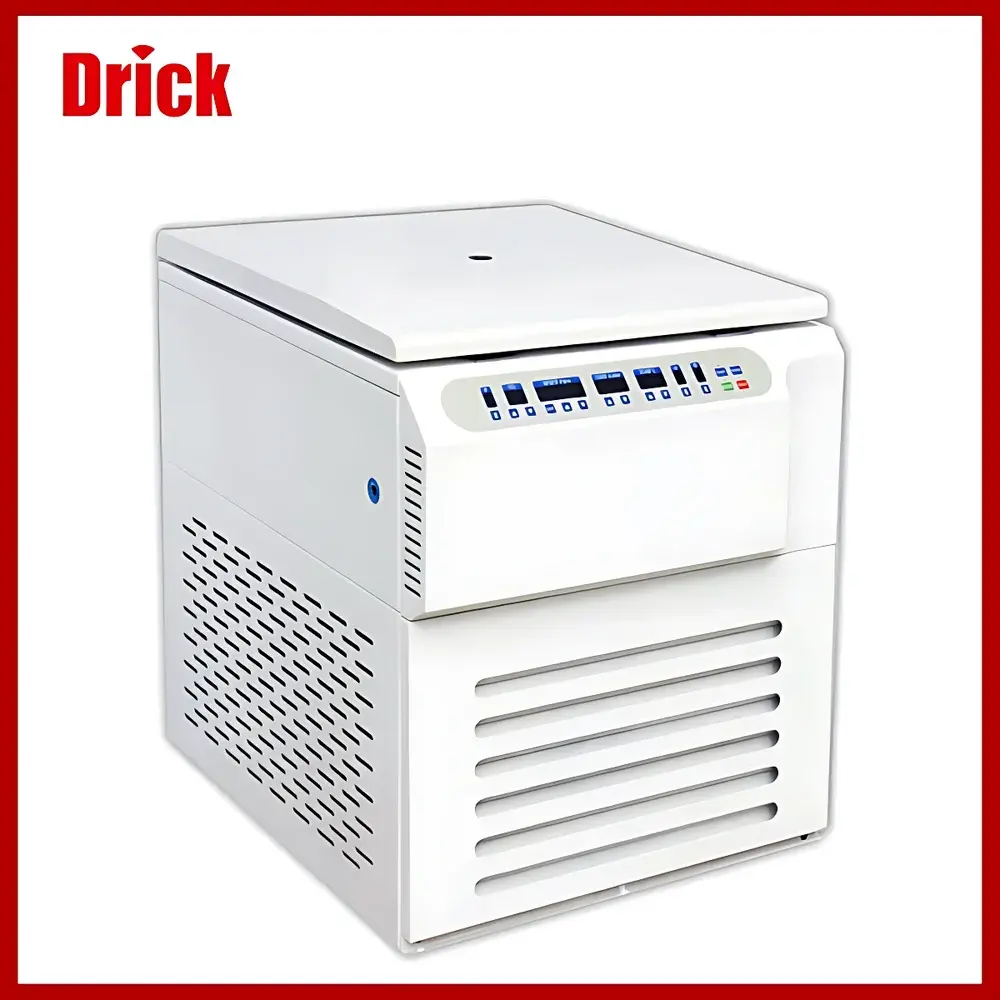
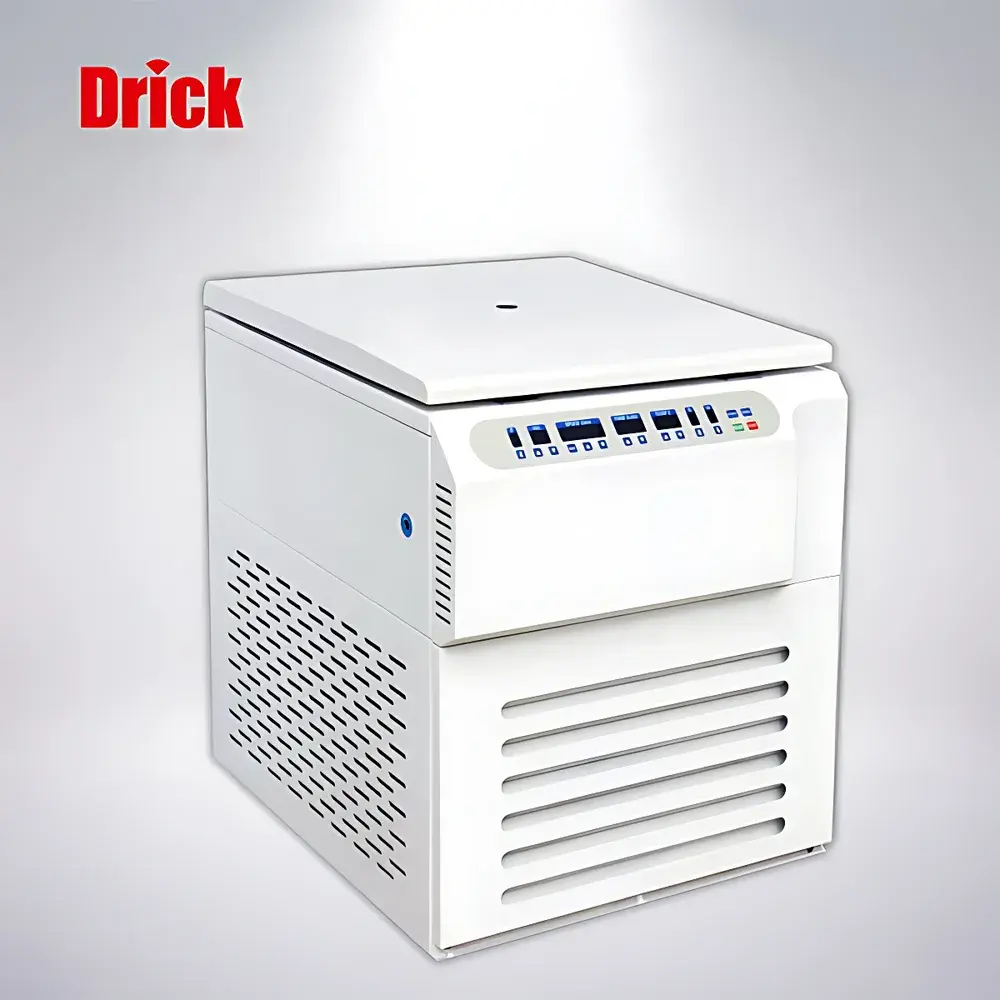
Drick DRK-DL8M Floor-standing High-Capacity Refrigerated Centrifuge with Microprocessor Control
| Brand | Drick |
|---|---|
| Origin | Shandong, China |
| Manufacturer Type | Direct Manufacturer |
| Instrument Type | Floor-standing Centrifuge |
| Speed Category | Low-Speed Centrifuge (up to 8,000 rpm) |
| Function | Refrigerated Centrifuge |
| Configuration | Horizontal Rotor Centrifuge |
| Maximum Capacity | 8 × 2000 mL (horizontal rotor) |
| Maximum Speed | 8,000 rpm |
| Maximum RCF | 14,551 × g |
| Dimensions | 940 × 890 × 1000 mm |
Overview
The Drick DRK-DL8M is a floor-standing, high-capacity refrigerated centrifuge engineered for robust routine separation of large-volume biological, clinical, and industrial samples under precisely controlled temperature and rotational conditions. Designed around the principles of sedimentation kinetics in horizontal rotor configurations, it operates within the low-speed centrifugation regime (≤8,000 rpm), delivering high reproducibility for applications requiring gentle yet effective pelleting of cells, organelles, precipitates, or suspended particulates without shear-induced damage. Its integrated refrigeration system maintains sample integrity across extended runs by stabilizing rotor chamber temperature between –20 °C and +40 °C, with ±1 °C thermal accuracy over the full operational range. The microprocessor-based control architecture ensures stable speed regulation, real-time RCF calculation, and programmable ramp/deceleration profiles—critical for method transfer and regulatory compliance in GLP- and GMP-aligned laboratories.
Key Features
- High-capacity horizontal rotor configuration supporting up to eight 2000 mL centrifuge bottles (e.g., 2×1000 mL or 4×500 mL per bucket), enabling batch processing of liters-scale samples in single runs.
- Brushless frequency-controlled motor with closed-loop speed feedback, achieving ≤±10 rpm speed stability at maximum load and rated speed.
- Intelligent refrigeration system with dual-stage compressor and independent rotor cavity cooling, minimizing thermal drift during prolonged operation.
- Microprocessor controller with backlit LCD interface, supporting up to 99 user-defined protocols with password-protected parameter editing and auto-start delay functionality.
- Integrated safety architecture including automatic rotor recognition (via mechanical keying), imbalance detection with dynamic load compensation, lid interlock with force-sensing switch, and emergency brake activation within 3 seconds upon power loss or door opening.
- Structural frame fabricated from reinforced steel with vibration-damping feet and acoustic insulation, reducing operational noise to ≤65 dB(A) at 1 m distance.
Sample Compatibility & Compliance
The DRK-DL8M accommodates standard ISO-compliant centrifuge bottles (e.g., polypropylene or polycarbonate 2000 mL conical bottles) and is validated for use with common laboratory containers meeting IEC 61010-2-020 safety requirements for centrifuges. It supports routine workflows involving whole blood fractionation, cell culture harvest, wastewater sludge concentration, polymer precipitate recovery, and food matrix clarification. While not certified to FDA 21 CFR Part 11 out-of-the-box, its audit trail–capable controller logs run parameters (time, speed, temperature, RCF, rotor ID, operator code) to internal non-volatile memory—enabling manual export for QA documentation. The system complies with ISO 13485 design controls (as applied to medical device–adjacent applications), CE marking per Machinery Directive 2006/42/EC and EMC Directive 2014/30/EU, and meets GB/T 28867–2012 (Chinese national standard for refrigerated centrifuges).
Software & Data Management
The embedded firmware provides local data retention for ≥1,000 completed runs, including timestamp, rotor serial number, setpoints, actual measured values, and fault codes. USB port enables export of CSV-formatted run logs for integration into LIMS or electronic lab notebooks. Optional PC-based software (DRK-CentriLink v3.x) offers remote monitoring, multi-instrument scheduling, graphical trend analysis of temperature and speed deviation, and customizable report generation aligned with ISO/IEC 17025 documentation templates. All software modules adhere to ALCOA+ principles for data integrity: attributable, legible, contemporaneous, original, accurate, complete, consistent, enduring, and available.
Applications
- Clinical diagnostics: Large-volume plasma/serum separation from anticoagulated blood collections (e.g., platelet-rich plasma preparation).
- Biopharmaceutical manufacturing: Harvesting mammalian or microbial cell cultures prior to downstream purification.
- Environmental testing: Concentration of suspended solids and microorganisms from municipal or industrial effluents.
- Food & beverage QA/QC: Clarification of dairy emulsions, juice suspensions, and starch slurries for viscosity or compositional analysis.
- Academic research: Bulk isolation of extracellular vesicles, mitochondria, or synthetic nanoparticles using differential centrifugation protocols.
- Industrial R&D: Recovery of catalyst particles, pigment dispersions, or latex suspensions in polymer and coating development.
FAQ
What is the maximum allowable imbalance tolerance for safe operation with the 8×2000 mL horizontal rotor?
The DRK-DL8M’s imbalance detection system triggers automatic shutdown if mass asymmetry exceeds ±25 g per bucket pair at 8,000 rpm—verified during factory calibration against ISO 21501-4 reference standards.
Does the centrifuge support validation documentation (IQ/OQ/PQ) packages?
Yes—Drick provides vendor-qualified IQ/OQ protocols compliant with ASTM E2500-13 and Annex 15 of the EU GMP Guide; PQ execution requires site-specific test media and calibrated metrology equipment.
Can the unit operate continuously for >8 hours at –10 °C and 6,000 rpm?
Yes—thermal management and motor duty cycle are rated for uninterrupted operation under these conditions, subject to ambient room temperature ≤25 °C and relative humidity <70% non-condensing.
Is rotor lifetime tracked automatically?
Rotor usage (total accumulated hours and max speed cycles) is stored in EEPROM on each rotor’s identification chip and displayed on the main screen during initialization.
Are third-party rotors compatible?
Only Drick-certified horizontal rotors with mechanical keying and embedded RFID tags are supported; use of non-approved rotors voids safety certification and warranty coverage.



