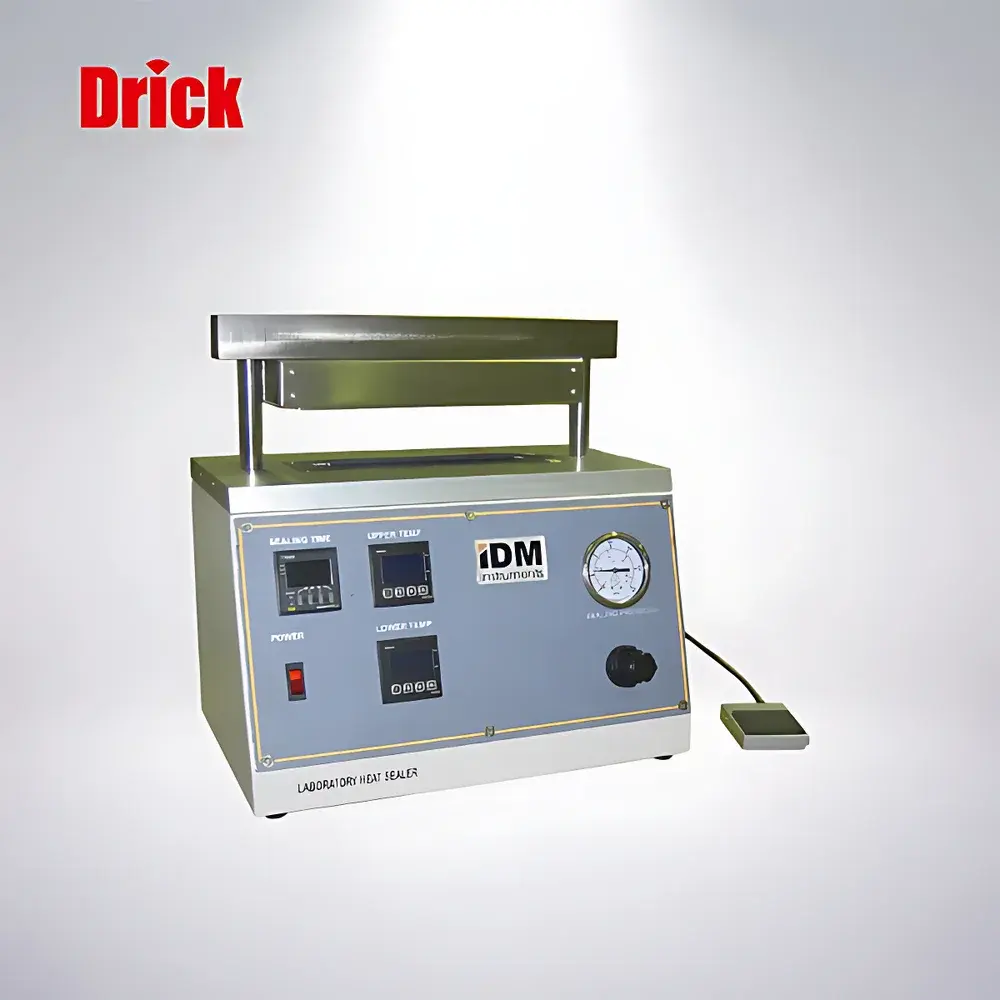
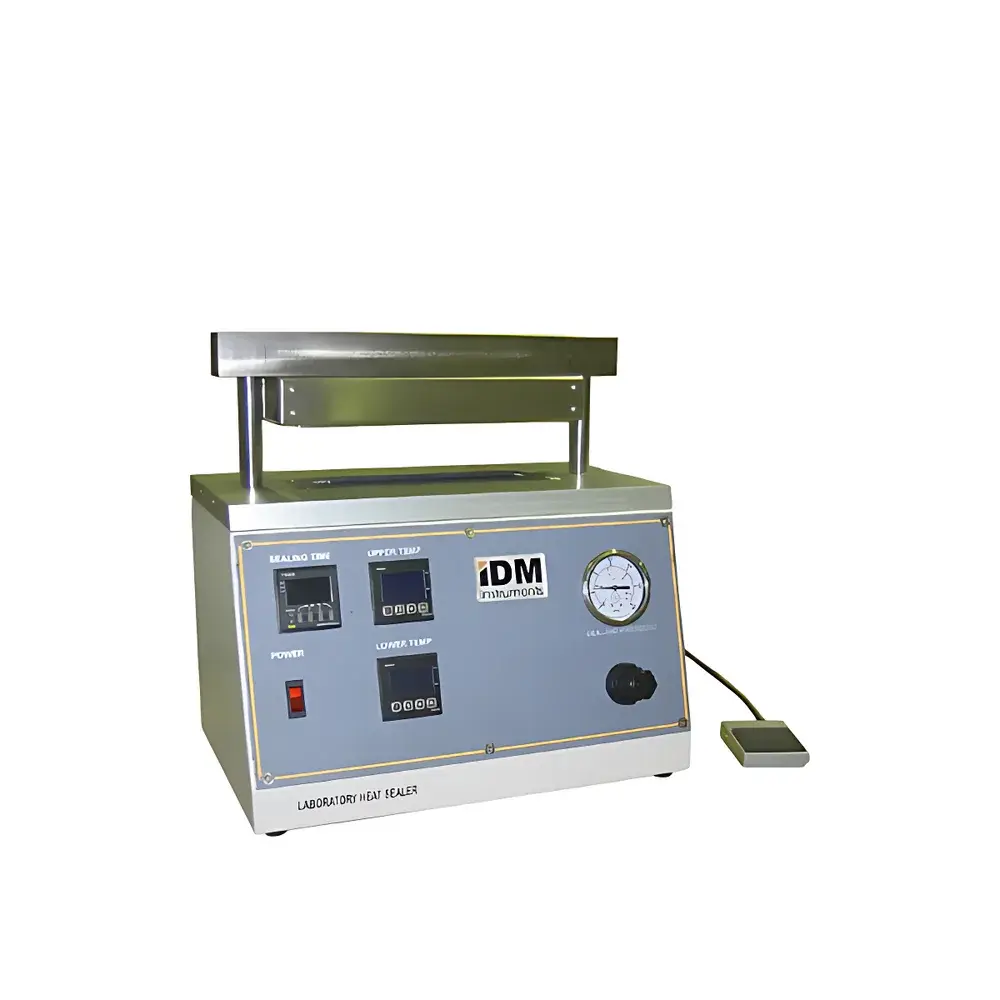
IDM L0001 Laboratory Heat Sealer for Packaging Film Integrity Testing
| Brand | IDM |
|---|---|
| Origin | Shandong, China |
| Manufacturer Type | Authorized Distributor |
| Country of Origin | China |
| Model | L0001 |
| Temperature Range | Ambient to 300 °C |
| Sealing Bar Dimensions | 5 mm × 180 mm (standard) |
| Sealing Surface Area | 10 mm × 180 mm |
| Adjustable Sealing Pressure | Up to 80 psi |
| Sealing Time Range | 0.1–999.9 s |
Overview
The IDM L0001 Laboratory Heat Sealer is an engineered thermal sealing instrument designed for precise, repeatable evaluation of heat seal integrity in flexible packaging materials. It operates on the principle of controlled conductive heating and mechanical compression—applying calibrated temperature, pressure, and dwell time to replicate industrial sealing conditions in a laboratory environment. Unlike empirical trial-and-error approaches, the L0001 enables systematic determination of optimal sealing parameters—including minimum sealing temperature, critical dwell duration, and pressure thresholds—by directly correlating thermal input with measurable seal strength outcomes. This capability is essential for validating packaging material compatibility, qualifying new laminates, troubleshooting seal failures, and supporting regulatory documentation for food, pharmaceutical, and medical device packaging. The system’s dual-zone temperature control ensures independent thermal regulation of upper and lower platens—a critical feature for asymmetric structures (e.g., PET/AL/PE laminates), where differential thermal expansion or layer-specific melting behavior must be accommodated.
Key Features
- Dual independent digital temperature controllers (upper and lower platens), enabling precise thermal profiling across asymmetric multilayer structures
- Adjustable sealing pressure up to 80 psi (552 kPa), calibrated via integrated load cell feedback for traceable force application
- Programmable sealing time from 0.1 to 999.9 seconds with 0.1-second resolution, supporting both short-pulse and extended dwell protocols
- Standard 5 mm × 180 mm heating element with 10 mm × 180 mm active sealing surface; optimized for narrow-width test strips per ASTM F2029
- Interchangeable sealing heads (10 mm, 15 mm, 20 mm, and 25 mm width options) for method flexibility and multi-width validation studies
- Foot-operated activation switch with integrated safety interlock—mechanically disables operation unless both platens are fully closed and pressure is confirmed
- Robust stainless-steel frame with ceramic-insulated heating elements and PID-controlled thermal stability (±1 °C over full range)
Sample Compatibility & Compliance
The L0001 accommodates a broad spectrum of thermoplastic-based packaging substrates, including but not limited to: oriented polypropylene (OPP), biaxially oriented polyethylene terephthalate (BOPET), cast polypropylene (CPP), low-density polyethylene (LDPE), linear low-density polyethylene (LLDPE), aluminum foil laminates, metallized films, and heat-sealable coated papers. It supports testing of single-layer films, coextruded structures, and adhesive-laminated composites used in pouches, sachets, blister lidding, and sterile barrier systems. The instrument conforms to ASTM F2029 – Standard Test Method for Making Heat Seal Joints for Determination of Heat Seal Strength, and its operational parameters align with the procedural requirements of ISO 11607-2 (Packaging for terminally sterilized medical devices) and FDA guidance on container closure integrity for pharmaceutical primary packaging. All thermal and mechanical settings are logged with timestamped metadata, supporting GLP-compliant audit trails when paired with validated data capture software.
Software & Data Management
While the L0001 operates as a standalone benchtop instrument with intuitive front-panel controls, it integrates seamlessly with external data acquisition systems via RS-232 or optional USB-to-serial interface. Temperature, pressure, and time parameters are output in real time as ASCII-formatted serial streams, compatible with LabVIEW, MATLAB, or custom Python-based logging platforms. For regulated environments, optional firmware upgrades enable 21 CFR Part 11–compliant electronic records—including user authentication, audit trail generation, and immutable parameter logging—when deployed with validated third-party software. Raw sealing parameter sets can be exported in CSV format for statistical analysis (e.g., Design of Experiments for seal optimization) or inclusion in technical dossiers submitted to regulatory authorities.
Applications
- Determination of minimum hot tack temperature and hot tack strength profiles for extrusion-coated and laminated films
- Validation of seal initiation temperature (SIT) and seal integrity window (SIW) during packaging line qualification
- Comparative assessment of seal performance across different resin grades, additive packages, or aging conditions (e.g., post-sterilization embrittlement)
- Root cause analysis of seal defects such as channeling, scorching, or root cutting in production-scale trials
- Supporting accelerated aging studies by correlating seal degradation with thermal history and environmental exposure
- Training and operator certification programs for packaging technicians and QC personnel
FAQ
What standards does the L0001 support for heat seal testing?
ASTM F2029 is the primary referenced standard; additional alignment exists with ISO 11607-2 Annex C, USP , and TAPPI T816.
Can the L0001 be used for hot tack testing?
Yes—when combined with a tensile tester and synchronized timing control, it enables hot tack measurements per ASTM F1921 and ASTM F2952.
Is calibration documentation provided with the instrument?
Each unit ships with a factory calibration certificate traceable to NIST standards for temperature (±1 °C) and pressure (±2% FS); annual recalibration is recommended.
How is thermal uniformity verified across the sealing bar?
A certified infrared thermal mapping report is available upon request, confirming ≤±2 °C deviation across the 180 mm active length at setpoints between 80 °C and 250 °C.
Does the L0001 meet electrical safety requirements for laboratory use?
It complies with IEC 61010-1:2010 for laboratory equipment, including protection against electric shock, mechanical hazards, and thermal burn risk mitigation.