
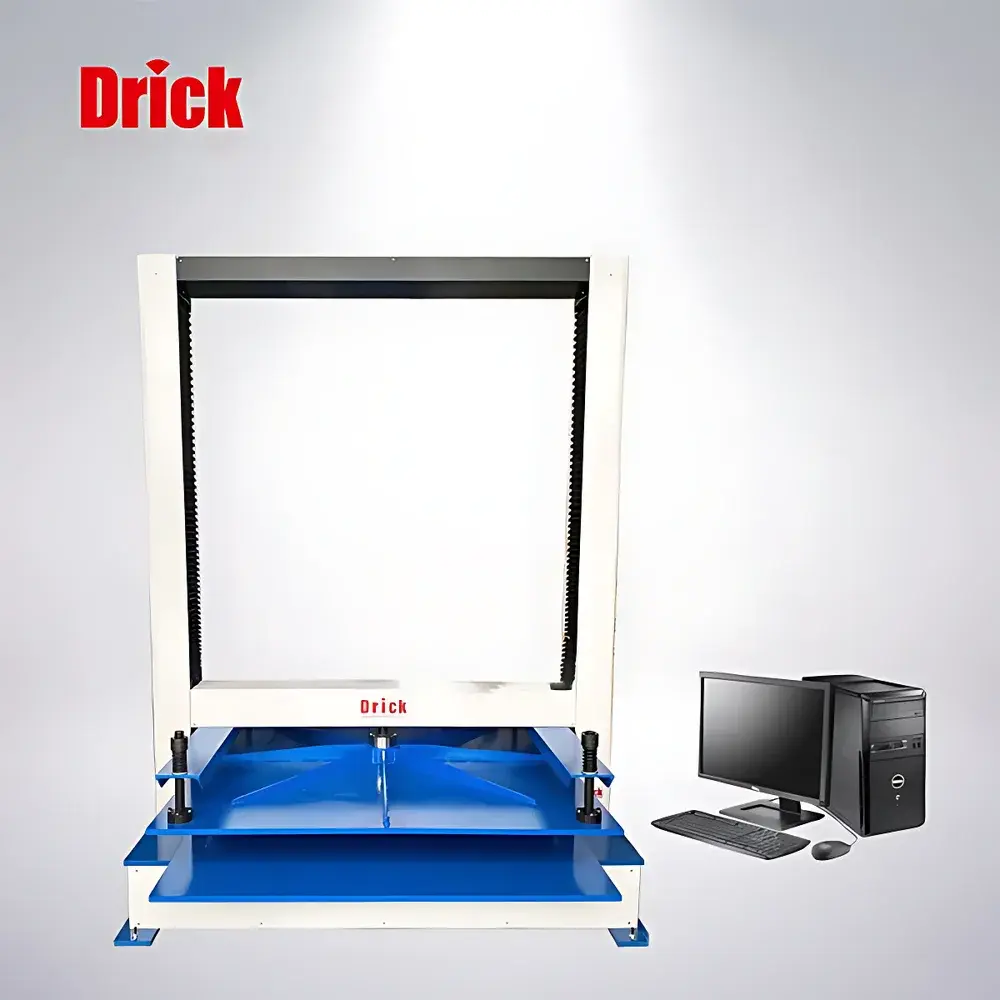
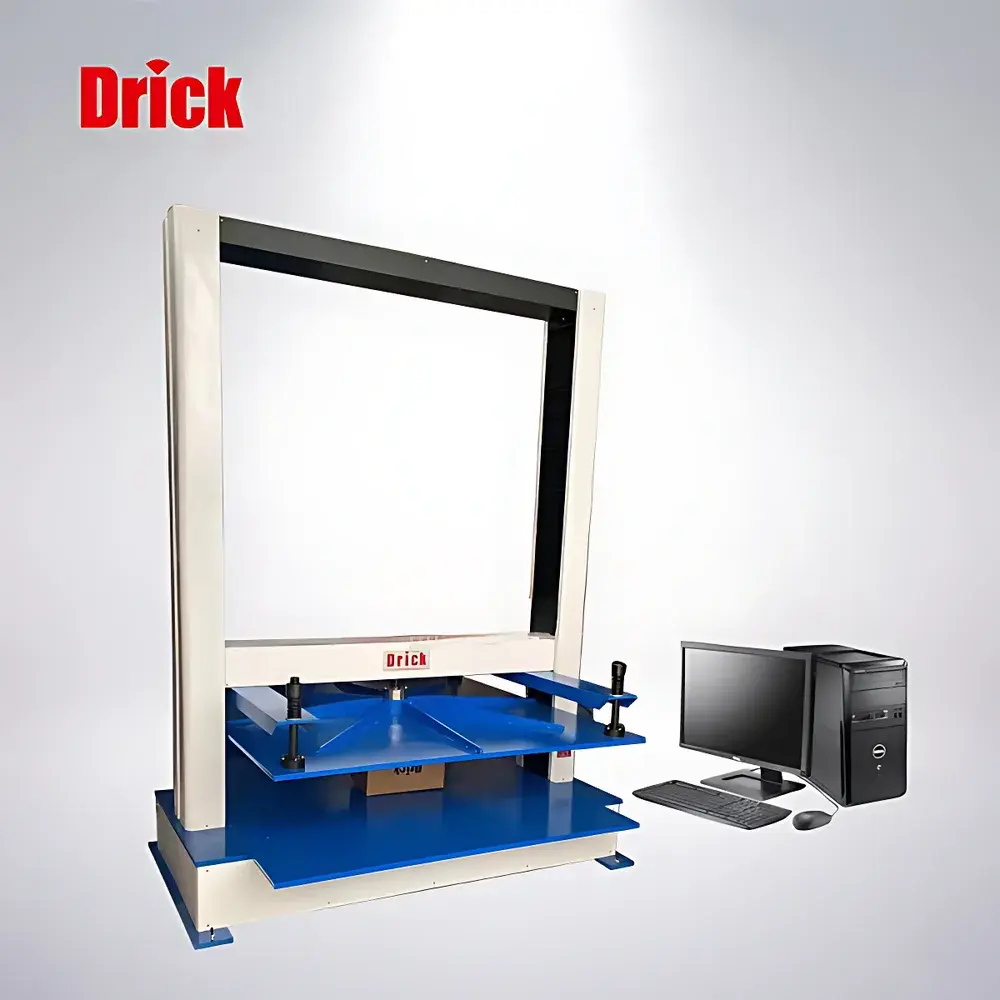
Drick DRK123PC 1500×1500×1500 mm Computer-Controlled Compression Tester
| Brand | Drick |
|---|---|
| Origin | Shandong, China |
| Manufacturer Type | Manufacturer |
| Country of Origin | China |
| Model | DRK123PC |
| Load Capacity Options | 10 kN / 20 kN / 50 kN |
| Accuracy Class | Class 1 |
| Force Resolution | 0.1 N |
| Deformation Resolution | 0.01 mm |
| Parallelism of Compression Plates | ≤1 mm |
| Test Speed Range | 1–300 mm/min (infinitely variable) |
| Return Speed Range | 1–300 mm/min (infinitely variable) |
| Maximum Stroke | 1500 mm |
| Test Chamber Dimensions | 1500 mm × 1500 mm × 1500 mm |
| Power Supply | AC 220 V ±5%, 50 Hz |
| Data Acquisition | 24-bit ADC (resolution up to 1/10,000,000) |
| Control System | Windows-based PC interface with automated test sequencing and real-time graphical display |
Overview
The Drick DRK123PC is a high-stability, computer-controlled compression tester engineered for precise evaluation of compressive strength and stacking performance in corrugated fiberboard containers, honeycomb packaging, rigid plastic drums, and PET bottles. It operates on the principle of axial force application between two parallel platens under controlled displacement rate, conforming to standardized load–deformation measurement protocols defined in ISO 2872, ISO 2874, GB/T 4857.4, and QB/T 1048. Designed specifically for packaging quality assurance laboratories, this instrument delivers repeatable, traceable, and audit-ready mechanical testing data essential for compliance validation, material specification verification, and shelf-life simulation studies.
Key Features
- Full PC-based control architecture with Windows-native GUI—supports intuitive test setup, real-time curve visualization (force vs. displacement), and dynamic parameter overlay including specimen ID, instantaneous load, deformation, and initial preload.
- Triple-test mode capability: (1) Crush resistance (peak load at collapse), (2) Stacking simulation (sustained load over time), and (3) Pass/fail pressure threshold testing per preconfigured limits.
- Robust dual-screw, dual-guide column frame with precision-machined steel platens; optimized parallelism (≤1 mm deviation across 1500 mm surface) ensures uniform stress distribution and eliminates edge-effect bias.
- Servo motor drive system with integrated planetary gear reducer and timing belt transmission—enables high positional accuracy (<0.01 mm repeatability), low acoustic noise (<65 dB(A)), and rapid speed response (0–300 mm/min in <100 ms).
- Comprehensive safety architecture: mechanical end-stop limit switches, software-enforced overload cutoff (adjustable up to 110% of selected capacity), automatic emergency stop on abnormal current draw or encoder fault.
- High-fidelity signal chain: industrial-grade 24-bit analog-to-digital converter (10 million counts resolution) paired with calibrated S-type load cells meeting ISO 376 Class 1 requirements for force metrology.
Sample Compatibility & Compliance
The DRK123PC accommodates full-size transport packaging units—including RSC, HSC, and die-cut corrugated boxes up to 1500 mm in height—and rigid containers such as HDPE drums (20–200 L) and PET water bottles (0.33–5 L). Its 1500 mm × 1500 mm × 1500 mm internal chamber enables testing of palletized unit loads without disassembly. All test routines are aligned with internationally recognized standards: ISO 2872 (compression testing of filled transport packages), ISO 2874 (stacking tests using compression testers), ASTM D642 (determining compressive resistance of shipping containers), and TAPPI T 810 (compressive strength of fiberboard boxes). The system supports GLP-compliant operation through user-level access control, electronic signature logging, and immutable audit trails per FDA 21 CFR Part 11 requirements when deployed with validated software configuration.
Software & Data Management
Test execution, calibration management, and report generation are handled via Drick’s proprietary CompressSoft v4.x platform—a modular, database-driven application built on Microsoft SQL Server Express. Each test session automatically logs timestamp, operator ID, environmental conditions (optional sensor integration), raw force/deformation arrays, and derived metrics (e.g., peak load, elastic modulus, yield point, creep strain at 24 h). Reports export to PDF, Excel, or XML formats with customizable templates compliant with ISO/IEC 17025 documentation requirements. Calibration certificates include uncertainty budgets traceable to NIM (National Institute of Metrology, China) reference standards. Data integrity is preserved through write-once archival mode and role-based permissions (admin, technician, reviewer).
Applications
- Corrugated box qualification: determination of edge crush test (ECT)-equivalent compression strength for BCT prediction using McKee equation inputs.
- Stacking durability assessment: simulation of warehouse or containerized maritime storage conditions under sustained static load profiles (e.g., 72-hr hold at 80% of predicted failure load).
- Regulatory conformance testing: verification of UN-certified packaging for dangerous goods (UN 4G, 4GV) per IMDG Code §6.1.5.3.
- Plastic container validation: evaluation of top-load resistance in blow-molded HDPE drums and PET beverage bottles under cold-chain temperature conditions (with optional environmental chamber integration).
- Material substitution studies: comparative analysis of recycled-content board versus virgin fiberboard under identical loading protocols.
FAQ
What standards does the DRK123PC support out-of-the-box?
Preconfigured test methods cover ISO 2872, ISO 2874, GB/T 4857.4, QB/T 1048, ASTM D642, and TAPPI T 810. Custom protocol development is available upon request.
Can the system be integrated into an existing LIMS or MES environment?
Yes—via OPC UA or RESTful API interfaces. Full metadata mapping (sample ID, result, pass/fail status, timestamp) is supported for bidirectional synchronization.
Is third-party calibration certification included with purchase?
A factory-issued calibration certificate traceable to national standards is provided. Optional on-site ISO/IEC 17025-accredited calibration by CNAS-recognized labs is available at additional cost.
What maintenance intervals are recommended for long-term accuracy retention?
Biannual verification of platen parallelism and load cell linearity is advised. Annual full recalibration—including amplifier gain/offset adjustment and mechanical alignment—is recommended for GLP/GMP environments.
Does the software support multi-language UI and report generation?
English and Simplified Chinese UI are standard. Additional languages (Spanish, German, French, Japanese) can be enabled via localized resource packs.







