
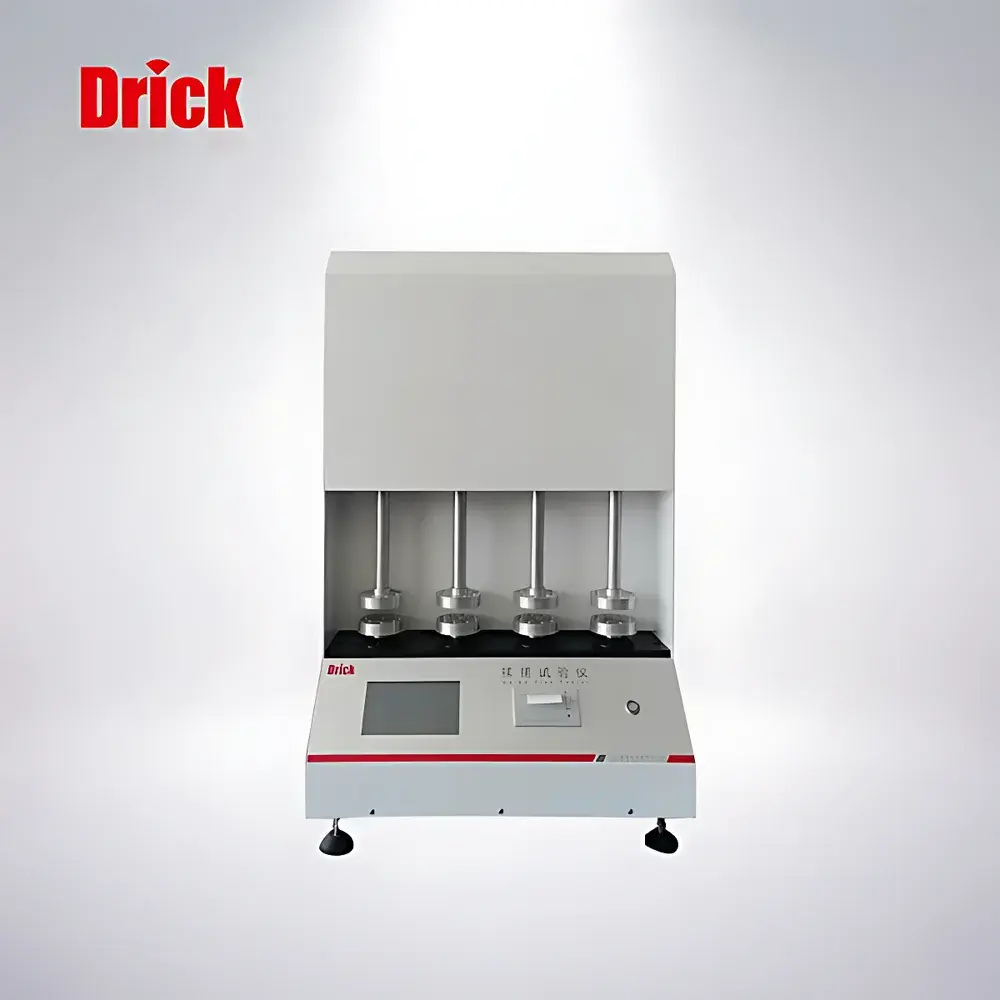
Drick DRK268 Rubbing and Abrasion Tester
| Brand | Drick |
|---|---|
| Origin | Shandong, China |
| Manufacturer Type | Manufacturer |
| Country of Origin | China |
| Model | DRK268 |
| Price | Upon Request |
| Frequency | 45 cycles/min |
| Stroke Options | 155 mm / 80 mm |
| Twist Angles | 440° / 400° |
| Cycle Count Range | 20–2700 cycles |
| LCD Display Lifespan | ~100,000 hours |
| Touchscreen Durability | ~50,000 actuations |
| Compliance Standard | ASTM F392 |
Overview
The Drick DRK268 Rubbing and Abrasion Tester is an engineered instrument designed for quantitative evaluation of mechanical durability in flexible packaging materials under controlled cyclic flexing, twisting, and compressive deformation. It operates on the principle of standardized mechanical fatigue simulation—reproducing real-world handling stresses encountered during manufacturing, filling, transportation, and consumer use. Based on ASTM F392 “Standard Test Method for Flexing Endurance of Flexible Barrier Materials,” the DRK268 applies repeatable, programmable motion profiles to induce surface micro-damage (e.g., micro-cracks, pinholes, delamination) in thin films and laminates. Its core architecture integrates an ARM-based embedded control system, high-resolution 800 × 480 color TFT-LCD touchscreen interface, precision stepper motor drive, and dual-stage analog signal conditioning—including low-noise amplification and 16-bit A/D conversion—to ensure measurement repeatability and long-term stability. The system supports both fixed-parameter test modes and user-defined cycle programming, enabling correlation between mechanical stress history and functional degradation (e.g., barrier loss, optical haze increase, or seal integrity failure).
Key Features
- ARM32-bit embedded controller with real-time task scheduling and non-volatile parameter storage
- Intuitive graphical interface with tactile feedback and on-screen status monitoring (cycle count, elapsed time, error codes)
- Dual-stroke configuration: 155 mm (standard) and 80 mm (low-displacement mode), each paired with calibrated torsional angles (440° and 400° respectively)
- Six preconfigured test modes (A–E + Custom) aligned with ASTM F392 protocol variants for comparative benchmarking
- Hardware-integrated safety interlocks: emergency stop, over-travel limit switches, motor thermal cutoff, and software-based cycle validation
- Robust aluminum alloy frame with vibration-damped base mount, minimizing external influence on motion fidelity
- Compliance-ready design: audit trail logging (via optional USB export), timestamped test records, and parameter lockout functionality for GLP/GMP environments
Sample Compatibility & Compliance
The DRK268 accommodates flat specimens up to 150 mm × 150 mm and thicknesses from 25 µm to 500 µm—including monolayer polymers (e.g., PET, OPP, PE), coextruded structures, metallized films, AlOx/SiOx coated substrates, and pharmaceutical blister lidding materials. Specimen clamping uses pneumatic-assisted dual-grip jaws with adjustable pressure (0.1–0.6 MPa) to prevent slippage without inducing edge creep. All test modes are traceable to ASTM F392-22, which defines the apparatus geometry, motion kinematics, and reporting requirements for flexing endurance assessment. While not certified to ISO/IEC 17025, the instrument’s mechanical calibration procedure (per manufacturer’s Technical Note TN-DRK268-01) supports internal verification against reference standards—enabling laboratories to establish metrological traceability per ISO/IEC 17025 Clause 6.5.
Software & Data Management
The DRK268 operates autonomously via its onboard firmware; no external PC is required for routine operation. Test parameters—including stroke, angle, frequency, and total cycles—are configured directly on the touchscreen and stored in EEPROM with write-protection options. Upon test completion, results display cycle count, final position, and pass/fail status (if threshold limits are defined). Raw motion data (position vs. time) is not streamed but can be exported in CSV format via USB flash drive for post-hoc analysis in third-party tools (e.g., MATLAB, Python pandas). Optional firmware upgrade DRK268-FWv2.3 introduces enhanced data security features: SHA-256 hashed log files, user role-based access (Operator/Supervisor/Admin), and electronic signature prompts compliant with FDA 21 CFR Part 11 Annex 11 principles for regulated industries.
Applications
This tester serves as a critical tool in R&D, QC, and packaging validation workflows across food, pharmaceutical, medical device, and consumer goods sectors. Typical use cases include: evaluating oxygen transmission rate (OTR) degradation after flexing in high-barrier pouches; correlating pinhole formation (measured by electrical leakage or dye penetration) with folding cycles in child-resistant blister cards; comparing delamination resistance of adhesive layers in retortable laminates; qualifying new biopolymer films (e.g., PLA, PHA) for shelf-life stability under mechanical stress; and supporting ISTA 3A/3B transport simulation protocols where flex-induced seal failure is a known risk vector. Data generated informs material selection, process optimization (e.g., annealing temperature, corona treatment level), and package redesign—directly linking lab-scale testing to field performance.
FAQ
Does the DRK268 comply with ASTM F392-22 edition?
Yes—the mechanical specifications (stroke, twist angle, frequency tolerance ±2%, cycle resolution ±1) and operational logic fully align with the current ASTM F392-22 standard.
Can test parameters be modified beyond the six preset modes?
Yes. The “Custom Mode” allows independent adjustment of stroke, angle, frequency, and total cycles within hardware limits (155 mm max stroke, 440° max twist, 20–2700 cycles).
Is calibration documentation provided with shipment?
Each unit ships with a Factory Calibration Certificate listing verification points for stroke linearity, angular encoder accuracy, and cycle counter integrity, traceable to NIST-traceable references.
What maintenance is required for long-term reliability?
Biannual inspection of belt tension, guide rail lubrication (with silicone-free grease), and touchscreen calibration using the built-in diagnostic utility is recommended.
Can the DRK268 integrate into a LIMS environment?
While native LIMS connectivity is not supported, CSV export enables manual ingestion into most laboratory information management systems via scheduled import scripts or middleware gateways.





