
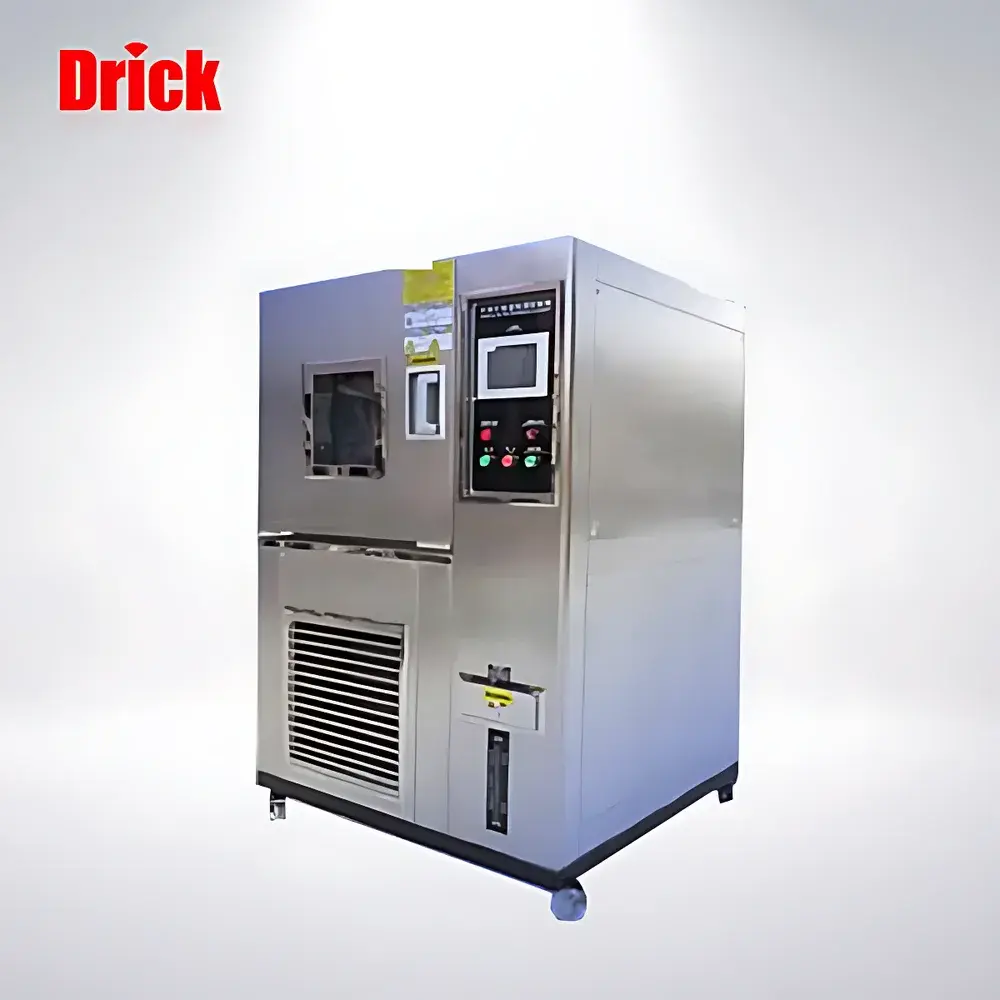
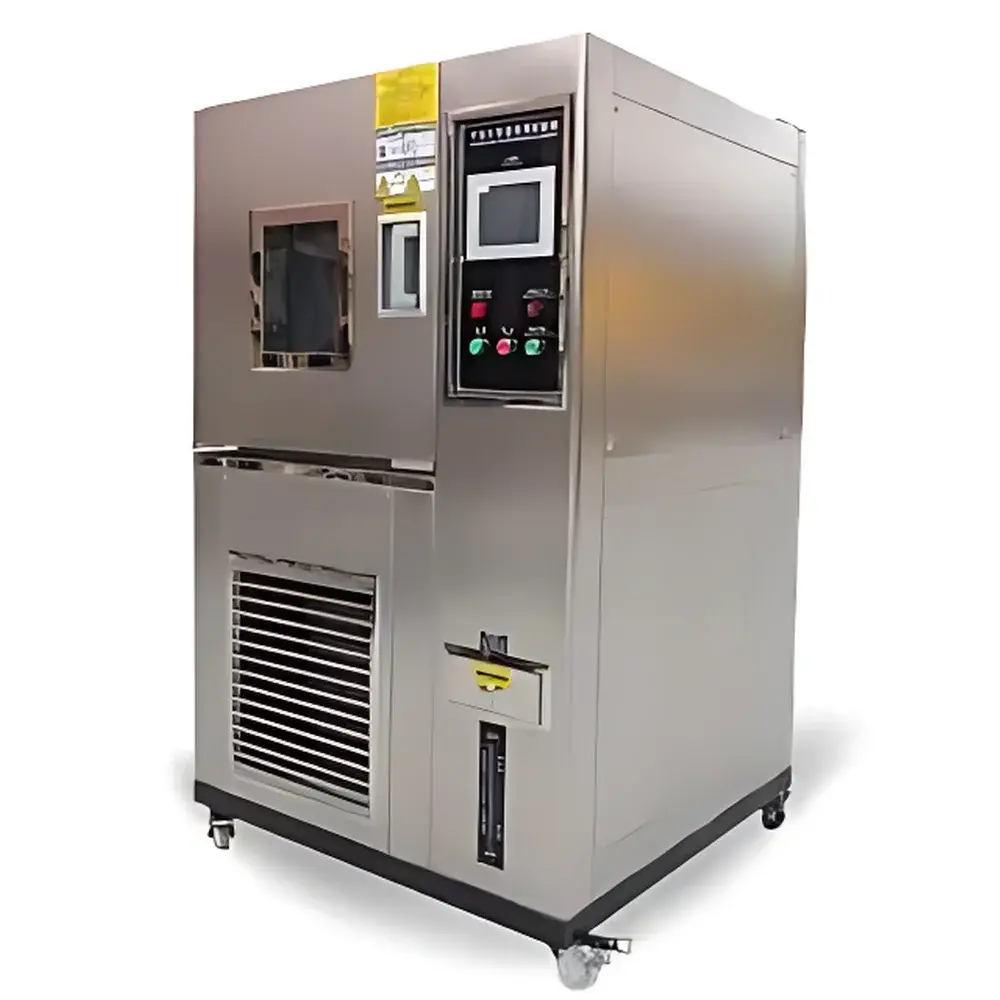
Drick GDW-50E Environmental Chamber for Thermal Cycling Testing of Rubber, Plastic & Electronic Materials
| Brand | Drick |
|---|---|
| Origin | Shandong, China |
| Manufacturer Type | Direct Manufacturer |
| Country of Origin | China |
| Model | GDW-50E |
| Internal Chamber Dimensions (W×D×H) | 320 × 350 × 450 mm |
| Temperature Range | −80 °C to +150 °C |
| Temperature Uniformity | ≤ ±0.5 °C |
| Temperature Stability (Fluctuation) | ±0.5 °C |
| Cooling Rate (No Load) | 0.7–1.0 °C/min |
| Heating Rate (No Load) | 2.0–3.0 °C/min |
| Noise Level | ≤65 dB(A) |
| Power Supply | AC 380 V, 50 Hz |
| Compliance | GB/T 2423.1–2023 (Cold Test), GB/T 2423.2–2023 (Dry Heat Test) |
Overview
The Drick GDW-50E Environmental Chamber is an engineered thermal cycling system designed for rigorous evaluation of material performance under controlled extreme temperature conditions. It operates on a forced-air convection principle with dual-stage refrigeration and PID-controlled electric heating, enabling precise, repeatable simulation of operational or storage environments across the full range of −80 °C to +150 °C. This chamber is specifically configured for use in rubber and plastic formulation development, polymer aging studies, electronic component qualification, and pre-compliance environmental stress screening—where reproducible thermal exposure is critical to failure mode analysis and reliability prediction. Its compact internal volume (320 × 350 × 450 mm) balances test capacity with rapid thermal response, making it suitable for laboratory-scale validation, QC batch testing, and accelerated life-cycle assessment per standardized thermal stress protocols.
Key Features
- High-stability dual-refrigeration circuit with cascade low-temperature compressor, enabling reliable operation down to −80 °C without liquid nitrogen dependency;
- PID-based digital temperature controller with real-time deviation compensation, ensuring ≤ ±0.5 °C uniformity across the working zone and ±0.5 °C stability during steady-state holds;
- Forced-air circulation system with adjustable multi-directional airflow nozzles to minimize thermal gradients and ensure sample exposure consistency;
- Stainless steel inner chamber (SUS304) with insulated double-wall construction and high-efficiency polyurethane foam insulation (≥120 mm thickness);
- Integrated safety protections including over-temperature cut-off, compressor high-pressure shutdown, phase sequence monitoring, and door-open alarm;
- Compliance-ready design aligned with fundamental requirements of IEC 60068-2 series and national equivalents (GB/T 2423.1 & GB/T 2423.2);
- Front-access observation window with double-layer tempered glass and anti-fog heater for continuous visual monitoring without thermal interruption.
Sample Compatibility & Compliance
The GDW-50E accommodates standard test specimens used in rubber vulcanization analysis (e.g., ASTM D573, ISO 188), plastic heat distortion evaluation (ASTM D648), and electronic packaging thermal shock screening (JEDEC JESD22-A104). Its chamber geometry supports mounting fixtures for tensile bars, molded elastomer rings, PCB assemblies, and encapsulated sensors. All thermal profiles—including ramp-hold-ramp cycles, stepwise temperature transitions, and dwell-based endurance tests—are fully traceable and configurable to meet GLP documentation requirements. The unit conforms to GB/T 2423.1–2023 (equivalent to IEC 60068-2-1 Ed. 4.0 for cold testing) and GB/T 2423.2–2023 (equivalent to IEC 60068-2-2 Ed. 4.0 for dry heat), supporting audit readiness for ISO/IEC 17025-accredited laboratories and automotive Tier-1 supplier validation workflows.
Software & Data Management
Equipped with an embedded 7-inch TFT touchscreen HMI, the GDW-50E provides intuitive local control of temperature setpoints, ramp rates, hold durations, and cycle repetition counts. Full test logging—including time-stamped temperature readings at 1-second intervals, alarm events, and system status flags—is stored internally and exportable via USB to CSV format. Optional RS485 Modbus RTU interface enables integration into centralized LabVIEW or SCADA systems for automated data aggregation and long-term trend analysis. While not natively 21 CFR Part 11 compliant, the device supports external electronic record systems that implement user authentication, audit trails, and electronic signatures—facilitating alignment with FDA-regulated R&D and quality assurance processes where environmental validation data must be archived and retrievable for regulatory review.
Applications
- Thermal aging of elastomeric seals and gaskets per ASTM D573 and ISO 188;
- Heat resistance evaluation of thermoplastic compounds used in automotive interior components;
- Low-temperature brittleness testing of PVC and TPE materials (ISO 9985, GB/T 5470);
- Pre-conditioning of lithium-ion battery modules prior to electrical performance characterization;
- Environmental stress screening (ESS) of printed circuit board assemblies before HALT/HASS;
- Validation of adhesive bond integrity under thermal cycling per ASTM D3692;
- Material selection support for aerospace-grade polymers exposed to stratospheric or re-entry thermal profiles.
FAQ
What is the maximum sample load capacity without compromising temperature uniformity?
The chamber maintains specified uniformity (≤ ±0.5 °C) with up to 15 kg of non-heat-generating inert mass. For active or thermally emissive samples (e.g., powered electronics), derating is recommended; consult the thermal load guidelines in the operator manual.
Does the GDW-50E support programmable multi-step thermal profiles?
Yes—it supports up to 99 segments per program, including ramps, holds, and loops, with independent control of rate and duration for each segment.
Is calibration certification included with shipment?
A factory-issued temperature verification report (at three points: −40 °C, 25 °C, and +85 °C) is provided. NIST-traceable third-party calibration is available as an optional service.
Can the unit operate continuously at −80 °C?
Yes—the dual-stage refrigeration system is rated for uninterrupted operation at minimum temperature, subject to ambient conditions ≤30 °C and relative humidity ≤75% RH.
What maintenance intervals are recommended for optimal performance?
Compressor oil and refrigerant levels should be verified annually; air intake filters require cleaning every 3 months; chamber door gasket integrity should be inspected quarterly.





