
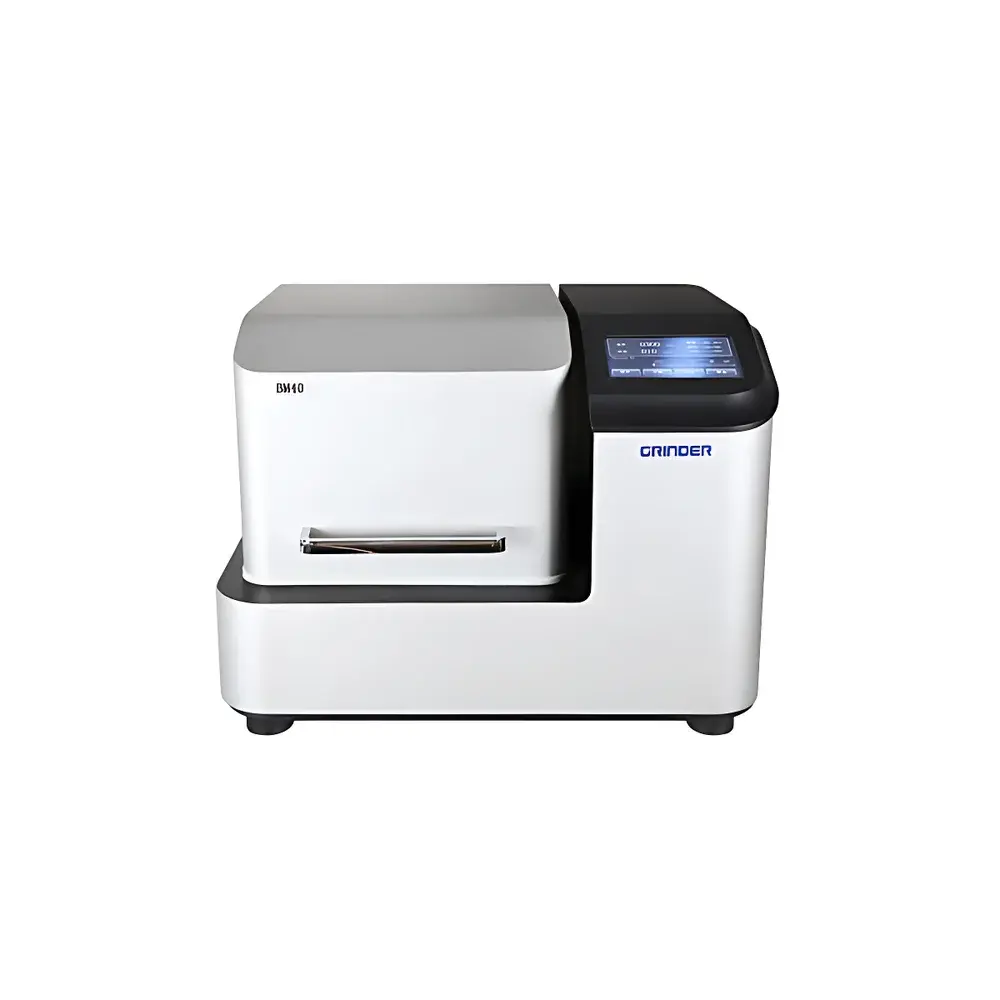
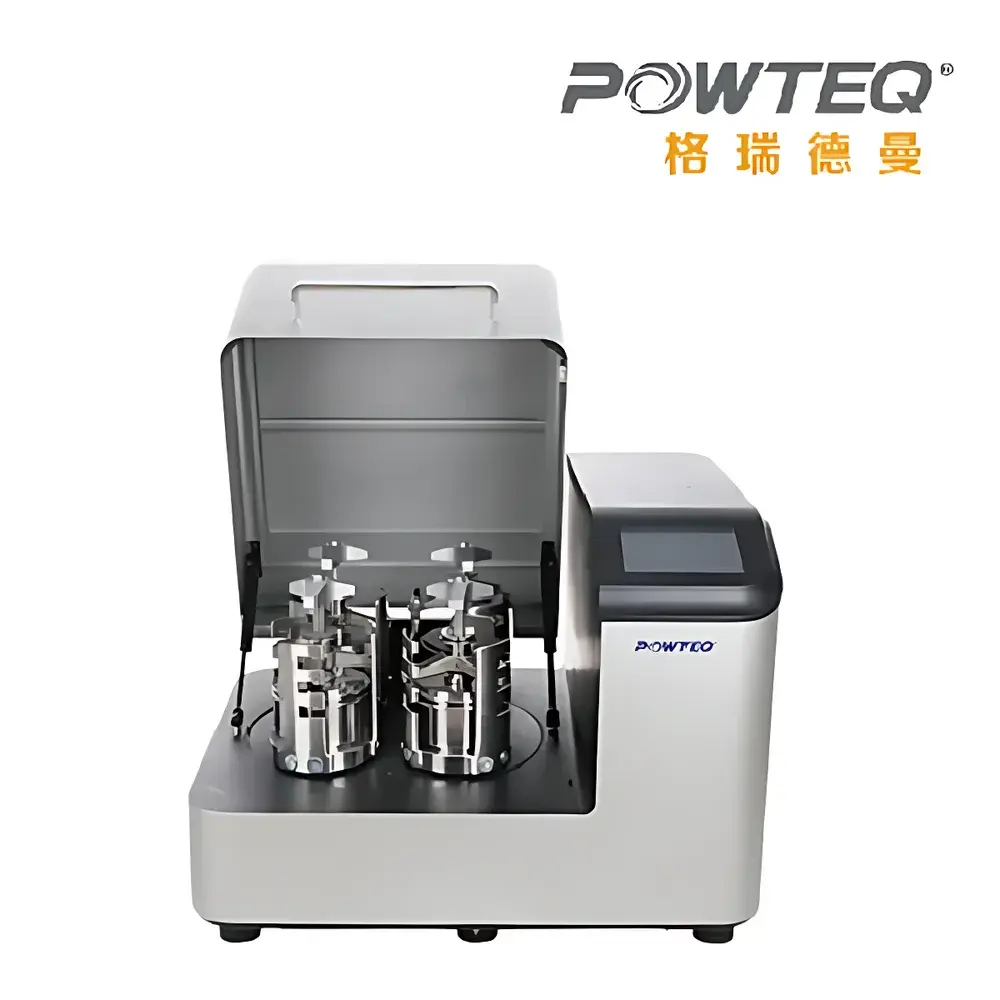
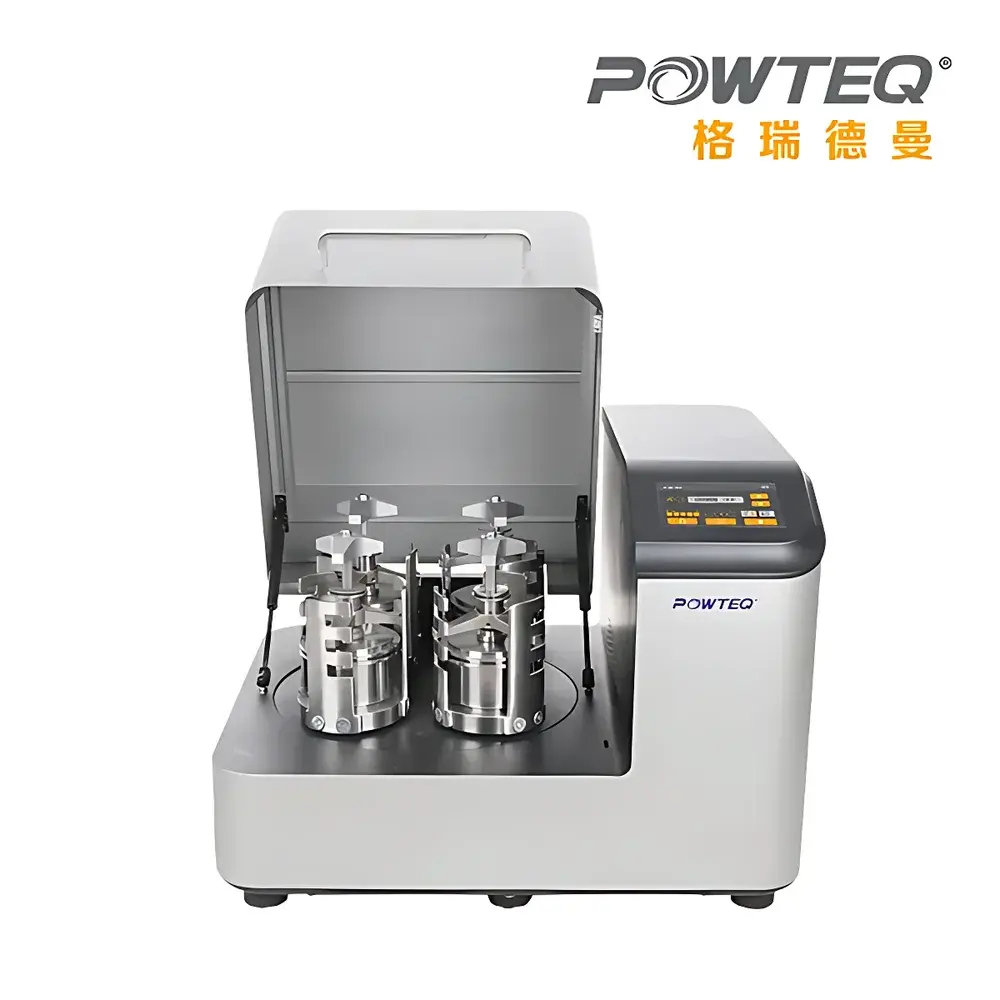
Grinderman BM40 Planetary Ball Mill
| Brand | Grinderman |
|---|---|
| Origin | Beijing, China |
| Manufacturer Type | Direct Manufacturer |
| Product Category | Domestic (China-made) |
| Model | BM40 |
| Price Range | USD 14,000–28,000 |
| Instrument Type | Planetary Ball Mill |
| Sample Suitability | Hard & Brittle Materials |
| Feed Size | < 15 mm |
| Final Particle Size | < 0.1 µm (colloidal/nanoscale achievable with optimized wet grinding) |
| Batch Capacity per Jar | 20 mL |
| Sun Wheel Speed | 30–450 rpm |
| Speed Ratio (Sun Wheel | Jar Rotation): 1 : –2.5 (customizable up to 1 : –3.5) |
| Effective Sun Wheel Diameter | 360 mm |
| Number of Grinding Stations | 4 |
| Max. Grinding Time per Cycle | 999 min (up to 99 cycles) |
| Display | 7-inch LED Touchscreen |
| Rated Power | 1500 W |
| Voltage/Frequency | 220 V / 50 Hz |
| Dimensions (W×D×H) | 784 × 598 × 577 mm |
| Packing Dimensions (W×D×H) | 865 × 979 × 896 mm |
| Net Weight | 195 kg |
| Compliance | Designed for GLP-compliant laboratories |
Overview
The Grinderman BM40 Planetary Ball Mill is an engineered solution for high-energy, reproducible size reduction of hard, brittle, and fibrous materials in research, quality control, and materials science laboratories. It operates on the principle of planetary motion—where grinding jars rotate around their own axes while simultaneously revolving around a central sun wheel in opposite direction (counter-rotation), generating centrifugal accelerations up to 45 g. This dual-motion mechanism subjects samples to intense impact, shear, and friction forces between grinding media and jar walls, enabling consistent sub-micron particle size distribution (PSD) down to <0.1 µm—and, under controlled wet-grinding conditions with appropriate media selection, colloidal or near-nanometric dispersion. The BM40 integrates robust mechanical architecture with precision electronic control, supporting both dry and wet milling protocols across diverse material classes including ceramics, alloys, minerals, pharmaceuticals, and battery electrode precursors.
Key Features
- Four independent grinding stations accommodate 2, 4, or 8 jars simultaneously—enabling parallel processing with full synchronization and identical kinetic energy input per station.
- Variable-speed drive with frequency-controlled motor delivers precise, stepless speed regulation from 30 to 450 rpm on the sun wheel, maintaining ±1 rpm repeatability across extended operation cycles.
- Optimized power transmission via fifth-generation synchronous belt gearing minimizes energy loss, reduces thermal drift, and ensures low-noise (<65 dB(A)) continuous operation—even over multi-hour sequences (max. 10,000 h cumulative runtime validated).
- Integrated active ventilation system cools grinding chambers during prolonged runs, mitigating thermal degradation of temperature-sensitive samples (e.g., polymers, APIs, or organic composites).
- Triple-point reinforced clamping system—using three 8 mm-thick stainless steel retention plates—secures each jar against lateral displacement, meeting IEC 61000-4-2 mechanical safety standards for rotating equipment.
- Interlocked lid design with silicone O-rings and deliberate clearance gaps ensures dust-tight sealing while facilitating rapid, tool-free jar opening and cleaning.
Sample Compatibility & Compliance
The BM40 accepts a broad spectrum of sample types: metallic alloys, oxides, carbides, geological specimens, and composite powders—with feed sizes up to 15 mm. Its modular jar system supports interchangeable vessels made from agate, zirconia, tungsten carbide, silicon nitride, sintered alumina, hardened steel, and titanium-coated steel—each labeled with material grade and nominal volume (12–500 mL range). Jars are fitted with stainless-steel protective sleeves where required, enhancing durability during high-impact milling. All configurations comply with ISO 17025 pre-analytical requirements for homogenization and comminution prior to XRD, SEM-EDS, BET surface area, or laser diffraction analysis. The instrument’s programmable logic controller logs timestamped operational parameters (speed, duration, cycle count), supporting audit trails aligned with FDA 21 CFR Part 11 and EU Annex 11 data integrity expectations.
Software & Data Management
Operation is managed through a 7-inch industrial-grade capacitive touchscreen interface with intuitive icon-based navigation. The embedded firmware stores up to 99 user-defined methods—including ramp profiles, pause intervals, reverse rotation sequences, and cooling activation triggers. Real-time monitoring displays actual rotational speed, elapsed time, and thermal status of each station. Exportable CSV logs include method ID, start/stop timestamps, energy consumption (kWh), and error codes—compatible with LIMS integration via RS-232 or optional Ethernet module. No proprietary software installation is required; raw data files conform to ASTM E2917-22 metadata conventions for analytical instrument output.
Applications
- Preparation of ultrafine ceramic powders for sintering studies and additive manufacturing feedstock qualification.
- Mechanochemical synthesis of metal–organic frameworks (MOFs) and solid-state battery cathode materials (e.g., NMC, LFP).
- Homogenization of heterogeneous geological samples prior to geochemical assay (ICP-MS/OES).
- Particle size reduction of pharmaceutical excipients and active ingredients to enhance dissolution kinetics per USP <724>.
- Production of reference standards with certified PSD for calibration of dynamic image analysis or static light scattering instruments.
FAQ
What jar materials are recommended for milling stainless steel samples?
Stainless steel jars are not advised due to cross-contamination risk; use tungsten carbide or silicon nitride jars instead.
Can the BM40 achieve true nanoscale particle size (≤100 nm)?
Yes—under optimized wet-grinding conditions using zirconia media, surfactant-stabilized suspensions, and extended dwell times (≥6 h), median D50 values below 100 nm have been independently verified via TEM and DLS.
Is remote monitoring or network connectivity supported?
Standard configuration includes RS-232; optional Ethernet/Wi-Fi module enables SCADA integration and remote parameter adjustment via secure HTTP API.
How is calibration traceability maintained for speed and time parameters?
Speed calibration is performed using NIST-traceable optical tachometry; timer accuracy is validated against atomic clock references per ISO/IEC 17025 clause 6.5.2.
Does the BM40 meet CE or UL certification requirements?
The BM40 complies with EN 61000-6-2 (immunity) and EN 61000-6-4 (emissions); UL listing is available upon request for North American deployments.



