
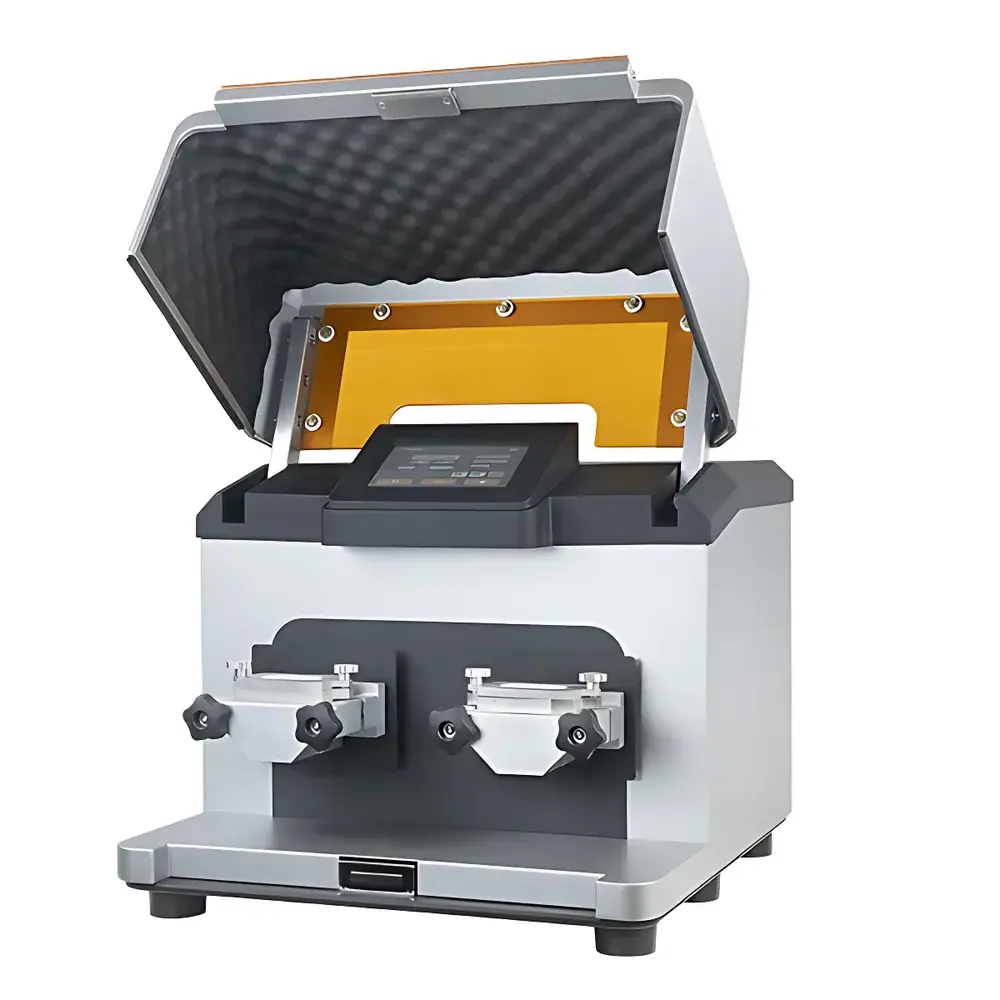
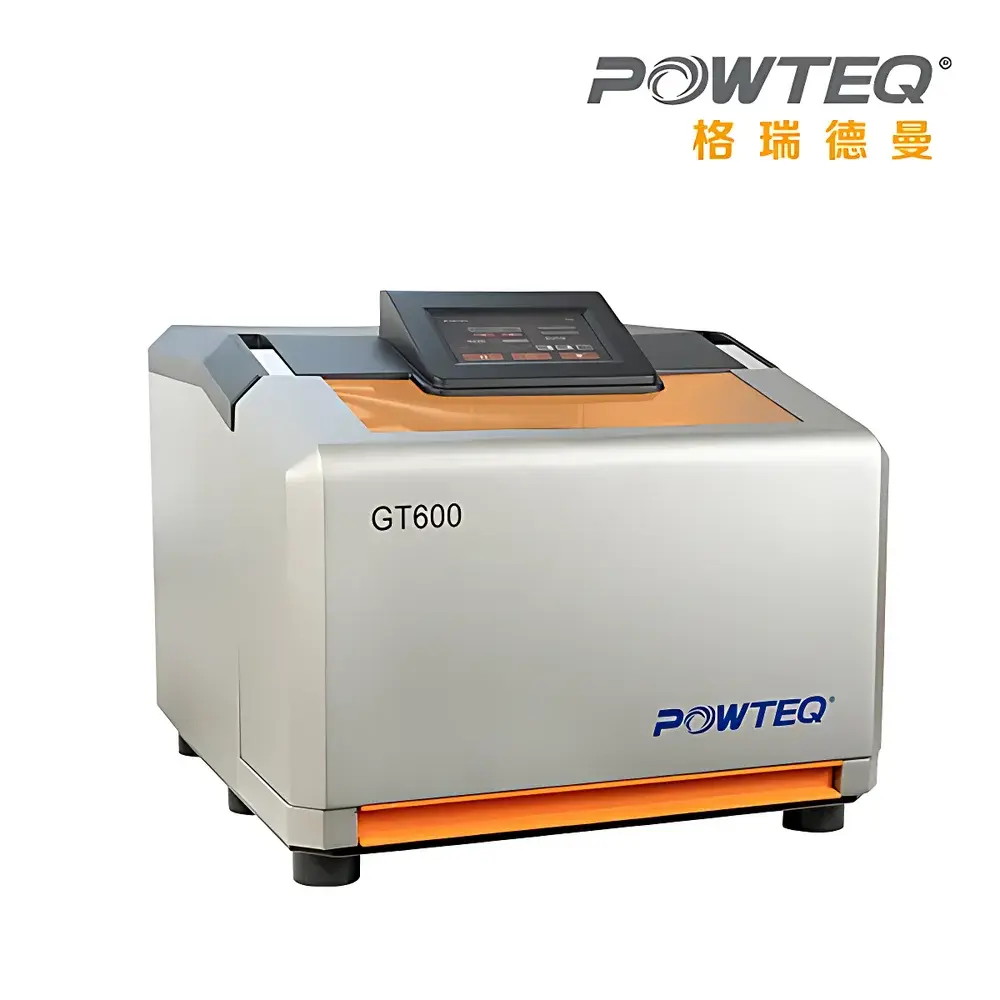
Grinderman GT600Dual High-Energy Vibratory Ball Mill
| Brand | Grinderman |
|---|---|
| Origin | Beijing, China |
| Manufacturer | Grinderman Instrument Co., Ltd. |
| Model | GT600Dual |
| Instrument Type | Vibratory Ball Mill |
| Sample Compatibility | Hard, brittle, fibrous, elastic, and soft materials |
| Maximum Feed Size | <10 mm |
| Final Particle Size | <100 nm (dependent on material properties and operational parameters) |
| Batch Capacity | 2 × 45 mL |
| Operating Frequency Range | 3–35 Hz (180–2100 rpm) |
| Temperature & Pressure Monitoring | Yes |
| Dual Grinding Stations | Yes |
| Safety Interlock | Yes |
| Power Rating | 1.8 kW |
| Grinding Vessel Options | 10, 25, 50, 80, 125 mL (material options: hardened steel, stainless steel, tungsten carbide, zirconia) |
| Cryogenic & Wet Grinding Capable | Yes |
| Programmable Cycles | Up to 99 |
| Method Storage | 20 user-defined protocols |
| Transparent Viewing Window | Yes |
| Optional Atmosphere Control Lid | Yes |
Overview
The Grinderman GT600Dual is a dual-station, high-energy vibratory ball mill engineered for reproducible, high-throughput mechanical comminution of diverse solid samples. It operates on the principle of high-frequency radial oscillation—where grinding vessels undergo controlled arc-shaped motion in the horizontal plane, inducing intense collisions between grinding media (e.g., balls), sample particles, and vessel walls. This dynamic impact energy enables efficient size reduction via fracture, abrasion, and cold welding mechanisms, making it suitable for nanoscale particle generation (<100 nm), mechanochemical synthesis, alloying, and cell disruption. Unlike planetary or centrifugal mills, the GT600Dual’s vibration-driven architecture delivers superior energy transfer efficiency at lower thermal load, particularly advantageous for heat-sensitive or reactive materials. Its design complies with fundamental mechanical safety standards for laboratory-scale milling equipment and supports GLP-aligned workflows through traceable parameter logging and method recall.
Key Features
- Dual independent grinding stations accommodate simultaneous processing of two samples—ideal for comparative studies, replication, or parallel method development.
- Adjustable frequency range (3–35 Hz / 180–2100 rpm) allows precise control over impact energy, enabling optimization for hard ceramics, soft biological tissues, or polymeric waste streams.
- Integrated temperature and pressure sensors within grinding vessels provide real-time process monitoring—critical for cryomilling, exothermic reactions, or volatile compound handling.
- Programmable operation includes total grinding time (up to 99 hours), intermittent cycles (on/off intervals), and storage of up to 20 user-defined methods with full parameter recall.
- Safety-certified interlock system halts motor operation instantly upon lid opening or incomplete closure; transparent polycarbonate viewing window permits visual verification without interrupting operation.
- Modular vessel system supports multiple capacities (10–125 mL) and chemically inert materials including zirconia, tungsten carbide, and stainless steel—ensuring compatibility with acidic, alkaline, or abrasive matrices.
- Optional atmosphere-controlled lids enable inert-gas purging (N₂, Ar) or vacuum sealing—essential for oxidation-sensitive alloys, air-sensitive catalysts, or solvent-free mechanochemical synthesis.
Sample Compatibility & Compliance
The GT600Dual processes a broad spectrum of materials without pre-drying or chemical pretreatment: hard minerals (quartz, basalt), metallic alloys, pharmaceutical tablets, plant biomass (seeds, leaves), animal tissues (bone, liver), polymers, electronic waste, and composite materials. It meets functional requirements aligned with ASTM E11-22 (standard specifications for wire cloth and sieves), ISO 13320:2020 (laser diffraction particle size analysis—supporting downstream characterization), and USP (for pharmaceutical powder fineness evaluation). While not certified under FDA 21 CFR Part 11, its digital parameter logging, method versioning, and audit-ready operation logs support GMP/GLP documentation practices when integrated into validated laboratory information management systems (LIMS).
Software & Data Management
The instrument features an embedded microcontroller-based interface with tactile keypad and LCD display. All operational parameters—including frequency, duration, pause intervals, cycle count, and sensor readings—are digitally preset and stored with timestamped execution records. No external software is required for basic operation; however, optional RS-232/USB data export enables integration with third-party data acquisition platforms. Method files are saved internally with alphanumeric naming, supporting traceability across batches and analysts. For regulated environments, users may implement supplementary electronic lab notebook (ELN) linkage to satisfy ALCOA+ data integrity principles (Attributable, Legible, Contemporaneous, Original, Accurate).
Applications
- Nanomaterial synthesis: production of metal oxide nanoparticles (TiO₂, Fe₃O₄), carbon nanocomposites, and layered double hydroxides via solid-state reaction.
- Mechanochemical activation: catalyst preparation, cocrystal formation, and solvent-free organic synthesis compliant with green chemistry principles.
- Biological sample homogenization: rapid lysis of microbial cells, plant tissues, and frozen animal organs—compatible with downstream DNA/RNA extraction protocols.
- Environmental analysis: grinding of soil, sludge, fly ash, and e-waste prior to XRF, ICP-MS, or leaching test preparation (TCLP, SPLP).
- Pharmaceutical R&D: particle size engineering of APIs, excipient blending, and amorphous solid dispersion development.
- Materials science: high-energy alloying of immiscible metals, grain refinement of bulk metallic glasses, and defect engineering in 2D materials.
FAQ
What is the maximum recommended feed size for optimal performance?
The GT600Dual accepts feed particles up to 10 mm in diameter; however, consistent sub-100 nm output requires initial size reduction (e.g., mortar pre-crushing) for highly heterogeneous or fibrous samples.
Can the GT600Dual be used for cryogenic grinding without modification?
Yes—standard configuration supports liquid nitrogen cooling using compatible cryo-adapters and low-temperature vessel seals; no hardware retrofitting is necessary.
Is the instrument suitable for regulatory-compliant quality control labs?
While the GT600Dual itself does not carry FDA or CE-IVD certification, its repeatable operation, method storage, and sensor logging align with IQ/OQ validation frameworks for analytical sample preparation equipment.
How is cross-contamination prevented between runs?
Vessels and grinding media are fully removable and autoclavable or solvent-cleanable; stainless-steel and zirconia options minimize elemental leaching during extended use.
What maintenance is required for long-term reliability?
Routine inspection of drive belt tension, vibration isolation mounts, and sensor calibration every 6 months (or per 500 operating hours) ensures sustained performance and measurement fidelity.



