
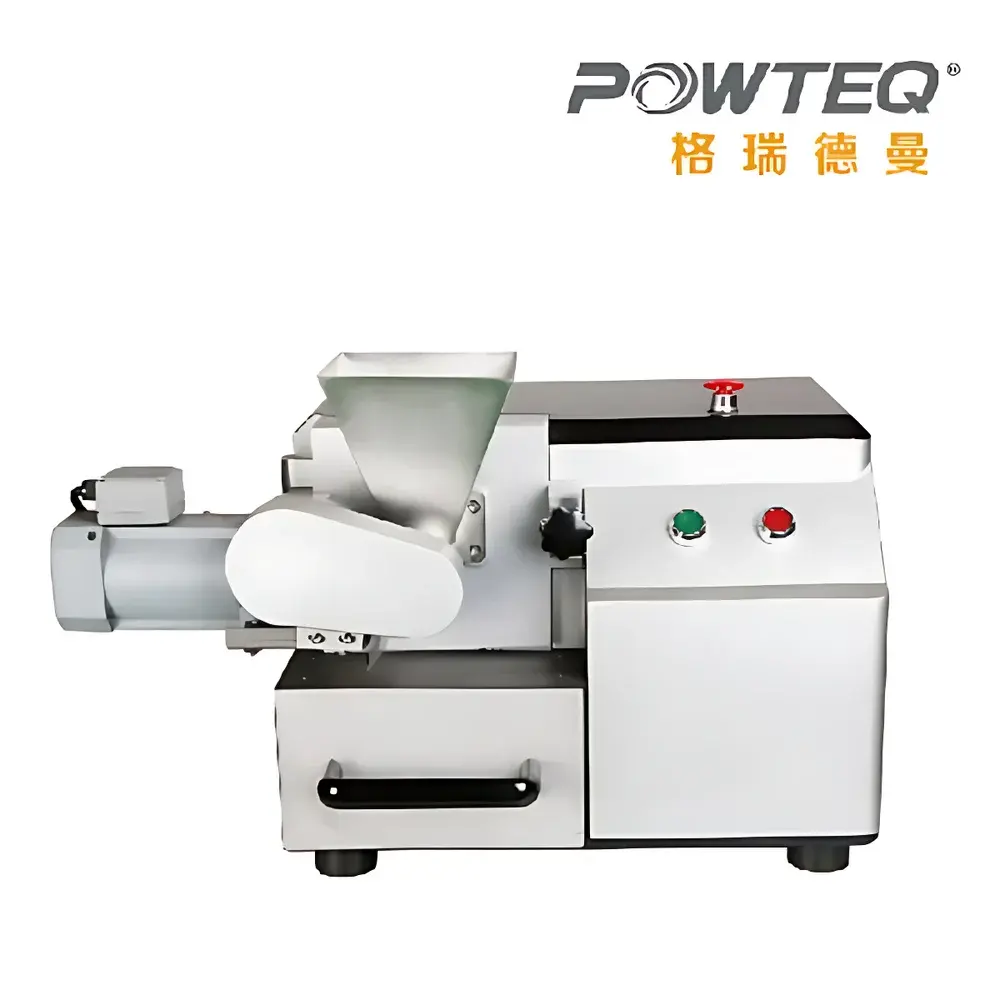
Grindemann CB1000 Hammer Mill Grinder
| Brand | Grindemann |
|---|---|
| Origin | Beijing, China |
| Manufacturer Type | Direct Manufacturer |
| Product Category | Domestic |
| Model | CB1000 |
| Instrument Type | Hammer Mill Crusher |
| Sample Applicability | Brittle to Medium-Hard Materials |
| Output Particle Size | 0.01–0.5 mm |
| Maximum Feed Size | < 4 mm |
| Final Output Granularity | < 100 µm |
| Batch Capacity | 2 L |
| Rotor Peripheral Speed | 76.3 m/s |
| Rated Power | 1.1 kW |
| Motor Speed | 10,000 rpm |
| Sieve Aperture Range | 0.12–10 mm |
| Features | Adjustable Speed, Electric Brake, Tool-Free Rotor & Sieve Access, Integrated Auto-Feeding System, Desktop Form Factor |
Overview
The Grindemann CB1000 Hammer Mill Grinder is an engineered laboratory-scale comminution system designed for reproducible, high-throughput size reduction of brittle and medium-hard solid materials. It operates on the principle of high-velocity impact comminution: feed material is introduced centrally into the grinding chamber via a patented gravity-assisted feed chute, where it is subjected to repeated collisions with rapidly rotating hammers (rotor blades) operating at 10,000 rpm. The resulting particle fragmentation follows a controlled attrition–impact mechanism, with final particle size governed by sieve aperture selection and residence time within the chamber. With a rotor peripheral speed of 76.3 m/s and a rated power output of 1.1 kW, the CB1000 delivers consistent energy input per unit mass—critical for achieving narrow particle size distributions in batch-mode preparation. Its design prioritizes operational repeatability, minimal carryover (< 0.1% residual mass after cleaning), and compatibility with regulated sample prep workflows in quality control and analytical laboratories.
Key Features
- Variable-speed motor control (0–10,000 rpm) enabling precise optimization of impact energy for diverse material hardness and friability profiles
- Electric braking system reducing rotor coast-down time to < 8 seconds—enhancing throughput in multi-batch operations
- Tool-free, quick-release mechanism for rotor assembly and bottom-mounted stainless-steel sieve—facilitating full chamber access in under 90 seconds without disassembly tools
- Integrated auto-feeding hopper with flow-regulating gate, minimizing operator exposure and eliminating manual spoon-feeding variability
- Desktop footprint (W × D × H: 420 × 480 × 510 mm) optimized for fume hood integration or benchtop placement in ISO 17025-accredited labs
- Sealed bearing housing with IP54-rated enclosure, ensuring dust resistance during extended operation with abrasive mineral samples
Sample Compatibility & Compliance
The CB1000 is validated for use with coal, coke, limestone, ceramic oxides, refractory clays, granitic rock, soil aggregates, and tempered glass—materials exhibiting Mohs hardness ≤ 6.5 and low ductility. It complies with ASTM D2013 (Standard Practice for Preparing Coal Samples for Analysis) and supports ISO 18283:2015 (Solid Mineral Fuels — Manual Sampling) workflow requirements. All wetted components are constructed from AISI 304 stainless steel, meeting FDA-recommended surface finish standards (Ra ≤ 0.8 µm) for non-sterile sample prep environments. The unit conforms to IEC 61000-6-2 (EMC immunity) and IEC 61000-6-4 (EMC emission) standards; CE marking is affixed per Machinery Directive 2006/42/EC.
Software & Data Management
While the CB1000 operates as a standalone electromechanical instrument, its operational parameters—including run time, rotor speed, and brake engagement status—are logged via embedded non-volatile memory (10,000-cycle retention). Optional RS-485 interface enables integration with LIMS or ELN platforms for audit-trail generation. When deployed in GLP/GMP environments, users may configure timestamped run records aligned with 21 CFR Part 11-compliant electronic signature protocols through third-party middleware. Calibration verification reports (speed accuracy ±0.5%, timer deviation < ±0.2 s) are generated semi-annually using NIST-traceable tachometers and stopwatches.
Applications
- Routine coal proximate and ultimate analysis sample preparation (ASTM D3172, D3176)
- Homogenization of geological core subsamples prior to XRF or ICP-OES digestion
- Size reduction of ceramic green bodies for particle size distribution (PSD) validation per ISO 9276-2
- Preparation of reference materials for certified proficiency testing schemes (e.g., IRMM, NIST SRMs)
- High-volume soil grinding for heavy metal leaching studies (TCLP, SPLP protocols)
- Crushing of spent catalyst pellets in petrochemical QA/QC labs
FAQ
What safety certifications does the CB1000 hold?
The unit carries CE marking under EU Machinery Directive 2006/42/EC and meets EN 61000-6-2/6-4 electromagnetic compatibility requirements.
Can the CB1000 be used for moisture-sensitive samples?
Yes—optional nitrogen purge port (M6 thread) allows inert atmosphere operation to prevent oxidation or hydrolysis during grinding.
Is routine maintenance documented in the user manual?
Yes—the manual includes torque specifications for rotor mounting bolts, recommended grease intervals (every 500 operating hours), and sieve wear inspection criteria (maximum allowable aperture deviation: ±5%).
How is cross-contamination minimized between batches?
The grinding chamber features zero dead-volume geometry, and residue removal is verified using gravimetric recovery tests per ASTM E2917-20 Section 7.2.
Does Grindemann provide method development support?
Yes—application engineers supply SOP templates, sieve selection guides, and PSD correlation matrices for common matrix types upon request.



