
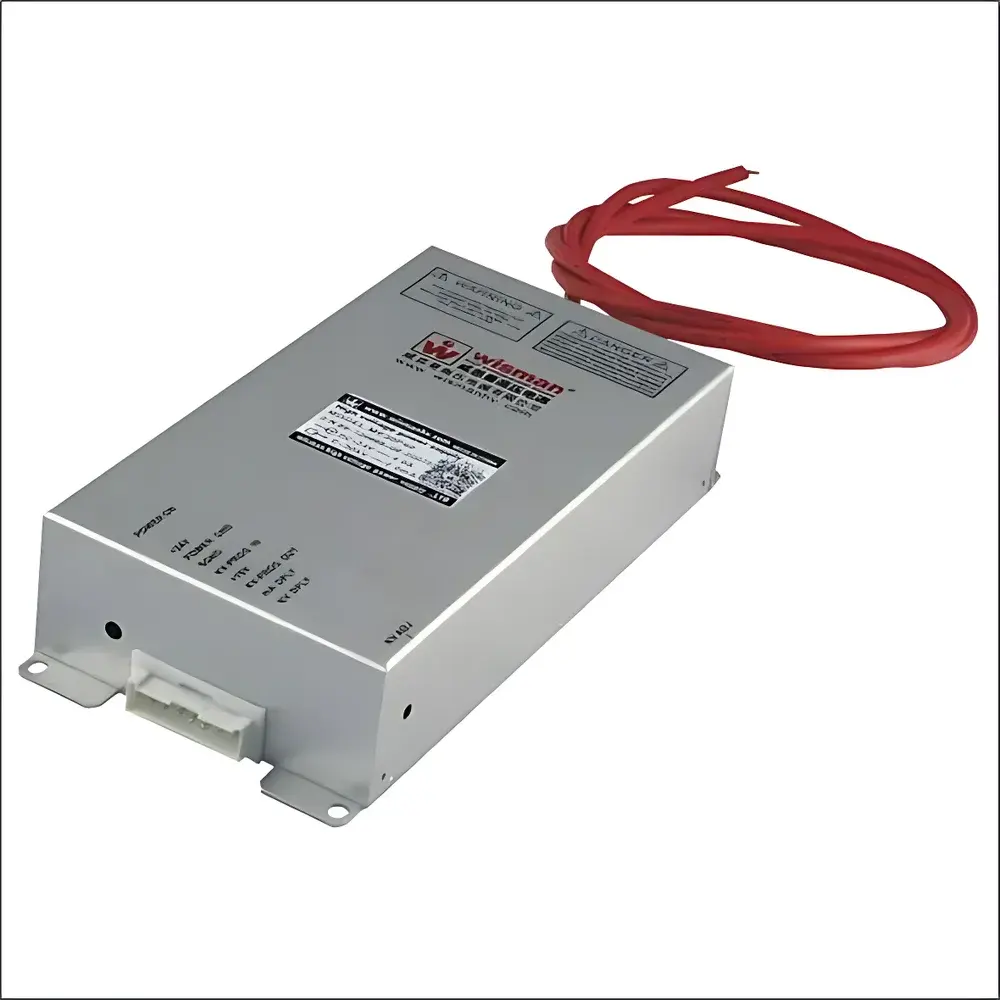
Wiseman DNA30kV/15W High-Voltage Power Supply Module
| Brand | Wiseman |
|---|---|
| Model | DNA30kV/15W |
| Output Voltage | 30 kV (adjustable from 600 V to 30 kV) |
| Output Current | 0.5 mA |
| Output Power | 15 W |
| Ripple & Noise | <0.01% p-p |
| Stability | ±0.02% over 8 hours |
| Temperature Coefficient | 25 ppm/°C |
| Input | DC 24 V |
| Communication Interface | Optional RS-232 / RS-485 |
| Polarity | Selectable Positive or Negative |
| Protection | Arc detection, short-circuit protection |
| Dimensions (H×W×D) | 43.0 × 100.0 × 205.0 mm |
| Operating Temperature | 0–50 °C |
| Storage Temperature | −40–+85 °C |
| Humidity | 20–85% RH (non-condensing) |
| Compliance | Designed for OEM integration in analytical instrumentation requiring IEC 61010-1 safety and EMC robustness |
Overview
The Wiseman DNA30kV/15W is a compact, high-stability DC/DC high-voltage power supply module engineered for precision scientific instrumentation requiring stable, low-noise bias voltages in the 600 V to 30 kV range. Based on zero-current resonant switching topology and proprietary high-voltage insulation design, the module delivers tightly regulated output with exceptional long-term stability and minimal electromagnetic interference. It is specifically optimized for applications demanding ultra-low ripple (<0.01% p-p), high reproducibility, and reliable operation under continuous duty cycles — including mass spectrometry ion optics, electrophoresis drive stages, electron/ion beam focusing systems, and photomultiplier tube (PMT) biasing. Its modular form factor and six-sided EMI shielding make it suitable for integration into space-constrained instrument enclosures without compromising signal integrity or regulatory compliance.
Key Features
- Output voltage programmable from 600 V to 30 kV; polarity selectable (positive or negative)
- Maximum output power of 15 W at 30 kV / 0.5 mA, with optional 10 W variant available
- Ultra-low output ripple and noise: <0.01% peak-to-peak under full load
- High short-term and long-term stability: ±0.01% per hour, ±0.02% over 8-hour continuous operation
- Low temperature coefficient of 25 ppm/°C ensures minimal drift across ambient variations (0–50 °C operating range)
- Comprehensive protection circuitry: real-time arc detection, automatic recovery from short circuits, and current limiting
- Digital control interface options: RS-232 or RS-485 with addressable multi-unit daisy-chaining capability
- Analog control via external potentiometer or 0–10 V input for seamless integration into feedback loops
- Compact mechanical footprint (43 × 100 × 205 mm) with fully shielded aluminum housing meeting IEC 61000-6-3 emission limits
- OEM-customizable output configurations, mounting options, and connector sets per customer specification
Sample Compatibility & Compliance
The DNA30kV/15W module is routinely deployed as the high-voltage bias source for critical subsystems in analytical instruments subject to stringent regulatory oversight. It supports stable operation in electrophoretic separation systems compliant with ISO 13485 and FDA 21 CFR Part 11–enabled platforms when integrated with audit-trail-capable controllers. For mass spectrometry applications, the module meets the voltage stability and noise requirements specified in ASTM E2297 (Standard Guide for Mass Spectrometer Calibration) and supports ion transmission efficiency optimization in quadrupole, TOF, and Orbitrap architectures. Its reinforced creepage/clearance design adheres to IEC 61010-1 Edition 3 for measurement/control laboratory equipment, while its low EMI profile facilitates CE marking under the EMC Directive (2014/30/EU). No internal high-voltage connectors require user servicing — all HV terminations are factory-sealed and potted for long-term reliability in GxP environments.
Software & Data Management
While the DNA30kV/15W operates as a hardware-integrated module without embedded firmware UI, its RS-232/RS-485 interface supports ASCII command protocol for remote configuration and monitoring. Standard commands include voltage setpoint adjustment, output enable/disable, status query (e.g., fault flags, actual output, temperature), and address assignment for multi-module networks. Integration with LabVIEW, Python (pySerial), or MATLAB is straightforward using documented SCPI-like syntax. When deployed in GLP/GMP-compliant instruments, the host controller may log timestamped voltage readings, fault events, and operational duration — satisfying data integrity requirements under ALCOA+ principles. Wiseman provides comprehensive communication protocol documentation and sample driver code for common industrial PLCs and DAQ systems, enabling traceable calibration and maintenance records.
Applications
- Mass spectrometry: Ion source acceleration, quadrupole rod biasing, detector (e.g., MCP, Faraday cup) high-voltage bias
- Electrophoresis & DNA sequencing: Capillary electrophoresis (CE) electrode drive, gel electrophoresis buffer voltage control
- Particle beam instrumentation: Electron microscopy column biasing, ion implantation beam steering, electrostatic lens arrays
- Photonics & radiation detection: PMT and APD biasing, scintillation detector high-voltage supply, X-ray tube filament regulation
- Industrial metrology: Electrostatic discharge (ESD) test equipment, corona charging systems, precision electrostatic chuck control
- Research infrastructure: Plasma physics experiments, accelerator injector stages, vacuum chamber conditioning systems
FAQ
Is the DNA30kV/15W certified for use in medical devices?
The module itself carries no standalone medical device certification (e.g., ISO 13485 or FDA 510(k)), but it is widely integrated into Class II and Class III diagnostic instruments by OEMs who validate the full system per IEC 62304 and IEC 60601-1.
Can multiple DNA modules be synchronized for phased output?
No native phase-synchronization feature exists; however, precise timing coordination can be achieved externally via TTL trigger inputs (available on custom variants) or master-slave digital command sequencing over RS-485.
What is the recommended input power supply for optimal performance?
A low-noise, well-regulated 24 V DC source with ≥20% headroom (e.g., 3 A minimum for 15 W model) and adequate local bulk capacitance (≥1000 µF) is required to maintain specified stability and transient response.
Does Wiseman provide calibration certificates with NIST traceability?
Yes — optional factory calibration with NIST-traceable HV meter verification is available upon request, including full uncertainty budget documentation per ISO/IEC 17025 guidelines.
How is thermal management handled in enclosed instrument designs?
The module relies on conductive cooling through its baseplate; forced-air convection is not required, but airflow >0.5 m/s across the heatsink surface improves derating margin. Thermal derating curves are provided in the datasheet for ambient temperatures above 40 °C.



