
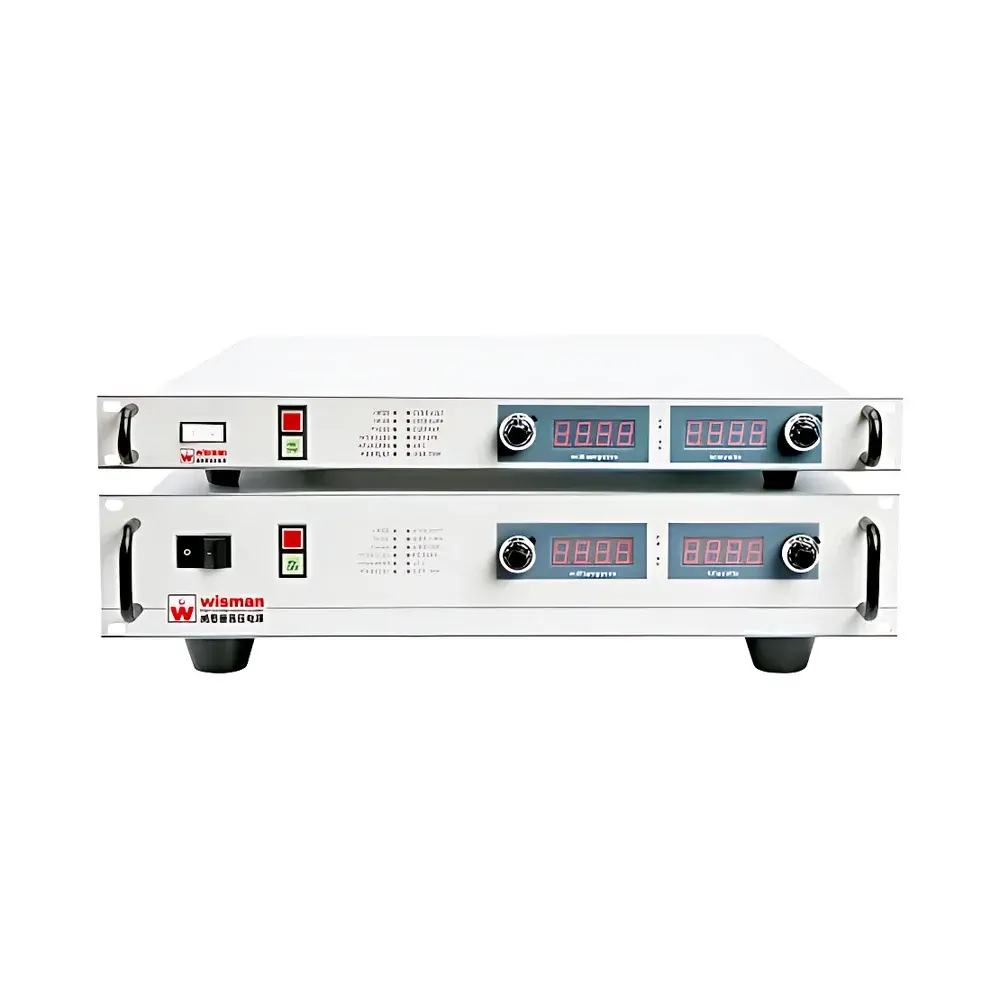
Wisman DC150 Rack-Mount High-Voltage Power Supply, 130 kV / 2 kW
| Key | Brand: Wisman |
|---|---|
| Origin | Shaanxi, China |
| Model | DC150 |
| Output Voltage | 0–130 kV (adjustable) |
| Output Power | 2 kW |
| Ripple | 0.02% p-p (customizable to 0.01% p-p) |
| Stability | <100 ppm/h (after 30-min warm-up), <500 ppm/8 h |
| Temperature Coefficient | ≤25 ppm/°C |
| Input | AC 220 V ±10% (AC 110 V optional), PF = 0.995, Efficiency = 85% |
| Protection | Overvoltage, Overcurrent, Short-Circuit, Arc Detection, Overtemperature, Interlock |
| Interfaces | RS-232, Ethernet (standard), RS-485 (optional) |
| Compliance | CE certified |
| Dimensions | 483 mm W × 610 mm D × 44 mm H (1U, for 80–130 kV models) |
| Application | Ion implantation, particle accelerators, X-ray tubes, electrostatic processes, scientific research |
Overview
The Wisman DC150 is a precision-engineered, 19-inch rack-mount high-voltage power supply designed for mission-critical laboratory and industrial applications demanding stable, controllable, and highly reliable DC output up to 130 kV and 2 kW. Based on regulated switching topology with active feedback control, the DC150 delivers ultra-low ripple and exceptional long-term stability—essential for sensitive electrostatic processes, charged particle beam generation, and high-energy physics instrumentation. Its architecture integrates hardened high-voltage insulation, fast-recovery arc suppression circuitry, and redundant safety interlocks to ensure operational integrity in environments prone to transient discharges—such as ion beam injection systems, electron accelerator test benches, and high-vacuum X-ray source drivers. Unlike general-purpose HV supplies, the DC150 is specifically calibrated and validated for continuous duty under variable load conditions, with performance traceable to NIST-traceable reference standards during factory acceptance testing.
Key Features
- Output range: Continuously adjustable 0–130 kV DC with 2 kW maximum power; multiple voltage tiers available (1–130 kV in discrete steps) and scalable power ratings (10 W to 2 kW)
- Ultra-stable regulation: <100 ppm/h drift after 30-minute thermal stabilization; <500 ppm over 8 hours; temperature coefficient ≤25 ppm/°C (custom options available)
- Low-noise output: 0.02% peak-to-peak ripple (standard); optional 0.01% p-p version for ultra-sensitive detector biasing or low-current spectroscopy
- Robust arc management: Intelligent arc detection with sub-millisecond recovery; maintains system uptime during repetitive flashover events typical in ion implanters and electrostatic precipitators
- Dual-mode control: Local adjustment via front-panel multi-turn potentiometers or remote analog (0–10 V) / digital (RS-232, Ethernet) interface with full command set per IEEE 488.2 syntax
- Comprehensive protection suite: Hardware-enforced overvoltage, overcurrent, short-circuit, arc fault, overtemperature, and safety interlock monitoring—each with independent latching and status reporting
- High power factor (0.995) and 85% efficiency minimize thermal loading and facility infrastructure demands
- CE-certified design compliant with EN 61000-6-3 (EMI) and EN 61000-6-2 (immunity); suitable for integration into ISO/IEC 17025-accredited laboratories
Sample Compatibility & Compliance
The DC150 is compatible with a broad spectrum of high-impedance and dynamic-load instruments—including electrostatic spray nozzles, corona discharge chambers, electrospray ionization (ESI) sources, field-emission electron guns, and dielectric withstand testers. Its low-starting-voltage capability (stable operation from 15 V) enables precise ramping for controlled breakdown studies and partial discharge characterization. All units undergo full functional and safety validation per IEC 61010-1 (Measurement, Control and Laboratory Equipment) and meet CE marking requirements for electromagnetic compatibility and low-voltage directive compliance. For GxP-regulated environments, firmware supports audit-trail logging (via Ethernet), user-access level control, and timestamped event records—facilitating alignment with FDA 21 CFR Part 11 and EU Annex 11 expectations when integrated into validated systems.
Software & Data Management
Standard Ethernet and RS-232 interfaces support native integration with LabVIEW™, Python (PySerial, socket), MATLAB®, and SCADA platforms. The embedded web server provides real-time monitoring of output voltage/current, internal temperatures, fault logs, and protection status without additional drivers. Firmware includes programmable ramp rates, sequence scripting (up to 100-step profiles), and alarm threshold configuration. Remote voltage/current readback is provided via isolated 0–10 V analog outputs (JP1 header), enabling connection to external DAQ systems or PLCs. All communication protocols are documented in the publicly available API Reference Manual (Rev. 3.2), supporting reproducible automation in GLP/GMP workflows.
Applications
- Ion implantation systems requiring stable beam energy control
- Electrostatic applications: spray coating,纺丝 (electrospinning), flocking, precipitation, and air filtration
- Scientific instrumentation: electron/X-ray tube biasing, mass spectrometer detectors, particle accelerator injectors
- Materials testing: dielectric strength evaluation, insulation resistance mapping, partial discharge analysis
- Industrial R&D: high-voltage capacitor charging, pulsed power conditioning, semiconductor device aging
- Academic research: plasma physics experiments, vacuum chamber biasing, surface charge manipulation
FAQ
What is the minimum starting voltage for stable operation?
The DC150 achieves stable regulation from 15 V output, enabling precise low-voltage commissioning and calibration procedures.
Can the unit be integrated into a validated QC/QA system?
Yes—firmware supports time-stamped event logging, user authentication, and electronic signature-ready audit trails compatible with 21 CFR Part 11 and EU Annex 11 requirements.
Is custom voltage or power rating available?
Wisman offers OEM customization including non-standard output voltages (e.g., 140 kV), enhanced stability (<50 ppm/8 h), and specialized cooling or shielding configurations.
How is arc recovery performance quantified?
Arc detection latency is <10 µs; recovery to full-rated output occurs within 100 ms after arc extinction—verified per IEC 61000-4-5 surge immunity testing.
What mechanical form factors are supported?
1U (44 mm height) and 2U (88 mm height) chassis variants are available; all conform to EIA-310-D 19-inch rack standards with front-panel access to HV connectors and status indicators.



