
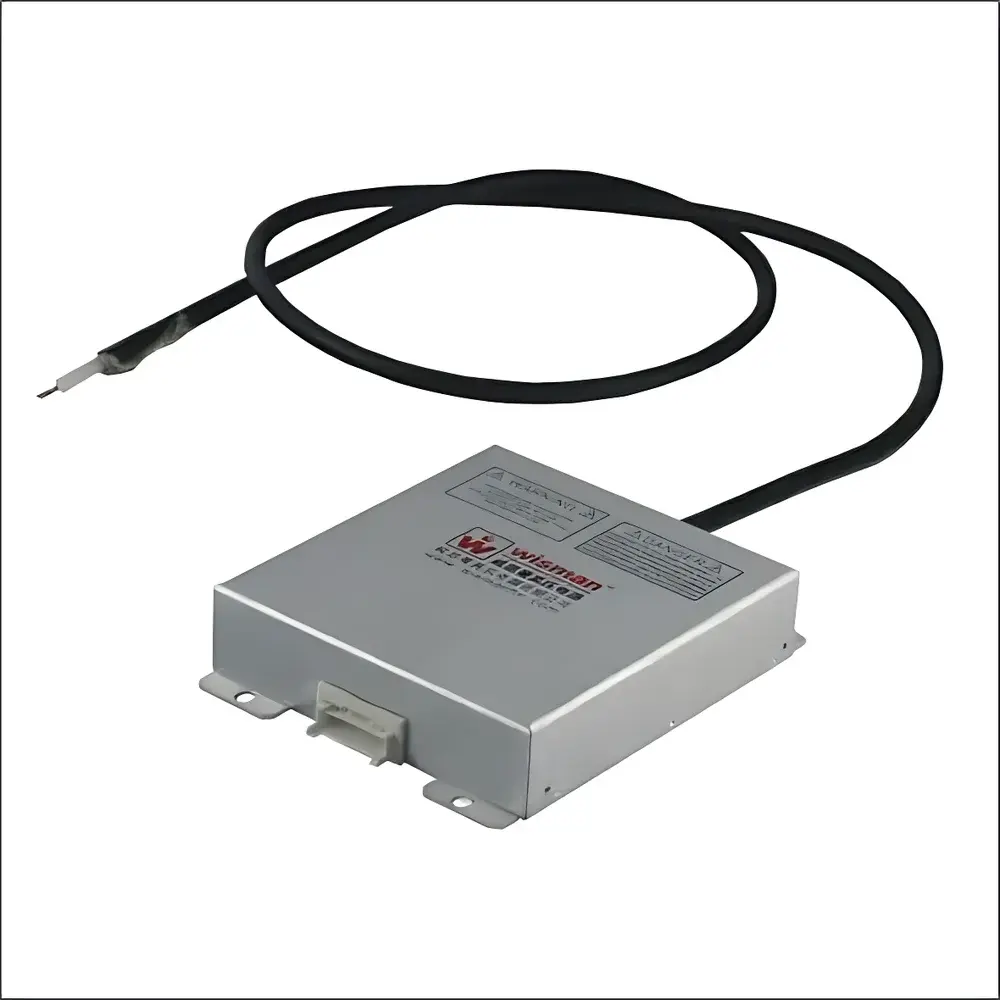
Wiseman PM10kV/10W High-Voltage Power Supply Module
| Brand | Wiseman |
|---|---|
| Model | PM10kV/10W |
| Output Voltage | 10 kV (adjustable from 500 V to 10 kV in discrete steps) |
| Output Power | 10 W |
| Output Current | up to 1 mA @ 10 kV |
| Ripple & Noise | < 2 mV<sub>P-P</sub> |
| Stability | ±0.001 %/hr |
| Temperature Coefficient | 25 ppm/°C |
| Input | DC 24 V |
| Communication Interface | RS-232 or RS-485 (addressable multi-module network support) |
| Polarity | Selectable positive or negative output |
| Protection | Arc detection, short-circuit protection, overvoltage lockout |
| Dimensions | 130 × 90 × 30 mm |
| Weight | 400 g |
| Operating Temperature | 0–50 °C |
| Storage Temperature | −40–+85 °C |
| Humidity | 20–80 % RH (non-condensing) |
| Compliance | Designed for OEM integration in analytical instrumentation requiring IEC 61010-1 safety and EMC robustness |
Overview
The Wiseman PM10kV/10W is a compact, high-stability DC-DC high-voltage power supply module engineered for precision biasing and signal amplification in demanding scientific and analytical instrumentation. Based on zero-current resonant switching topology and proprietary high-voltage insulation design, the module delivers regulated DC output voltages up to 10 kV with exceptional long-term stability and minimal electromagnetic interference. Its six-sided shielded aluminum housing ensures robust immunity against radiated and conducted noise—critical when powering ultra-low-current detectors such as photomultiplier tubes (PMTs), microchannel plates (MCPs), and ionization chambers in mass spectrometers and electron microscopes. Unlike general-purpose HV supplies, the PM series is specifically optimized for OEM integration into vacuum-compatible, space-constrained instrument platforms where thermal management, size, and electrical cleanliness are non-negotiable.
Key Features
- High-voltage DC-DC conversion delivering up to 10 kV at 1 mA (10 W), with selectable output voltage steps: 500 V, 1 kV, 1.5 kV, 2 kV, 3 kV, 5 kV, 7.5 kV, and 10 kV
- Ultra-low output ripple and noise: < 2 mVP-P, enabling stable gain control in low-signal applications such as scintillation detection and time-of-flight mass spectrometry
- Thermal and temporal stability: ±0.001 %/hr drift and 25 ppm/°C temperature coefficient—meeting requirements for GLP-compliant calibration traceability
- Integrated arc and short-circuit protection with automatic recovery, ensuring uninterrupted operation during transient discharge events common in vacuum systems and ESD testing environments
- Dual analog control options: external potentiometer or 0–10 V control input for closed-loop feedback integration
- RS-232 and RS-485 digital interfaces; RS-485 supports daisy-chained multi-module addressing—ideal for distributed HV subsystems in modular mass spectrometer arrays or multi-detector radiation monitoring systems
- Compact form factor (130 × 90 × 30 mm) with 400 g mass, facilitating direct PCB-mount or chassis-integrated deployment without heatsink dependency
Sample Compatibility & Compliance
The PM10kV/10W is validated for use with high-impedance, low-current scientific detectors including photomultiplier tubes (PMTs), proportional counters, Geiger-Müller tubes, and electrostatic lens stacks. It meets IEC 61010-1 Edition 3 for measurement, control, and laboratory equipment safety, with reinforced insulation rated for 10 kV DC working voltage. While not certified to FDA 21 CFR Part 11 out-of-the-box, its deterministic digital control architecture and non-volatile parameter storage support audit-ready system-level validation under ISO 17025 and GMP frameworks when integrated into validated instruments. RoHS 3 and REACH compliance are maintained across all components.
Software & Data Management
The module operates standalone via analog control but achieves full configurability through ASCII-command-based protocols over RS-232 or RS-485. Commands include voltage setpoint, polarity toggle, enable/disable, and status query (e.g., “VSET?”, “STAT?”). Firmware supports user-defined address assignment (0–255) and broadcast mode for synchronized ramping across multiple units. No proprietary driver is required—standard terminal emulators or Python-based LabVIEW/PySerial scripts suffice. All communication logs and parameter changes can be timestamped and exported for 21 CFR Part 11-aligned electronic records when implemented with application-layer audit trail functionality.
Applications
- Mass spectrometry: Ion source biasing, detector dynode chain supply, and quadrupole lens voltage stabilization
- Electron microscopy: MCP biasing, Faraday cup preamplifier HV, and beam blanker actuation
- Nuclear instrumentation: PMT anode supply for gamma spectroscopy, proportional counter biasing in neutron detection
- Electrophoresis and capillary electrophoresis: Electrokinetic separation field generation
- Industrial ESD testing: Controlled high-voltage bias for contact/current injection test fixtures
- Scientific research: Electron/ion beam focusing, electrospinning, and dielectric breakdown studies
FAQ
Is the PM10kV/10W suitable for continuous-duty operation in vacuum environments?
Yes—its hermetically sealed construction, absence of outgassing plastics, and conduction-cooled thermal design make it compatible with UHV-compatible instrument integration when mounted on thermally anchored chassis.
Can multiple PM modules be synchronized for ramped voltage sequencing?
Yes—via RS-485 broadcast commands or coordinated analog control signals, enabling precise inter-module timing for applications such as time-resolved detector gating.
Does the module support remote calibration verification?
While no internal DAC self-calibration is provided, the analog control input and digital readback of actual output voltage (via “VOUT?” command) allow external metrology-grade voltmeters to validate linearity and hysteresis per ISO/IEC 17025 procedures.
What is the recommended input power supply specification?
A well-regulated 24 V DC source with ≤50 mV ripple and ≥2 A current capacity is required; switching supplies must comply with CISPR 11 Class B emissions limits to preserve module noise performance.
How is firmware updated in the field?
Firmware is factory-programmed and not field-upgradable; however, configuration parameters (e.g., default voltage, address, polarity) are stored in non-volatile memory and persist across power cycles.



