
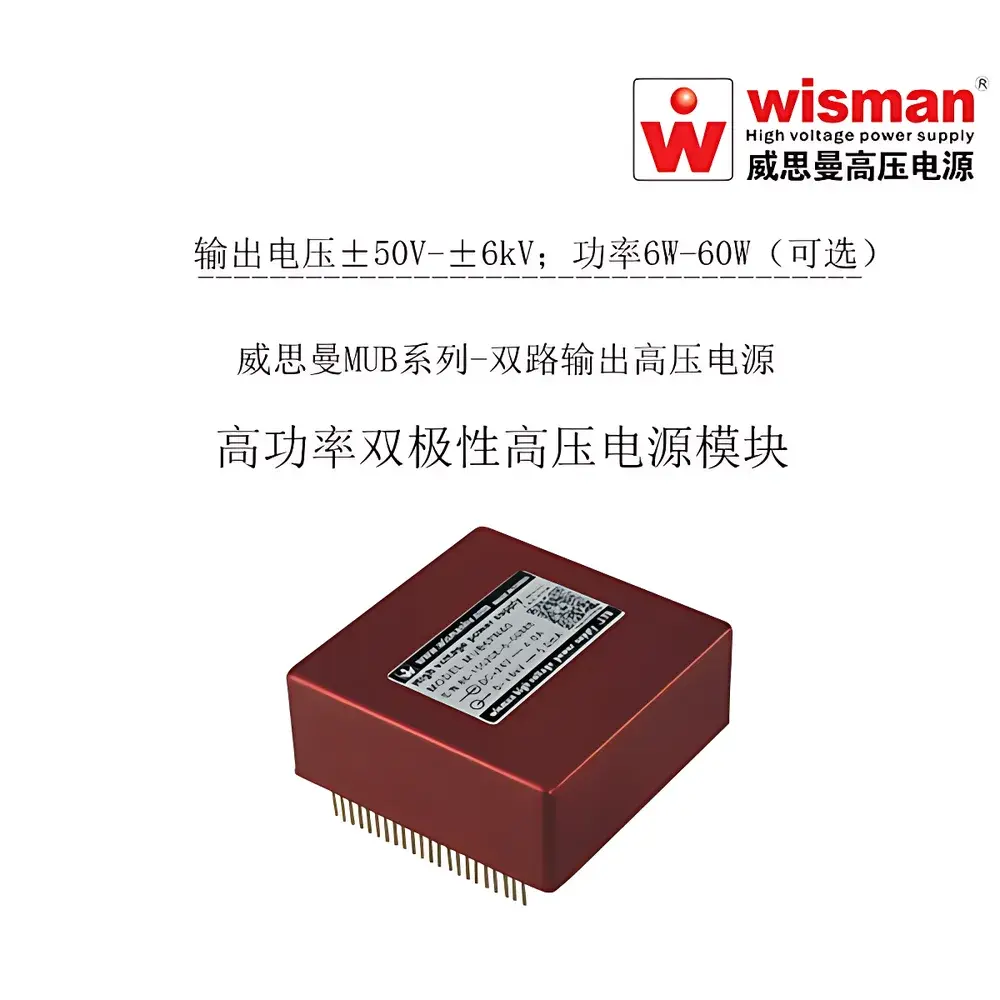
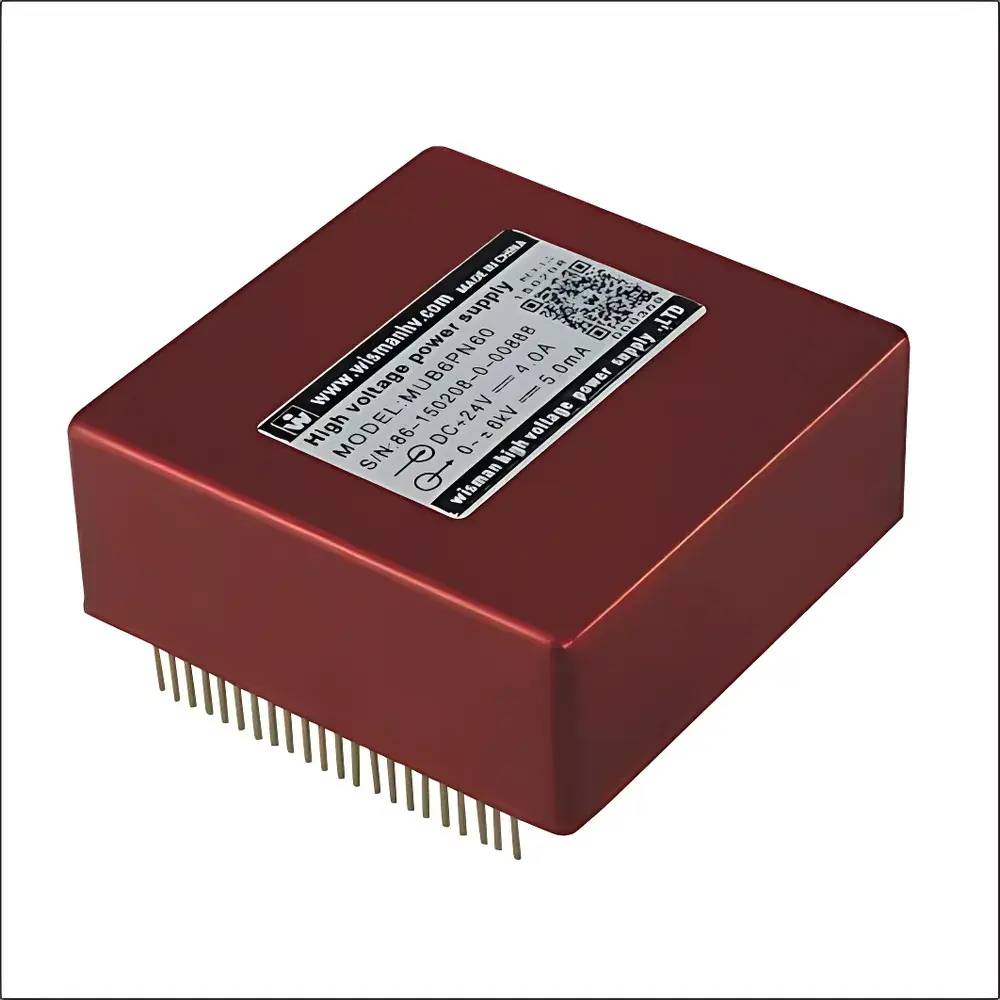
Wiseman MUB Series Dual-Output High-Voltage Power Module (6 kV, 60 W)
| Brand | Wiseman |
|---|---|
| Model | MUB |
| Output Voltage | ±0–6 kV (dual-channel, independently controllable) |
| Output Power | 2 × 30 W (60 W total) |
| Input | DC 24 V |
| Ripple | < 0.001% P-P |
| Stability | ≤ 0.001% over 8 hours |
| Temperature Coefficient | 15 ppm/°C |
| Protection | Arc detection, short-circuit protection |
| Mounting | PCB-mount (SMT-compatible) |
| Dimensions | 28.5 mm × 72.6 mm × 72.6 mm (H × W × D) |
| Operating Temperature | Industrial grade –25 °C to +65 °C (case temperature) |
| Compliance | Designed for OEM integration in analytical instrumentation per IEC 61010-1, EN 61326-1 (EMC), RoHS-compliant |
Overview
The Wiseman MUB Series is a dual-channel, printed circuit board (PCB)-mount high-voltage DC/DC power module engineered for precision OEM integration into analytical and scientific instrumentation. Each channel delivers independently regulated output voltages from 0 to ±6 kV, with up to 30 W per channel (60 W total), supporting flexible polarity configurations — dual positive, dual negative, or push-pull (one positive, one negative). Its architecture leverages zero-current resonant switching and advanced high-voltage insulation design to achieve exceptional stability, ultra-low output ripple (< 0.001% P-P), and minimal thermal drift (15 ppm/°C). Designed specifically for demanding applications such as mass spectrometry detector biasing, ion optics control, and pulsed high-voltage excitation, the MUB module meets the stringent electrical and mechanical requirements of laboratory-grade instrument manufacturers seeking compact, reliable, and repeatable HV sourcing.
Key Features
- Dual independent outputs: Each channel supports selectable polarity (±) and full 0–6 kV range, enabling both symmetrical and complementary high-voltage biasing
- High power density: 60 W total output in a compact 28.5 mm × 72.6 mm × 72.6 mm SMT-compatible footprint
- Ultra-stable regulation: ≤ 0.001% output variation over 8-hour continuous operation under constant load and ambient conditions
- Low-noise performance: Output ripple and noise < 0.001% peak-to-peak, critical for low-current detection systems and charge-sensitive amplifiers
- Robust protection suite: Integrated arc detection, current-limiting short-circuit protection, and automatic recovery
- Flexible control interface: Analog voltage (0–10 V) or potentiometer-based remote setpoint adjustment for each channel
- EMI-hardened construction: Six-sided mu-metal and conductive polymer shielding ensures immunity to external electromagnetic fields
- Wide operating envelope: Industrial-grade thermal rating (–25 °C to +65 °C case temperature) with optional extended-range variants (–40 °C to +95 °C)
- OEM-optimized design: Fully compatible with automated PCB assembly; no through-hole components; conformal coating available upon request
Sample Compatibility & Compliance
The MUB module is routinely integrated into mass spectrometers (e.g., TOF, quadrupole, and ion trap systems) requiring stable, low-noise detector or lens array biasing. It also supports semiconductor parameter analyzers, cable insulation testers, and electron multiplier supply chains where precise, isolated HV sourcing is mandatory. The module complies with IEC 61010-1 (Safety Requirements for Electrical Equipment for Measurement, Control, and Laboratory Use) and EN 61326-1 (EMC requirements for laboratory equipment). While not certified to FDA 21 CFR Part 11 by default, its analog control architecture and deterministic response support audit-trail-capable system-level validation when embedded in GLP/GMP-compliant instruments. RoHS 3 and REACH compliance are standard; halogen-free variants available for aerospace and medical OEMs.
Software & Data Management
As a hardware-only DC/DC module, the MUB does not include embedded firmware or digital communication interfaces (e.g., RS-232, USB, or CAN). However, its analog control inputs (0–10 V per channel) enable seamless integration with host instrument controllers running LabVIEW, Python-based DAQ frameworks, or proprietary FPGA-based timing engines. For traceable calibration and long-term stability monitoring, users may log input voltage setpoints, measured output currents (via external shunts), and ambient temperature against time using standard SCPI-compatible data acquisition systems. The module’s inherent stability eliminates need for real-time closed-loop feedback in most analytical applications — simplifying software architecture and reducing validation burden during regulatory submissions.
Applications
- Mass spectrometer detector and ion optic biasing (e.g., MCP, Faraday cup, einzel lens arrays)
- Capacitor charging and dielectric characterization test systems
- Pulsed-power supplies for laser-triggered switches and electrostatic precipitators
- High-voltage bias for photomultiplier tubes (PMTs) and avalanche photodiodes (APDs)
- Insulation resistance testing and partial discharge detection in R&D labs
- OEM integration into portable X-ray generators and compact particle accelerators
- Aging and burn-in systems for high-reliability electronic components
- Electrophoresis and electrospray ionization (ESI) source power delivery
FAQ
Is the MUB module suitable for use in FDA-regulated medical devices?
Yes — when integrated into a validated system architecture with appropriate risk management (ISO 14971) and design controls, the MUB’s safety certifications (IEC 61010-1), RoHS compliance, and long-term stability make it appropriate for Class II medical instruments requiring HV biasing.
Can both outputs be synchronized for timing-critical applications?
No — the MUB provides independent analog control per channel without built-in synchronization logic. Precise inter-channel timing must be managed externally via the host controller’s DAC outputs or FPGA-driven voltage ramps.
What is the maximum safe working voltage between outputs in push-pull mode?
When configured with opposite polarities (e.g., +6 kV and –6 kV), the potential difference reaches 12 kV. PCB layout must maintain ≥ 12 mm creepage/clearance between output traces per IEC 60664-1, and conformal coating is strongly recommended.
Does Wiseman provide calibration certificates or traceable metrology data?
Standard units ship without NIST-traceable calibration. However, Wiseman offers optional factory calibration with documented uncertainty budgets (±0.02% of reading, k=2) upon request for GxP-aligned deployments.
Is convection cooling sufficient, or is forced airflow required?
Natural convection is adequate at full 60 W load within the industrial temperature range, provided the module is mounted on a 2-oz copper PCB with ≥ 4 thermal vias per output pad and ≥ 10 cm² of adjacent copper pour. Forced air (>1 m/s) improves derating margin by ~15%.



