
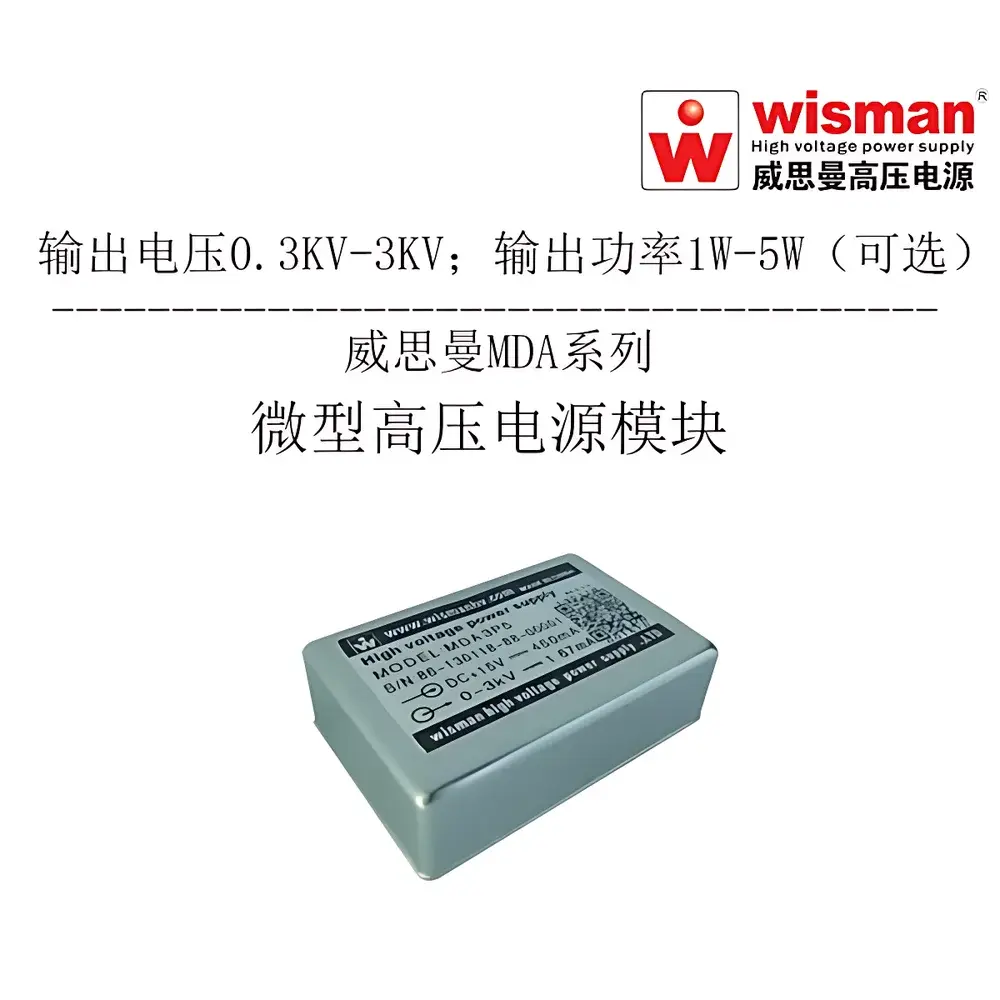

Wiseman MDC3kV/5W High-Voltage DC-DC Power Module
| Brand | Wiseman |
|---|---|
| Model | MDC3kV/5W |
| Output Voltage | 3 kV DC |
| Output Power | 5 W |
| Ripple & Noise | <0.001% P-P |
| Stability | ±0.001% per hour |
| Temp. Coefficient | ±0.001% / °C |
| Input | 15 VDC ±1 V, 450 mA typ. |
| Dimensions | 60 mm × 40 mm × 17 mm |
| Weight | 65 g |
| Operating Temp. (S-grade) | −10 °C to +50 °C (case) |
| Protection | Arc detection, short-circuit protection |
| Mounting | PCB-mountable, six-sided EMI shielding |
| Polarity | Selectable positive/negative output |
| Compliance | Designed for OEM integration in regulated instrumentation environments |
Overview
The Wiseman MDC3kV/5W is a compact, high-stability DC-DC high-voltage power module engineered for precision scientific and analytical instrumentation requiring clean, tightly regulated bias voltage. Based on zero-current resonant converter topology and proprietary high-voltage insulation design, the module delivers up to 3 kV DC output at 5 W continuous power with exceptional long-term stability and ultra-low electromagnetic interference. Its architecture eliminates line-frequency modulation artifacts and minimizes parasitic coupling—critical for applications where signal integrity, detector sensitivity, and baseline noise floor directly impact measurement fidelity. Designed from inception for OEM integration into mass spectrometers, electron optics systems, radiation detectors, and electrostatic control subsystems, the MDC series meets the stringent spatial, thermal, and electrical constraints of modern benchtop and embedded instrumentation platforms.
Key Features
- Output voltage programmable across standard options: 300 V, 500 V, 1 kV, 1.25 kV, 1.5 kV, 2 kV, 2.5 kV, and 3 kV DC—factory-configured per application requirement
- Ultra-low output ripple and noise: <0.001% peak-to-peak (measured over 20 MHz bandwidth), enabling stable bias for low-current sensing elements such as photomultiplier tubes and ionization chambers
- High short-term and long-term stability: ±0.001% per hour drift under constant thermal conditions; load regulation ±0.01%, line regulation ±0.001%
- Thermal coefficient of ≤±0.001% / °C ensures minimal voltage drift across operational temperature ranges
- Integrated arc detection and auto-recovery short-circuit protection—prevents damage during transient discharge events common in vacuum or gas-filled detector environments
- Flexible control interface: analog voltage setpoint (0–10 V) or external potentiometer; polarity-selectable output (positive or negative HV referenced to chassis ground)
- PCB-mountable form factor (60 mm × 40 mm × 17 mm) with six-sided mu-metal and conductive coating shielding for EMI/RFI suppression
- Multiple environmental grades available: Commercial (S), Industrial (G), and Extended (T) operating temperature ranges—validated per IEC 61000-6-2/6-4 for conducted/radiated emissions
Sample Compatibility & Compliance
The MDC3kV/5W is routinely integrated into instruments requiring stable, low-noise HV bias for charged-particle manipulation and detection—including quadrupole and time-of-flight mass spectrometers, scanning electron microscope (SEM) lens stacks, proportional counters, Geiger-Müller tubes, and electrostatic chucks used in semiconductor metrology. Its design adheres to fundamental safety and EMC requirements aligned with IEC 61010-1 (measurement/control/lab equipment) and supports system-level compliance with FDA 21 CFR Part 11 when deployed in validated analytical workflows. While the module itself carries no third-party certification mark, its construction—using reinforced insulation, creepage/clearance distances exceeding IPC-2221B Class B requirements, and UL94 V-0 rated encapsulation—enables straightforward incorporation into ISO 13485 or GMP-compliant instrument designs.
Software & Data Management
As a standalone analog-controlled module, the MDC3kV/5W does not incorporate digital communication interfaces or embedded firmware. Voltage setpoint, enable/disable, and fault status are managed via discrete analog and TTL-level signals—ensuring deterministic timing, immunity to protocol stack failures, and compatibility with legacy and real-time control architectures. For systems requiring audit-trail capability or remote calibration logging, integration is typically achieved through host instrument firmware that monitors input control voltage, reads auxiliary analog monitor outputs (e.g., 0–10 V proportional to actual HV), and logs timestamps alongside operational parameters. This architecture aligns with GLP and 21 CFR Part 11 data integrity principles when implemented with appropriate system-level access controls and electronic signature protocols.
Applications
- Mass spectrometry: Ion source acceleration, detector dynode chain biasing, and RF lens pre-bias networks
- Electron microscopy: Condenser and objective lens focusing, beam blanking electrodes, and Faraday cup biasing
- Nuclear instrumentation: PMT gain stabilization, ion chamber polarization, and scintillation detector anode biasing
- Electrophoresis and microfluidics: Electrokinetic pumping and capillary electrophoresis voltage drivers
- Industrial electrostatics: E-chuck clamping voltage, corona charging, and ESD test simulation modules
- Research infrastructure: Particle accelerator beamline steering elements, plasma diagnostics probes, and laser cavity Q-switching triggers
FAQ
Is the MDC3kV/5W suitable for use in FDA-regulated medical devices?
Yes—when integrated into a system designed and validated per FDA QSR (21 CFR Part 820) and IEC 62304, its analog control architecture, predictable failure modes, and robust insulation support Class II device certification pathways.
Can output polarity be reversed in-field?
No—polarity is fixed at manufacture (positive or negative output). Selection must be specified at order entry; dual-polarity variants require custom engineering.
Does Wiseman provide calibration certificates traceable to NIST?
Calibration documentation is available upon request for production lots; full NIST-traceable unit-level certificates require optional extended QA service at time of order.
What is the recommended derating for continuous operation at 45 °C ambient?
For S-grade units, full 5 W output is rated up to +50 °C case temperature; no derating required below that threshold when adequate PCB copper pour and airflow are maintained.
Are there agency safety certifications (UL, CE) for this module?
The MDC series is designed to meet applicable clauses of UL 61010-1 and EN 61010-1; end-equipment manufacturers are responsible for final system-level certification.



