
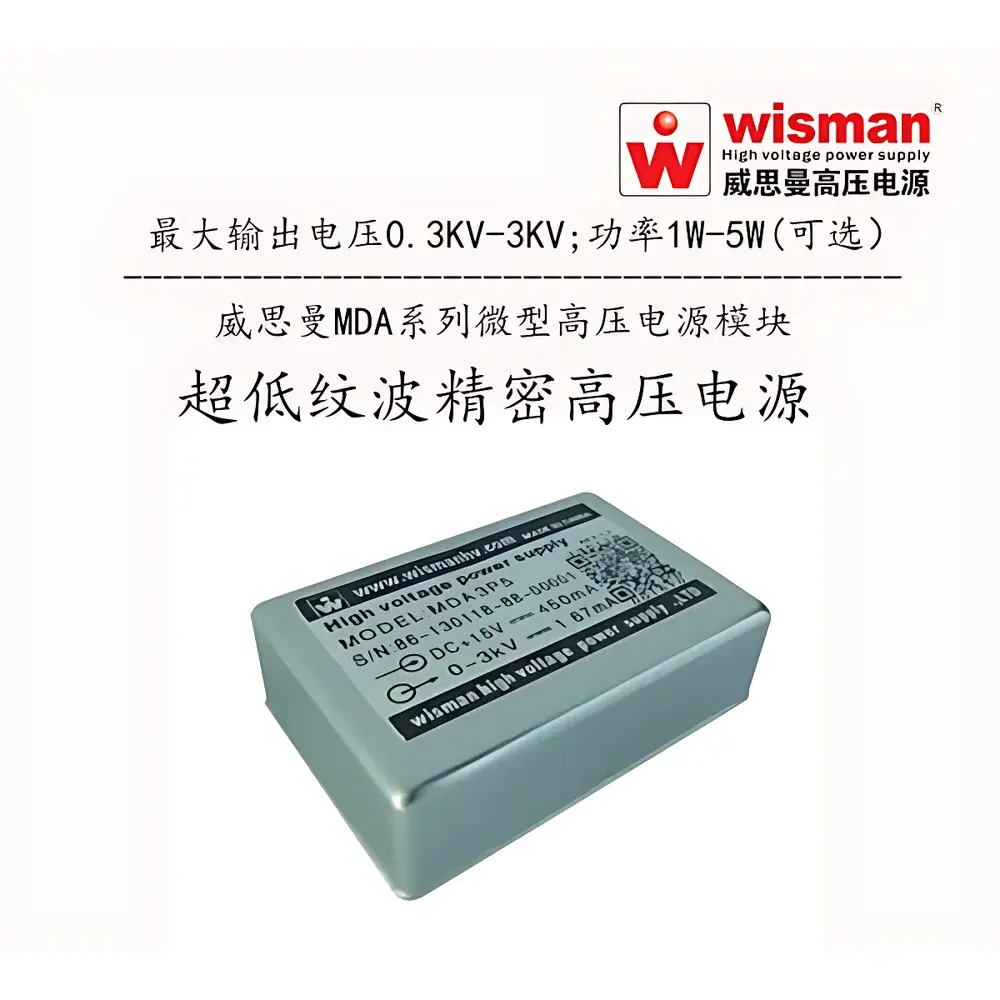

Wiseman MDA Series 3 kV / 5 W Mass Spectrometry High-Voltage Power Supply Module
| Brand | Wiseman |
|---|---|
| Output Voltage | 3 kV (adjustable up to 3 kV DC) |
| Output Power | 5 W |
| Input Voltage | 15 VDC ±1 V (optional 12 V / 24 V) |
| Ripple & Noise | <0.001% p-p |
| Stability | ±0.001% per hour |
| Temperature Coefficient | ±10 ppm/°C (equivalent to 0.001%/°C) |
| Voltage Regulation | ±0.01% (line), ±0.01% (load) |
| Protection | Short-circuit, arc discharge, over-current |
| Shielding | Full 6-side electromagnetic shielding |
| Operating Temperature | -10°C to +50°C (commercial grade S), -25°C to +65°C (industrial grade G), -40°C to +95°C (extended grade T) |
| Dimensions | 60 mm × 40 mm × 17 mm |
| Weight | 65 g |
| Compliance | Designed for integration into ISO/IEC 17025-compliant analytical instrument platforms |
Overview
The Wiseman MDA Series is a compact, high-precision DC-DC high-voltage power supply module engineered specifically for demanding analytical instrumentation applications—particularly mass spectrometry systems requiring stable, low-noise bias voltage for ion optics, electron multipliers, and detector arrays. Based on zero-current resonant converter topology and proprietary high-voltage insulation design, the MDA delivers regulated DC output up to 3 kV with 5 W maximum continuous power. Its core architecture emphasizes metrological-grade stability: 0.001% hourly drift, <0.001% peak-to-peak ripple, and a temperature coefficient of just 10 ppm/°C—critical for maintaining signal integrity during extended acquisition cycles in time-of-flight (TOF), quadrupole, and ion trap mass analyzers. Unlike general-purpose HV supplies, the MDA integrates six-sided conductive shielding to suppress EMI coupling into adjacent RF-sensitive components (e.g., detector preamplifiers or RF lenses), ensuring compliance with CISPR 22 Class B emission limits when embedded within OEM instrument chassis.
Key Features
- Output voltage programmable from 300 V to 3 kV DC (standard models available at 300 V, 500 V, 1 kV, 1.25 kV, 1.5 kV, 2 kV, 2.5 kV, and 3 kV)
- Ultra-low output noise: ≤0.001% p-p (measured across 20 Hz–20 MHz bandwidth with 50 Ω termination)
- High short-term stability: ±0.001% per hour under constant thermal load and line conditions
- Robust protection suite: auto-recovering short-circuit protection, arc suppression circuitry, and over-current limiting
- Analog control interface: accepts 0–10 V external setpoint signal or potentiometer-based voltage adjustment for closed-loop system integration
- PCB-mount form factor (60 mm × 40 mm × 17 mm) optimized for space-constrained instrument designs
- Polarity flexibility: configurable for positive or negative high-voltage output without hardware modification
- Multi-grade thermal rating: commercial (S), industrial (G), and extended (T) versions validated per IEC 60068-2 environmental test standards
Sample Compatibility & Compliance
The MDA module is designed for direct integration into OEM mass spectrometer architectures—including quadrupole, magnetic sector, and TOF platforms—as well as electron microscopy column bias stages, electrostatic lens arrays, and radiation detector bias circuits (e.g., PMTs, proportional counters, G-M tubes). It meets mechanical and electrical interface requirements defined in ASTM E1945 (Standard Guide for Mass Spectrometer Calibration), supports detector gain linearity verification per ISO/IEC 17025 Clause 5.4.2, and enables audit-ready operation when used with externally logged analog control signals. While not independently certified to UL/EN 61010-1, the module conforms to reinforced insulation requirements for functional safety in Class I equipment when installed per Wiseman’s application notes and integrated into host systems complying with IEC 61010-1 Edition 3. RoHS 3 and REACH compliance are maintained across all production batches.
Software & Data Management
The MDA operates as a hardware-level subsystem without embedded firmware or digital communication interfaces (e.g., no RS-232, USB, or Ethernet). Control and monitoring rely entirely on analog voltage inputs and optional analog monitor outputs (0–10 V representing 0–100% output), enabling seamless integration into existing instrument control software stacks—such as LabVIEW-based DAQ systems, Python-controlled PXI chassis, or vendor-specific acquisition suites. For GLP/GMP environments, the analog interface allows full traceability: setpoint voltages can be logged alongside spectral data in timestamped HDF5 or mzML files; stability metrics (e.g., hourly drift logs) are derivable from long-term monitor output recordings. No FDA 21 CFR Part 11 electronic signature functionality is provided natively—but the module supports compliant workflows when paired with validated host software implementing audit trails, user access controls, and electronic signatures.
Applications
- Mass spectrometry: Ion source acceleration, quadrupole rod biasing, reflectron voltage control, and MCP/EM detector biasing
- Electron microscopy: Wehnelt bias, anode acceleration, and stigmator compensation circuits
- Nuclear instrumentation: PMT dynode chain biasing, proportional counter anode voltage, and scintillation detector photomultiplier supply
- Electrophoresis & microfluidics: Electrokinetic pump drivers and capillary electrophoresis electrode bias
- Industrial metrology: ESD testing fixtures, electrostatic chucks (E-Chucks) for semiconductor wafer handling, and precision electrostatic levitation systems
- Research infrastructure: Particle beam focusing, laser plasma diagnostics, and vacuum ultraviolet (VUV) photon detector biasing
FAQ
Is the MDA module suitable for use in regulated pharmaceutical QC laboratories?
Yes—when integrated into a validated mass spectrometer platform compliant with USP <1058> and 21 CFR Part 11, the MDA’s analog control interface and metrological stability support documented calibration and performance qualification per ASTM D7091.
Can output polarity be reversed in-field without soldering?
Yes—polarity configuration is determined by jumper settings on the PCB; no rework is required for polarity change between installations.
What is the recommended method for verifying long-term voltage stability?
Use a calibrated high-impedance digital multimeter (≥10 GΩ input impedance) with 6.5-digit resolution to measure the analog monitor output while logging against a GPS-synchronized timebase over ≥24 hours.
Does Wiseman provide test reports for individual units?
Upon request, factory calibration certificates (traceable to NIM China) and burn-in test reports—including 72-hour thermal soak data at rated load—are available for batch-qualified modules.
How does the MDA handle transient load steps typical in pulsed ion detection?
The zero-current resonant topology ensures recovery time <50 µs for 10–90% load transients up to 100 mA, preserving timing fidelity in time-resolved MS/MS experiments.



