
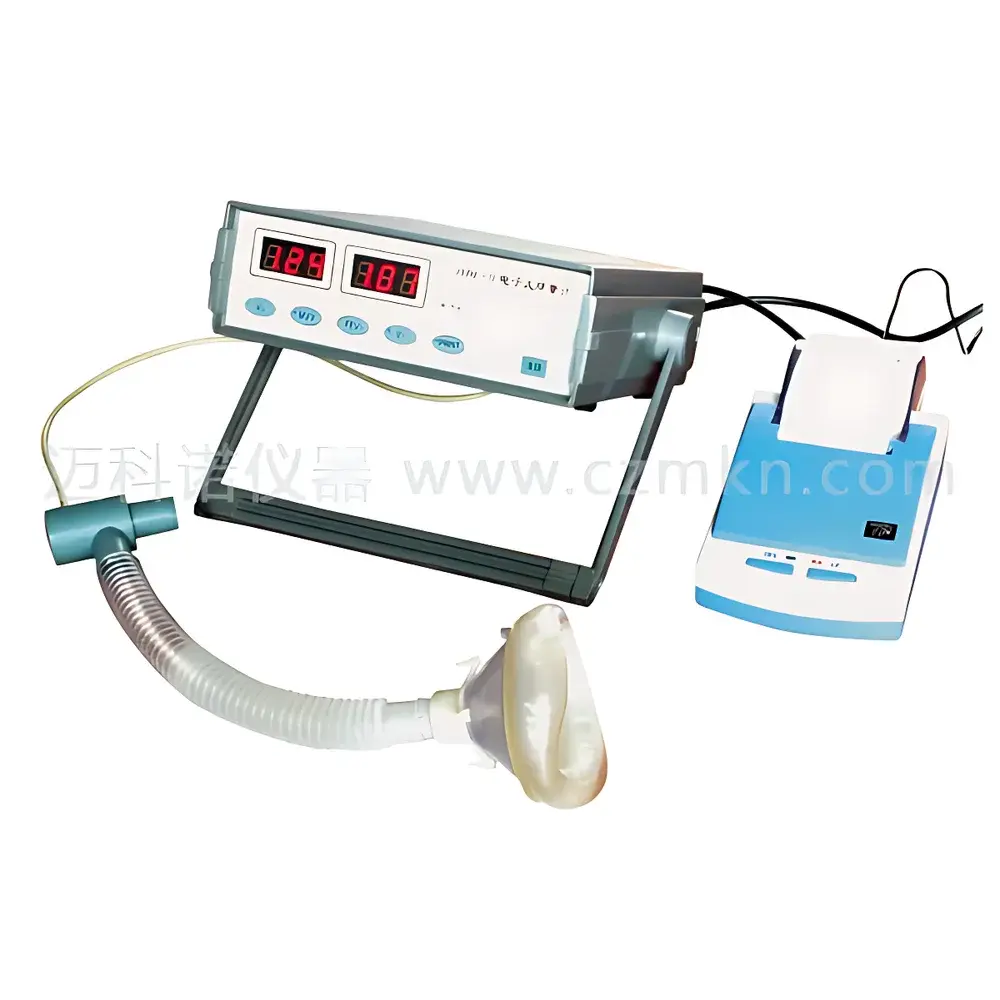
DF-II Digital Spirometer with Integrated Thermal Micro-Printer
| Origin | Zhejiang, China |
|---|---|
| Manufacturer Type | Authorized Distributor |
| Origin Classification | Domestic (China) |
| Model | DF-II |
| Price | USD 1,240 (FOB Zhejiang) |
| Max Instantaneous Flow Rate | 300 L/min |
| Flow Range | 20–250 L/min |
| Vital Capacity Range | 0–9.99 L |
| Tidal Volume Range | 0.10–2.00 L |
| MVV Range | 0–200 L/min |
| FEV₁ Range | 0–5.00 L |
| Accuracy | ≤ ±5% FS across all pulmonary parameters |
| Operating Temperature | 5–40 °C |
| Relative Humidity | ≤80% RH |
| Power Supply | AC 220 V ±10%, 50/60 Hz or Rechargeable Internal Battery |
| Power Consumption | ≤6 W |
Overview
The DF-II Digital Spirometer with Integrated Thermal Micro-Printer is a compact, portable clinical spirometry device engineered for reliable measurement of key respiratory parameters in point-of-care, occupational health, sports medicine, and primary care settings. It operates on the principle of infrared photoelectric flow sensing—utilizing a non-contact, drift-free optical transducer to detect real-time airflow velocity across a laminar flow path. This sensor architecture ensures high sensitivity, low hysteresis, and excellent repeatability under dynamic breathing conditions—including forced expiratory maneuvers and variable tidal patterns. Unlike mechanical turbine or pneumotachograph-based systems, the infrared sensor eliminates moving parts, reducing calibration drift and maintenance requirements. The instrument processes raw flow signals via an embedded low-power microcontroller (ARM Cortex-M series), applying real-time numerical integration to derive volume metrics (VC, VT, FEV₁, MVV) in accordance with ATS/ERS 2005 and 2022 spirometry standardization guidelines. All measurements are displayed on a high-contrast LED screen with 0.01-L resolution and simultaneously stored in internal memory (≥1,000 test records) for later export.
Key Features
- Infrared photoelectric flow sensor with no moving parts—ensures long-term stability and minimal zero drift over repeated use
- Integrated thermal micro-printer (58 mm width) supporting immediate hard-copy output of full spirometric reports, including time-volume and flow-volume curves
- Dual power operation: AC mains (220 V ±10%) or built-in rechargeable Li-ion battery (up to 8 hours continuous use per charge)
- Compliance-ready data handling: Each printed report includes date/time stamp, operator ID field, patient ID input, and test mode indicator (e.g., “FVC”, “SVC”, “MVV”)
- Front-panel membrane switch interface with tactile feedback—designed for glove-compatible operation in clinical environments
- Low power consumption (≤6 W) enables deployment in mobile clinics, school health screenings, and field-based occupational surveillance programs
Sample Compatibility & Compliance
The DF-II is validated for use with adult and pediatric populations (ages ≥6 years) using standardized disposable mouthpieces and bacterial/viral filters compliant with ISO 10993-5 and EN 14683:2019 Class IIa requirements. Its measurement accuracy (≤±5% FS across VC, FEV₁, VT, and MVV) meets the minimum performance thresholds defined in ISO 26782:2021 (Respiratory function—Spirometers) and aligns with the acceptability criteria outlined in ATS/ERS 2022 technical standards for office-based spirometry. While not certified for FDA 510(k) or CE Marking under IVDR, the device conforms to general electrical safety requirements per GB 9706.1–2020 (equivalent to IEC 60601-1:2012) and electromagnetic compatibility per GB/T 18268.1–2010. Data integrity is supported by write-once internal memory storage; however, the system does not implement audit trail, electronic signature, or 21 CFR Part 11 compliance features required for regulated GCP or GLP studies.
Software & Data Management
The DF-II operates as a standalone unit without external PC dependency. All data acquisition, calculation, and display occur onboard. Test results—including raw flow-time data points (sampled at 100 Hz), derived volumes, and graphical curve previews—are retained in non-volatile flash memory. A USB 2.0 port (Type-B) enables optional firmware updates and bulk data export in CSV format for post-hoc analysis in third-party software (e.g., MATLAB, Excel, or dedicated pulmonary analytics platforms). No proprietary desktop application is provided; exported files follow ANSI/ISO-compliant column headers (e.g., “Time_s”, “Flow_L_per_s”, “Volume_L”). The thermal printer generates permanent, tamper-evident records suitable for inclusion in paper-based medical charts or occupational health dossiers.
Applications
- Primary care screening for obstructive and restrictive ventilatory defects—particularly in rural or resource-constrained clinics lacking access to full pulmonary function laboratories
- Pre-employment and periodic occupational lung function surveillance for workers exposed to dust, fumes, or respirable aerosols (e.g., mining, construction, textile manufacturing)
- Sports physiology monitoring—tracking longitudinal changes in VC and MVV during endurance training cycles or rehabilitation protocols
- Elderly wellness assessments—evaluating age-related decline in respiratory reserve and detecting early signs of COPD progression
- Preoperative pulmonary risk stratification—supporting ASA physical status classification and identifying patients requiring pre-anesthetic optimization
FAQ
Does the DF-II support Bluetooth or Wi-Fi connectivity for wireless data transfer?
No. The device communicates exclusively via USB 2.0 for data export; no wireless modules are integrated.
Is calibration traceable to national standards?
The unit includes a factory calibration certificate referenced to NIM (National Institute of Metrology, China) traceable flow standards. Field recalibration requires a certified dry gas meter (e.g., Collins or Hans Rudolph) and must be performed annually or after impact damage.
Can the thermal printer accommodate custom header information (e.g., clinic logo or physician name)?
No. The printer outputs fixed-format reports with user-input fields only for Patient ID, Operator ID, and Test Date/Time.
What is the expected service life of the infrared flow sensor?
Under normal clinical use (≤50 tests/day), the sensor maintains specification compliance for ≥5 years or 50,000 actuations, as verified by accelerated lifetime testing per GB/T 2423.22–2012.
Are replacement mouthpieces and filters available through the distributor?
Yes. Sterile, single-use mouthpieces (polypropylene, ISO 594-1 compliant) and hydrophobic viral filters (0.3 µm pore size, 99.99% efficiency) are stocked and supplied with batch-specific CoA documentation.





