
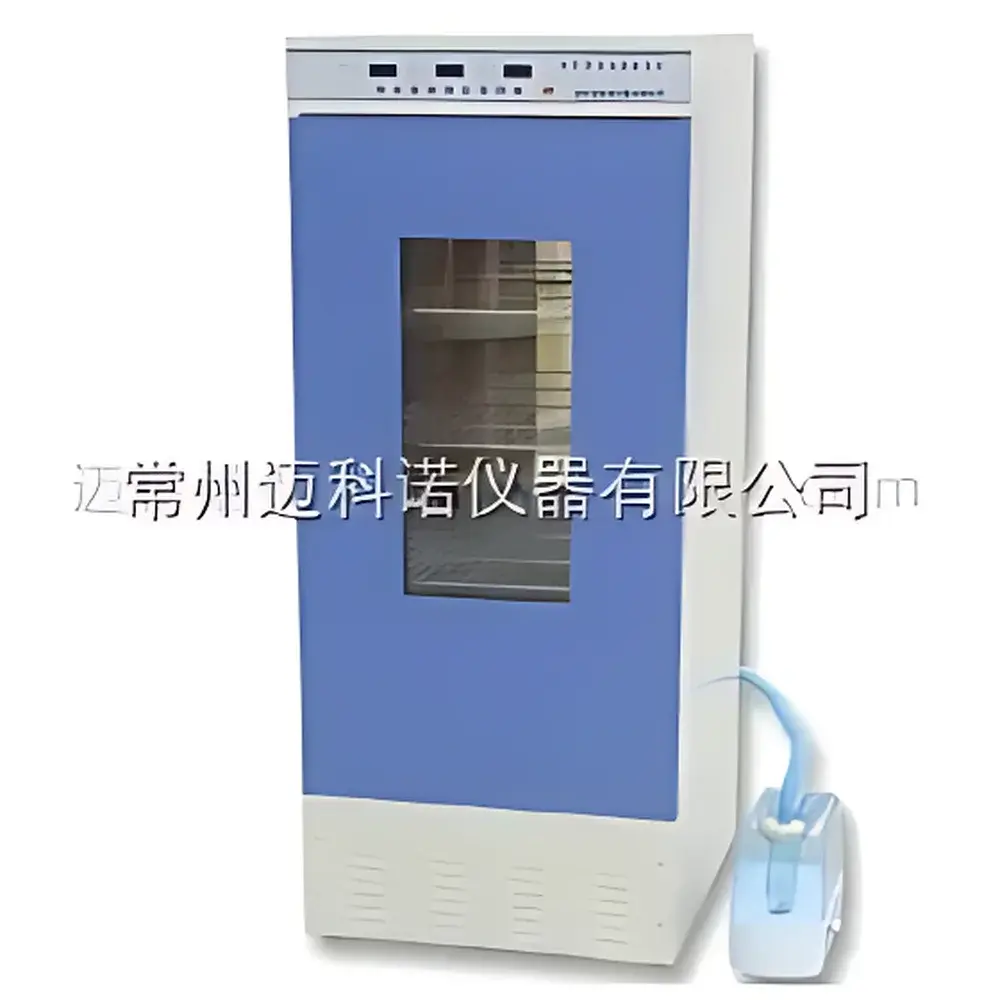
MKN MJX-250 Mold Incubator
| Brand | MKN |
|---|---|
| Model | MJX-250 |
| Capacity | 250 L |
| Temperature Range | 5–50 °C |
| Temperature Uniformity | ±1 °C |
| Humidity Range | 45–90 %RH |
| Humidity Control Accuracy | ±5 %RH |
| Power Supply | AC 220 V ±10%, 50 Hz ±2% |
| Operating Environment | 0–40 °C, ≤85 %RH (non-condensing) |
| UV Sterilization | Integrated ultraviolet lamp |
| Insulation | Polyurethane foam |
| Chamber Material | Stainless steel interior, powder-coated carbon steel exterior |
| Viewing Window | Double-glazed tempered glass door |
| Lighting | Internal LED illumination |
| Protection Features | Compressor delay start, power interruption recovery |
Overview
The MKN MJX-250 Mold Incubator is a precision-controlled environmental chamber engineered for reliable long-term cultivation of filamentous fungi, yeasts, and other moisture-sensitive microorganisms requiring stable temperature and humidity conditions. Unlike general-purpose incubators, this unit integrates dual independent control loops for temperature and relative humidity—critical for mycological studies where hyphal growth, sporulation kinetics, and colony morphology are highly sensitive to ambient vapor pressure. The system operates on a forced-air convection principle with an optimized air distribution manifold, ensuring spatial homogeneity across the full 250 L working volume. Its design complies with fundamental laboratory infrastructure requirements for GLP-aligned microbiological testing, including controlled environment validation per ISO 14644-1 (cleanroom classification) and operational stability under continuous duty cycles.
Key Features
- Dual-parameter microprocessor-based control system with LED digital display for real-time monitoring of temperature (5–50 °C) and relative humidity (45–90 %RH).
- Integrated germicidal UV-C lamp (254 nm) mounted inside the stainless steel chamber, enabling periodic decontamination between culture runs without disassembly.
- High-efficiency polyurethane foam insulation (≥50 mm thickness) minimizing thermal bridging and reducing energy consumption during extended operation.
- Double-glazed tempered glass observation door with anti-fog coating, permitting non-invasive visual inspection while maintaining internal environmental integrity.
- Internally mounted LED lighting system with switchable activation—designed to avoid spectral interference with photobiological assays or light-sensitive fungal strains.
- Compressor protection circuitry featuring automatic delay restart (3-minute interval) and brownout recovery logic to prevent mechanical stress during grid fluctuations.
- Robust chamber construction: electropolished 304 stainless steel interior (Ra ≤ 0.8 µm surface finish) and static-dissipative epoxy-powder-coated carbon steel outer casing.
Sample Compatibility & Compliance
The MJX-250 accommodates standard microbiological consumables—including Petri dishes (up to 150 mm diameter), multi-well plates, slant tubes, and agar-filled Erlenmeyer flasks—within its adjustable stainless steel shelving system (3 shelves, load capacity ≥15 kg/shelf). Its humidity control architecture avoids direct water-contact humidification; instead, it employs a heated evaporation reservoir with feedback-regulated airflow, eliminating condensation risks on sample surfaces. The unit meets baseline safety standards per IEC 61010-1:2010 (Laboratory Equipment Safety) and electromagnetic compatibility per EN 61326-1:2013. While not certified for ISO 13485 or FDA 21 CFR Part 11 out-of-the-box, its data logging interface supports external validation protocols required for regulated environments in pharmaceutical QC labs or clinical microbiology departments.
Software & Data Management
The MJX-250 operates via embedded firmware without proprietary software dependencies. All setpoints, real-time readings, and alarm events are logged internally (non-volatile memory, 30-day buffer) and accessible via front-panel navigation. Optional RS-485 Modbus RTU output enables integration into centralized building management systems (BMS) or LIMS platforms for audit-trail generation. When paired with third-party SCADA tools (e.g., Ignition, LabVIEW), users may configure automated reporting of temperature/humidity excursions exceeding user-defined thresholds—supporting compliance with ISO/IEC 17025 clause 7.7 (monitoring of environmental conditions) and USP recommendations for microbial growth chamber qualification.
Applications
- Mycological taxonomy and strain preservation under defined water activity (aw) conditions.
- Antifungal susceptibility testing (AFST) per CLSI M38-A3 guidelines, where incubation at 35 °C ± 1 °C and 70 %RH ± 5 %RH is specified for dermatophytes.
- Environmental monitoring of HVAC systems using settle plate and air sampling methods per ISO 14698-1.
- Biodegradation studies of polymers and coatings exposed to controlled mold challenge (ASTM G21, ISO 846).
- Educational use in undergraduate microbiology laboratories for comparative fungal growth kinetics experiments.
- Regulatory stability testing of medical devices per ISO 11137 (bioburden assessment under accelerated humidity stress).
FAQ
What is the maximum allowable ambient temperature for continuous operation?
The unit is rated for uninterrupted service at ambient temperatures up to 40 °C, provided relative humidity remains below 85 %RH and ventilation clearance (≥10 cm on all sides) is maintained.
Does the MJX-250 support programmable ramp-hold profiles?
No—the controller implements only static setpoint regulation. For time-dependent environmental sequencing, external programmable logic controllers (PLCs) must be interfaced via Modbus.
Can the UV lamp operate simultaneously with temperature/humidity control?
Yes, but UV exposure is manually initiated and automatically terminates after 30 minutes to prevent ozone accumulation and polymer degradation of chamber components.
Is calibration documentation included with shipment?
A factory-issued calibration certificate (traceable to NIM, China) covering temperature and humidity sensors is provided. Users are responsible for periodic re-calibration per ISO/IEC 17025 requirements.
What maintenance intervals are recommended for optimal performance?
Evaporator tray cleaning every 2 weeks; UV lamp replacement annually; condenser coil inspection quarterly; door gasket integrity verification semiannually.




