FA Series Analytical Electronic Balance
| Origin | Zhejiang, China |
|---|---|
| Manufacturer Type | Authorized Distributor |
| Product Origin | Domestic (China) |
| Model | FA Series |
| Price Range | USD 700 – 1,120 |
| Instrument Type | Analytical Balance |
| Capacity | 100 g / 200 g |
| Readability | 0.1 mg (0.0001 g) |
| Repeatability | ≤ ±0.0001 g |
| Linearity Error | ±0.0003 g |
| Stabilization Time | ≤ 8 s |
| Minimum Weight | 0.0008 g |
| Sensor Technology | Electromagnetic Force Compensation |
| Pan Diameter | Φ80 mm |
| Draft Shield | Sliding Triple-Door Glass Enclosure (240 × 190 × 265 mm) |
| Operating Temperature | 17.0–25.5 °C |
| Display | Backlit LCD with 0.1–0.4 s refresh rate |
| Tare Range | 0–100 g / 0–200 g |
| Calibration | Internal/External (100 g / 200 g standard weights) |
| Connectivity | RS232 serial interface |
| Power Supply | AC 220 V ±12 V, 50 Hz, 600 mA |
| Housing Material | Precision Die-Cast Aluminum |
| Net Weight | 7.8 kg |
| Gross Weight | 11 kg |
| Package Dimensions (Inner/Outer) | 415 × 285 × 430 mm / 475 × 315 × 485 mm |
Overview
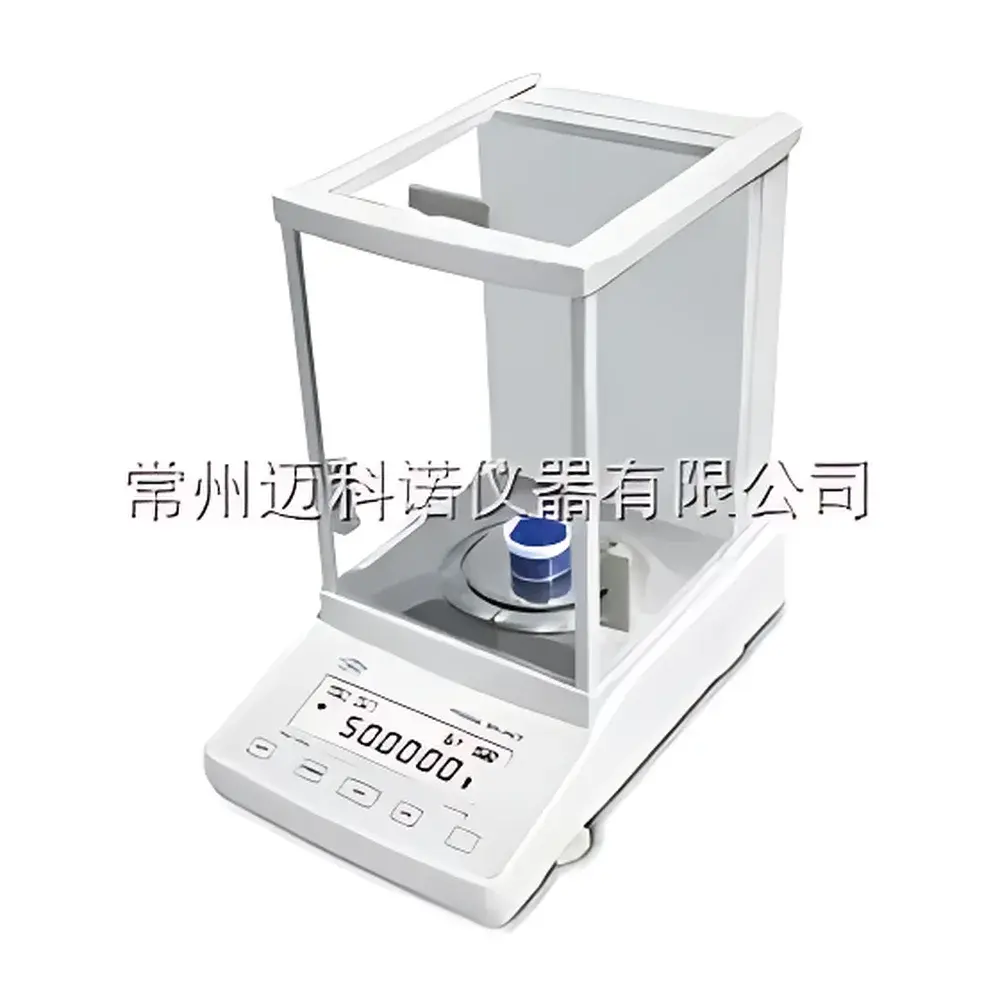
The FA Series Analytical Electronic Balance is a high-precision mass measurement instrument engineered for routine and regulated laboratory applications requiring accuracy at the 0.1 mg readability level. Built upon electromagnetic force compensation (EMFC) sensor technology, it delivers stable, drift-resistant measurements by generating a counteracting electromagnetic field proportional to the applied load—eliminating mechanical wear and enabling long-term calibration stability. Unlike strain-gauge or capacitive load cells, EMFC architecture ensures linearity across the full capacity range (100 g or 200 g), with documented linearity error of ±0.0003 g and repeatability ≤ ±0.0001 g under controlled environmental conditions (17.0–25.5 °C). The balance features a die-cast aluminum housing for thermal and mechanical stability, coupled with a triple-door sliding glass draft shield (240 × 190 × 265 mm) that minimizes air turbulence while maintaining unobstructed operator visibility and ergonomic access. Its five-key intuitive interface—ON, OFF, CAL, PRINT, and directional TARE—supports rapid operation without menu navigation overhead, making it suitable for high-throughput QC environments and teaching laboratories alike.
Key Features
- Electromagnetic force compensation (EMFC) transducer delivering 0.1 mg readability with ≤8 s stabilization time
- Dual-capacity models: FA1004 (100 g / 0.0001 g) and FA2004 (200 g / 0.0001 g), both with identical resolution and metrological performance
- Triple-door sliding glass draft shield optimized for airflow management and user ergonomics
- Backlit LCD display with selectable refresh rates (0.1–0.4 s) to balance responsiveness and readability
- Auto-tare function with full-range tare capability (0–100 g or 0–200 g)
- Overload protection and visual/audible overload warning system
- Multi-unit conversion (g, oz, ct) and built-in piece-counting mode with statistical summary
- RS232 serial port compliant with standard ASCII protocol for direct connection to PCs, printers, or LIMS
- Internal diagnostics including sensitivity drift monitoring (±0.0005 g over 24 h) and temperature compensation
Sample Compatibility & Compliance
The FA Series accommodates standard analytical samples in crucibles, weighing boats, vials, and filter papers—compatible with ISO/IEC 17025-compliant weighing procedures when operated within its specified temperature range (17.0–25.5 °C) and humidity limits (<80 % RH non-condensing). Its minimum weight (0.0008 g) satisfies USP requirements for analytical balance qualification when used with appropriate reference standards. While not pre-certified to FDA 21 CFR Part 11, the balance supports audit-ready workflows via timestamped RS232 data export, manual calibration logs, and external weight traceability (100 g or 200 g Class M2 or better certified砝码). The enclosure design meets ISO 9001 and GLP documentation prerequisites for environmental control during critical weighings.
Software & Data Management
Data output is transmitted via RS232 using standard ASCII framing (9600 baud, 8N1), enabling seamless integration with third-party laboratory software—including Excel-based templates, custom Python scripts, or enterprise LIMS platforms. Each transmission includes weight value, unit, timestamp (if host-provided), and status flags (e.g., “STABLE”, “OVERLOAD”). No proprietary drivers or cloud dependencies are required. For regulatory environments, users may configure external logging systems to capture calibration events, tare actions, and print outputs—supporting ALCOA+ principles (Attributable, Legible, Contemporaneous, Original, Accurate) when paired with procedural controls.
Applications
- Pharmaceutical formulation: Active pharmaceutical ingredient (API) dispensing, excipient ratio verification, and tablet content uniformity testing
- Chemical synthesis: Stoichiometric reagent weighing, catalyst loading, and yield calculation
- Materials science: Powder density determination, coating thickness validation via mass-thickness correlation
- Environmental testing: Filter mass change analysis for particulate matter (PM2.5/PM10) gravimetric assays
- Academic instruction: Teaching fundamental metrology concepts including uncertainty propagation, calibration hierarchy, and measurement traceability
- Food & beverage QA: Nutrient labeling compliance, moisture loss tracking, and blend homogeneity assessment
FAQ
What calibration standards are recommended for external calibration?
Class M2 or better certified weights (e.g., ASTM E617 or OIML R111) matching the balance’s capacity (100 g or 200 g) are required for traceable calibration.
Is internal calibration available?
No—the FA Series relies on external calibration; however, its EMFC sensor exhibits low long-term drift, reducing recalibration frequency under stable lab conditions.
Can the balance operate outside the specified temperature range?
Operation outside 17.0–25.5 °C may increase linearity deviation and extend stabilization time; temperature-compensated models are not offered in this series.
Does the RS232 interface support bidirectional communication?
No—it is transmit-only; commands (e.g., tare, print) must be initiated locally via front-panel keys.
How is minimum weight determined for GxP applications?
Per USP , minimum weight = 10 × repeatability (here, 10 × 0.0001 g = 0.001 g); the stated 0.0008 g reflects conservative instrument-specific validation under ideal conditions.