
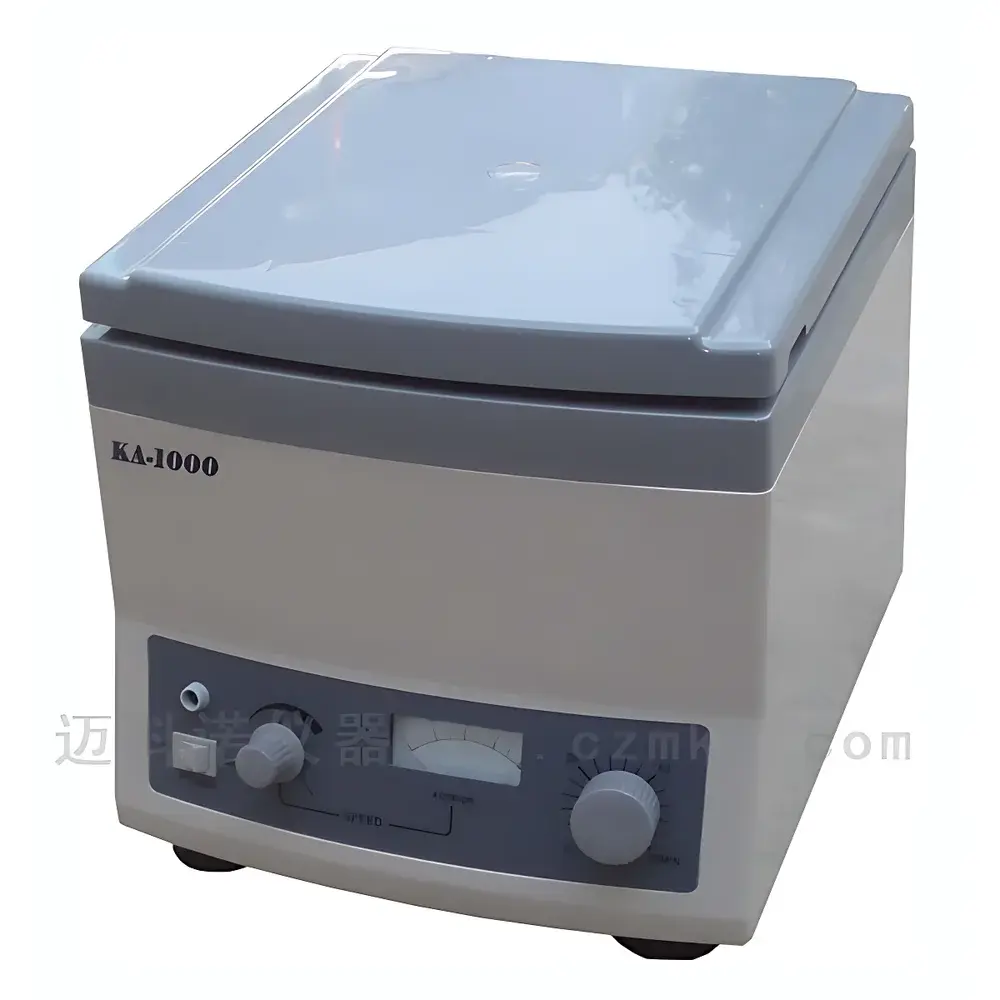
MKN KA-1000 Benchtop Low-Speed Centrifuge
| Brand | MKN |
|---|---|
| Model | KA-1000 |
| Max Speed | 0–4000 rpm |
| Relative Centrifugal Force (RCF) | 2325 × g |
| Capacity | 12 × 20 mL (or 12 × 15 mL) |
| Timer Range | 0–60 min |
| Power | 135 W |
| Noise Level | ≤60 dB(A) |
| Supply | AC 220 V, 50 Hz, 2 A |
| Rotor Material | Anodized Aluminum |
| Drive System | Dedicated Brushed DC Motor |
| Safety Features | Mechanical Lid Interlock, Dual Fuse Protection, Imbalance Detection Circuit |
| Display | Analog Speed Indicator + Graduated Timer Dial |
| Compliance | Designed per IEC 61010-1 (Safety Requirements for Electrical Equipment for Measurement, Control, and Laboratory Use) |
Overview
The MKN KA-1000 Benchtop Low-Speed Centrifuge is an engineered solution for routine sedimentation and phase separation tasks in life science, clinical, pharmaceutical, and environmental laboratories. Operating on the principle of centrifugal force generation via rotational acceleration, this instrument separates components of heterogeneous liquid mixtures—such as whole blood, cell suspensions, precipitated proteins, or particulate-laden reagents—based on differences in density, size, and shape. With a maximum rotational speed of 4000 rpm and an RCF of 2325 × g, the KA-1000 delivers reproducible, low-shear separation ideal for fragile biological matrices where high-speed or ultracentrifugation would induce denaturation or aggregation. Its compact footprint, low acoustic emission (<60 dB), and mechanical simplicity make it suitable for shared lab environments, teaching facilities, and quality control workflows requiring consistent, operator-independent sample preparation.
Key Features
- Robust anodized aluminum rotor with 12-position capacity for 15 mL or 20 mL conical tubes—optimized for standard polypropylene and glass centrifuge vessels.
- Dedicated brushed DC motor provides smooth torque delivery across the full 0–4000 rpm range, enabling precise low-speed sedimentation without overshoot or oscillation.
- Mechanically interlocked lid ensures automatic power cutoff upon opening, meeting IEC 61010-1 requirements for operator safety during operation.
- Integrated imbalance detection circuit halts rotation immediately if mass asymmetry exceeds safe thresholds—preventing bearing wear and rotor deformation.
- Analog speed indicator with calibrated dial and mechanical timer (0–60 min) offer intuitive, non-digital control—eliminating firmware dependencies and reducing calibration complexity.
- Dual fuse protection (main supply + motor circuit) enhances electrical fault resilience and supports long-term reliability under repeated thermal cycling.
Sample Compatibility & Compliance
The KA-1000 accommodates common laboratory tube formats including 15 mL and 20 mL conical centrifuge tubes (e.g., Falcon® 352095, Corning® 430775), as well as standard glass test tubes up to 20 mm diameter. It is compatible with aqueous buffers, saline solutions, serum, plasma, bacterial lysates, and food homogenates—provided samples remain within defined viscosity and density limits for low-speed sedimentation (≤1.2 g/mL, <10 cP). The device conforms to IEC 61010-1:2010 for electrical safety in laboratory equipment and includes documentation supporting GLP-aligned installation qualification (IQ) and operational qualification (OQ) protocols. While not certified to ISO 13485 or FDA 21 CFR Part 11, its analog interface and deterministic mechanical timing facilitate audit-ready recordkeeping in regulated QC environments when paired with lab notebook entries or external time-stamped log sheets.
Software & Data Management
The KA-1000 operates without embedded software or digital connectivity—intentionally designed to minimize validation burden in GxP-regulated settings. All operational parameters (speed, time) are set manually and recorded externally, eliminating concerns related to electronic record integrity, cybersecurity, or firmware version control. This architecture aligns with Annex 11 principles by removing electronic data capture points that would otherwise require validation of audit trails, user access controls, or change management systems. For labs requiring traceability, integration with LIMS is achieved through manual entry or barcode-scanned run logs synchronized with sample identifiers. No proprietary drivers, cloud services, or remote diagnostics are implemented—ensuring full operational transparency and long-term maintenance predictability.
Applications
- Pre-analytical processing of whole blood into serum or plasma fractions prior to ELISA, immunoassay, or clinical chemistry analysis.
- Sedimentation of cultured mammalian or microbial cells for harvesting, washing, or lysis buffer exchange.
- Clarification of crude enzyme extracts, antigen preparations, or vaccine intermediates where thermal or shear stress must be minimized.
- Separation of suspended solids from food extracts, wastewater samples, or soil leachates during environmental monitoring.
- Standardized pelleting in academic teaching labs for demonstrating sedimentation kinetics, Stoke’s law, and density gradient fundamentals.
FAQ
What is the maximum relative centrifugal force (RCF) achievable with the KA-1000?
The KA-1000 generates a peak RCF of 2325 × g at 4000 rpm with the standard 12-place rotor loaded symmetrically with 15 mL tubes.
Does the centrifuge support rotor autoclaving?
No—the anodized aluminum rotor is not autoclavable. Cleaning is performed using ethanol or isopropanol wipes; chemical sterilization with oxidizing agents (e.g., sodium hypochlorite) is not recommended.
Can I use this centrifuge for blood banking applications?
Yes, provided centrifugation parameters comply with CLSI GP44-A6 guidelines for platelet-poor plasma preparation (e.g., 1500 × g for 15 min at room temperature).
Is the timer programmable in seconds?
No—the mechanical timer is graduated in 1-minute increments only, consistent with routine clinical and QC workflows requiring coarse temporal resolution.
What safety certifications does the KA-1000 carry?
It complies with IEC 61010-1:2010 for laboratory electrical safety. CE marking is not affixed; users should verify regional conformity requirements prior to deployment.



