
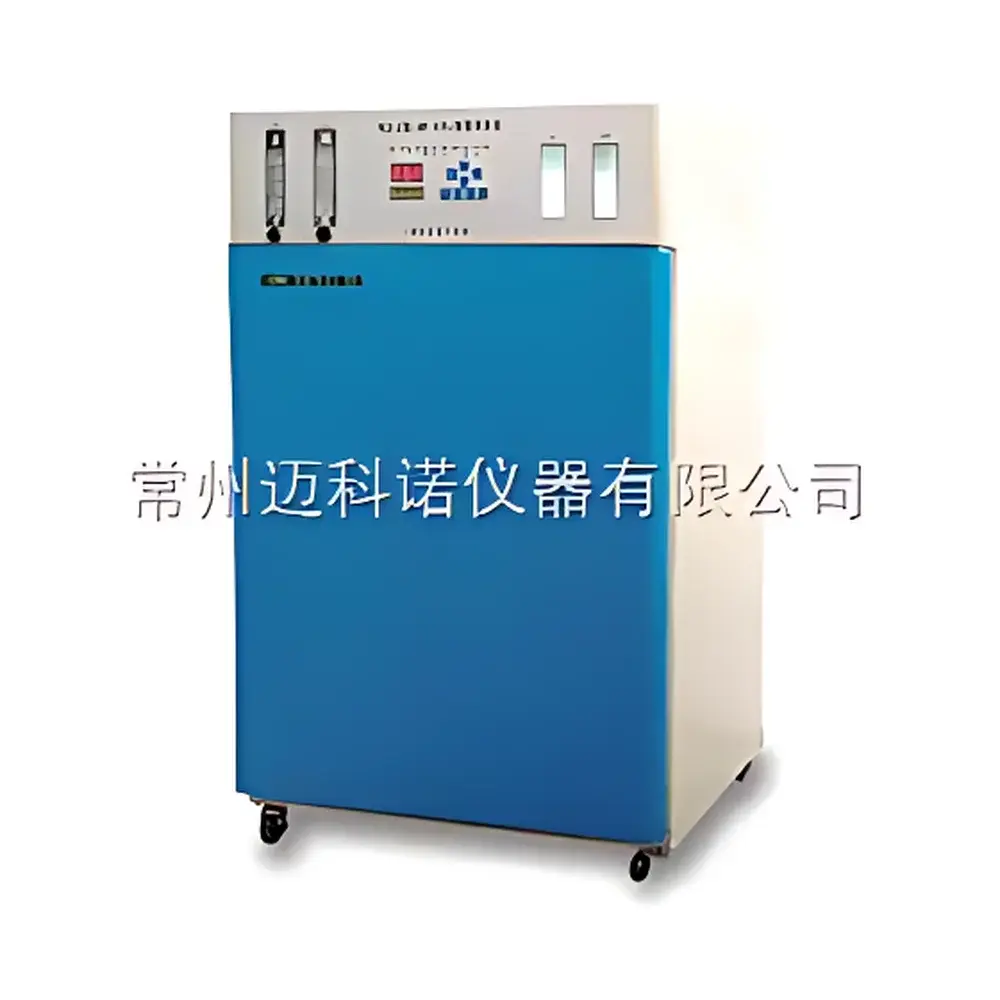
MKN CHP-160 Water-Jacketed CO₂ Incubator
| Brand | MKN |
|---|---|
| Model | CHP-160 |
| Type | Water-jacketed CO₂ incubator |
| Chamber Volume | 160 L |
| Temperature Control Range | Ambient +5°C to 60°C |
| Temperature Accuracy | ±0.3°C at 37°C |
| Temperature Resolution | 0.1°C |
| CO₂ Concentration Range | 0–20% (v/v) |
| CO₂ Accuracy | ±0.1% (v/v) |
| CO₂ Uniformity | ±0.1% at 5% setpoint |
| CO₂ Recovery Time | ≤1.2 × setpoint (min) |
| Heating Method | Water jacket |
| Humidification | Natural evaporation |
| Power Consumption | 950 W |
| Internal Dimensions (W×D×H) | 500×500×650 mm |
| External Dimensions (W×D×H) | 650×610×990 mm |
| Standard Shelving | 2 stainless steel trays |
| Working Ambient Temperature | 5–35°C |
| Power Supply | 220 V, 50 Hz |
| Construction | Stainless steel inner chamber with seamless argon arc welding, fully rounded corners |
| CO₂ Filtration | Dual-stage gas filtration (particulate + hydrocarbon) |
| Door Heating | Integrated anti-condensation heating element |
| Alarm System | Audible/visual alarms for CO₂ deviation, temperature excursion, and door open |
Overview
The MKN CHP-160 is a precision-engineered, water-jacketed CO₂ incubator designed for reliable, long-term cultivation of mammalian cells, primary tissues, hybridomas, stem cells, and sensitive microbial strains under tightly controlled physiological conditions. It operates on the principle of maintaining a stable humidified atmosphere enriched with carbon dioxide—typically 5% (v/v)—to buffer culture media pH via the bicarbonate/CO₂ equilibrium system. The water-jacketed thermal architecture provides superior thermal inertia and spatial uniformity compared to air-jacketed alternatives, minimizing temperature fluctuations during door openings and ensuring high reproducibility across extended incubation cycles (e.g., 72–168 h). Its stainless steel chamber—fabricated using full-penetration argon arc welding and featuring fully radiused internal corners—eliminates crevices that harbor biocontaminants, supporting adherence to GLP-compliant cell culture workflows.
Key Features
- Water-jacketed thermal design ensures exceptional temperature stability (±0.3°C at 37°C) and low thermal drift (<0.1°C/h), critical for sensitive applications such as embryonic stem cell expansion and cytokine-dependent lymphocyte assays.
- Dual-stage CO₂ gas filtration system removes particulates, hydrocarbons, and trace organics from incoming CO₂ supply, reducing risk of media oxidation and cellular stress responses.
- Integrated door-heating element prevents condensation on the inner glass surface, preserving optical clarity for uninterrupted microscopic observation without compromising humidity integrity.
- Microprocessor-based control module delivers independent digital regulation of temperature, CO₂ concentration, and relative humidity—each parameter continuously monitored and logged in real time.
- Robust stainless steel interior with seamless welds and 100% rounded corners facilitates validated cleaning protocols (e.g., 70% ethanol, hydrogen peroxide vapor) and meets ISO 14644-1 Class 5 cleanroom-compatible handling requirements.
- Multi-level alarm architecture includes visual/audible alerts for CO₂ deviation (>±0.3%), temperature excursion (>±1.0°C), door-open duration (>30 s), and system fault diagnostics—fully configurable via front-panel interface.
Sample Compatibility & Compliance
The CHP-160 accommodates standard tissue-culture formats including T-25 to T-225 flasks, 6–96-well plates, Petri dishes, and roller bottles—up to two full-height stainless steel shelves (500 × 500 mm usable area per shelf). Its chamber geometry supports uniform CO₂ distribution verified by ISO 13408-2 mapping protocols. The incubator complies with IEC 61010-1 (Safety Requirements for Electrical Equipment for Measurement, Control, and Laboratory Use) and incorporates design elements aligned with USP and ASTM E1921 for cell culture environment qualification. While not inherently 21 CFR Part 11 compliant, its event-log functionality (time-stamped alarm records, parameter deviations) supports audit-ready documentation when integrated into validated laboratory information management systems (LIMS).
Software & Data Management
The embedded controller stores up to 30 days of continuous parameter history (temperature, CO₂, door status) with 1-minute resolution. Data export is supported via USB port in CSV format for traceability and trending analysis in Excel or statistical process control (SPC) platforms. Optional RS-485 communication enables integration with building management systems (BMS) or centralized environmental monitoring networks. All configuration changes—including setpoint adjustments and alarm thresholds—are logged with user ID and timestamp, satisfying basic ALCOA+ data integrity principles (Attributable, Legible, Contemporaneous, Original, Accurate).
Applications
- Mammalian cell line maintenance (HEK293, CHO, HeLa) requiring strict pH and osmolality control
- Primary neuronal and mesenchymal stem cell expansion under low-oxygen priming conditions (when paired with optional O₂ sensor upgrade)
- Hybridoma production and monoclonal antibody development workflows
- Regulatory-grade bioprocessing support for Phase I–II preclinical studies
- Microbiological culture of capnophilic organisms (e.g., Capnocytophaga, Brucella) per CLSI M45 guidelines
- Plant protoplast regeneration and callus induction where elevated CO₂ enhances metabolic activity
FAQ
What is the recommended calibration frequency for CO₂ sensors in the CHP-160?
Annual verification against NIST-traceable gas standards is advised; field calibration using certified 5.00 ± 0.05% CO₂ reference gas is supported via the service menu.
Can the CHP-160 operate in a room with ambient temperatures below 15°C?
No—the specified operating range is 5–35°C ambient; sub-15°C environments may impair water-jacket thermal equilibration and extend CO₂ recovery time beyond specification.
Is the stainless steel chamber electropolished?
No—the interior features mechanically polished #4 finish (Ra ≤ 0.8 µm), sufficient for routine decontamination; electropolishing is available as a factory-installed option (MKN EP-Kit).
Does the unit include a HEPA filter for internal air circulation?
No—air circulation is unfiltered recirculation; external laminar flow hoods or isolators are required for sterile manipulation.
How is humidity maintained without active humidification?
Via natural evaporation from a dedicated 2.5 L stainless steel water pan located beneath the chamber floor—humidity levels stabilize at ~95% RH at 37°C/5% CO₂ after 12 h equilibration.





