
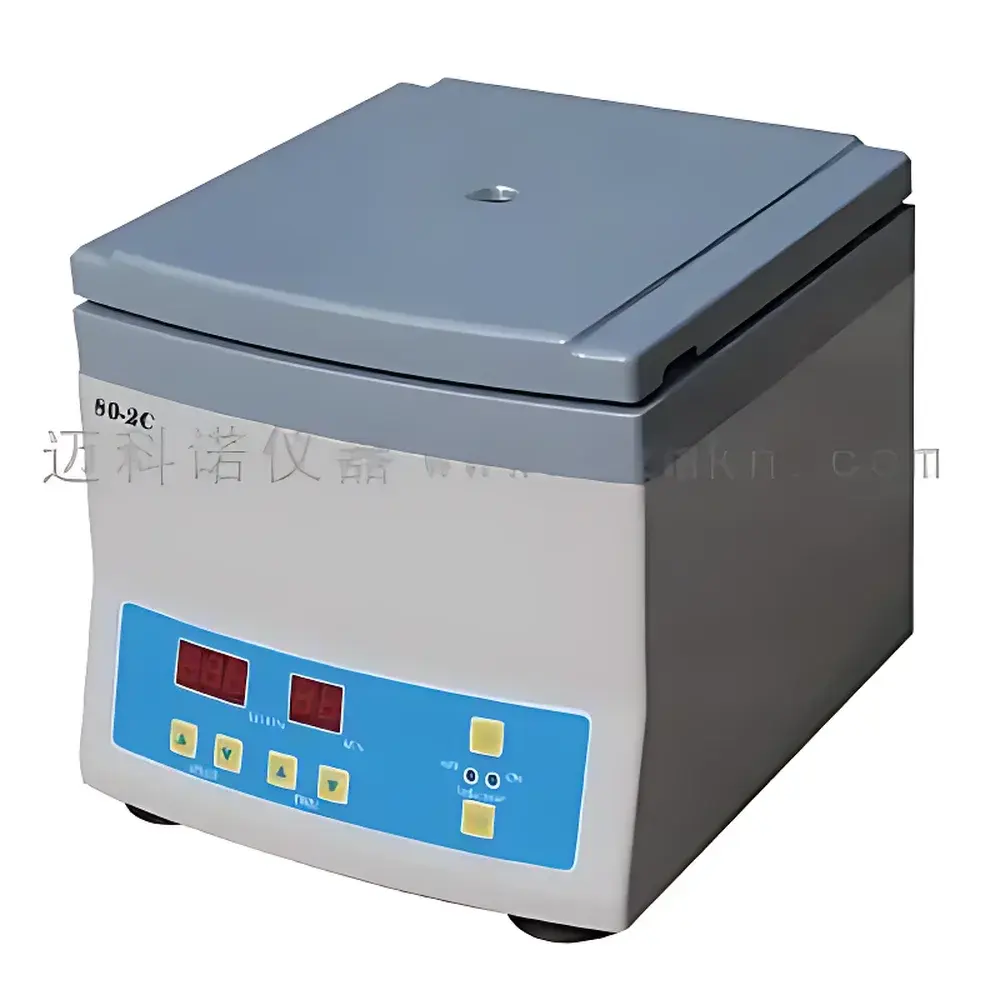
MKN 80-2C Digital Display Brushless Motor Centrifuge
| Brand | MKN |
|---|---|
| Origin | Jiangsu, China |
| Model | 80-2C |
| Max Speed | 0–4000 rpm |
| Relative Centrifugal Force (RCF) | 2325 × g |
| Capacity | 12 × 15 mL or 12 × 20 mL |
| Timer Range | 0–99 min |
| Power | 135 W |
| Noise Level | ≤60 dB(A) |
| Supply Voltage | AC 220 V, 50 Hz, 2 A |
Overview
The MKN 80-2C Digital Display Brushless Motor Centrifuge is a compact, high-reliability benchtop centrifuge engineered for routine separation tasks in life science, clinical, pharmaceutical, food safety, and environmental laboratories. It operates on the principle of sedimentation under controlled centrifugal force—accelerating particle separation based on density, size, and shape within liquid suspensions. Designed for daily use in resource-constrained or space-limited lab environments, this unit delivers consistent performance across standard protocols involving plasma preparation, cell pelleting, precipitate recovery, and reagent clarification. Its brushless DC motor ensures stable rotational output without carbon brush wear, contributing to long-term torque consistency and reduced maintenance intervals. The microprocessor-based control system enables precise regulation of speed and time, while mechanical and electronic safety interlocks comply with IEC 61010-1 requirements for laboratory electrical equipment.
Key Features
- Brushless DC motor drive for low-vibration, high-efficiency operation and extended service life
- Digital LED display showing real-time rotational speed (rpm) and remaining run time (min)
- Integrated mechanical door lock and automatic rotor stop-on-lid-opening safety mechanism
- Balanced-load detection system prevents operation under unbalanced conditions, minimizing risk of rotor wobble or bearing stress
- Touch-sensitive control panel with intuitive interface—no physical buttons to degrade over repeated use
- Compact footprint (W × D × H ≈ 300 × 320 × 270 mm) and lightweight construction (<15 kg) facilitate placement on shared benches or mobile carts
- Low-noise design (≤60 dB[A] at maximum speed) supports quiet lab environments and reduces operator fatigue during extended shifts
Sample Compatibility & Compliance
The 80-2C accommodates conical-bottom polypropylene tubes up to 20 mL capacity in its fixed-angle rotor (12-position). Compatible tube types include standard 15 mL and 20 mL centrifuge tubes meeting ISO 8573-1 Class 4 purity specifications for plasticware used in biological applications. Rotor geometry supports effective pelleting of mammalian blood cells (RBC/WBC separation), bacterial cultures (OD600 normalization), and protein precipitates from aqueous buffers. While not certified for biosafety level (BSL)-3 containment, the unit meets general-purpose laboratory safety standards per EN 61010-1:2010 + A1:2019 and carries CE marking for conformity with EU health, safety, and environmental protection directives. It is suitable for GLP-compliant workflows where audit trails are maintained manually; however, it does not support FDA 21 CFR Part 11 electronic signature functionality due to absence of user-accessible data logging or password-protected configuration changes.
Software & Data Management
This centrifuge operates as a standalone instrument with no external software dependency. All operational parameters—including speed setpoint, timer duration, and start/stop commands—are entered directly via the front-panel touch interface. No proprietary drivers, USB connectivity, or cloud-based firmware updates are provided. For laboratories requiring traceable recordkeeping, users may document run parameters manually in bound logbooks or integrate usage into LIMS via external barcode-scanned worklists. The device retains no internal memory of past runs, nor does it generate timestamped digital logs—consistent with its classification as a Class I, non-data-intensive laboratory appliance per ISO/IEC 17025:2017 Annex A.3 guidance on equipment qualification.
Applications
- Preparation of platelet-poor plasma (PPP) and platelet-rich plasma (PRP) from whole blood specimens in clinical diagnostics labs
- Harvesting microbial biomass from liquid culture media prior to DNA extraction or metabolite profiling
- Clarification of crude enzyme extracts or antibody-containing supernatants in bioprocessing QC workflows
- Sedimentation of suspended solids in water quality testing (e.g., turbidity reduction prior to spectrophotometric analysis)
- Routine cleanup of organic solvent extracts in food contaminant screening (e.g., pesticide residue analysis by GC-MS)
- Separation of lipid layers from emulsified samples in nutritional research settings
FAQ
What is the maximum relative centrifugal force (RCF) achievable with the 80-2C?
The unit generates up to 2325 × g at its rated maximum speed of 4000 rpm with the standard 12-place rotor.
Can this centrifuge be used for temperature-sensitive samples?
No—it is a non-refrigerated model and lacks active cooling; ambient temperature fluctuations will affect sample thermal stability.
Is rotor calibration required before first use?
The fixed-angle rotor is factory-balanced and does not require user recalibration; however, visual inspection for cracks or deformation is recommended prior to each use.
Does the 80-2C support variable acceleration/deceleration profiles?
No—this model uses fixed-rate ramp-up and coast-down braking; programmable gradient control is not available.
What maintenance schedule is recommended for optimal longevity?
Wipe exterior surfaces with 70% ethanol weekly; inspect rotor threads and lid seal monthly; verify door latch engagement quarterly; replace carbon brushes is not applicable (brushless motor).



