
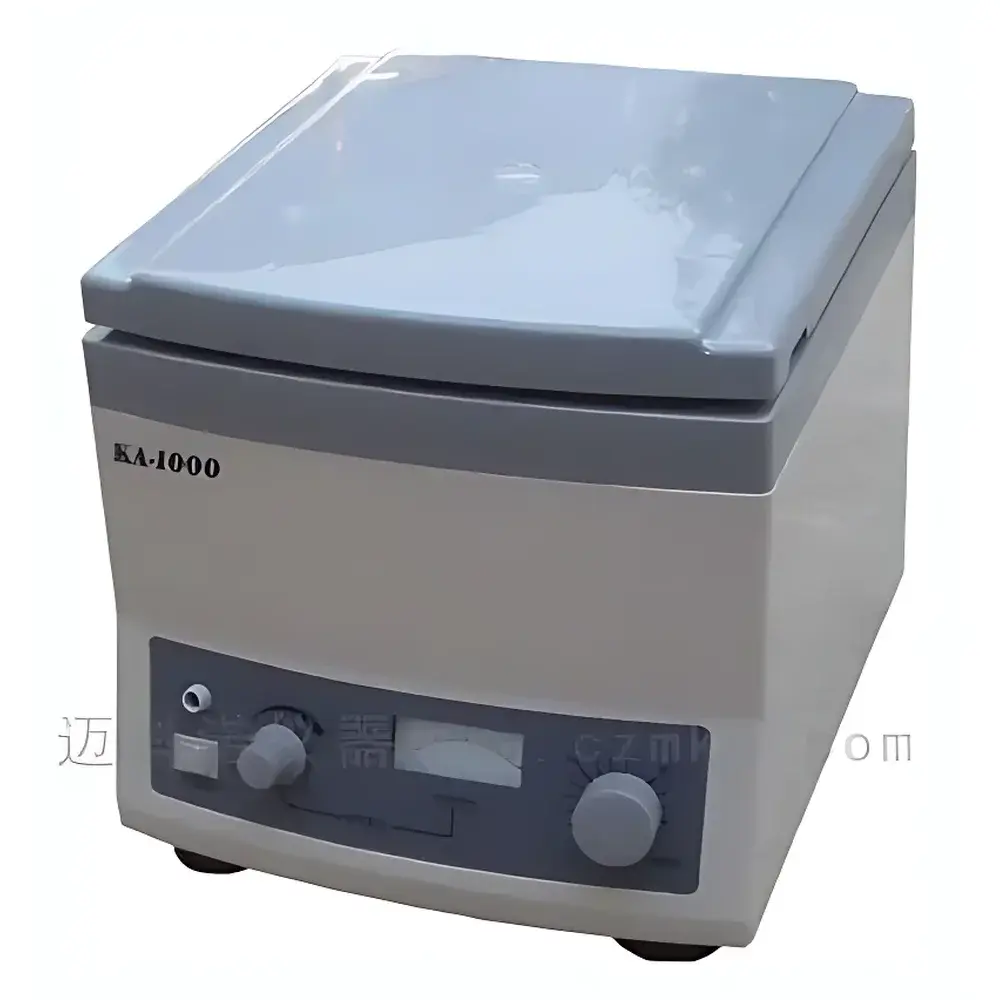
MKN KA-1000 Benchtop Low-Speed Centrifuge
| Brand | MKN |
|---|---|
| Model | KA-1000 |
| Max Speed | 0–4000 rpm |
| Relative Centrifugal Force (RCF) | 2325 × g |
| Capacity | 12 × 20 mL (or 12 × 15 mL) |
| Timer Range | 0–60 min |
| Power | 135 W |
| Noise Level | ≤60 dB(A) |
| Input Voltage | AC 220 V, 50 Hz, 2 A |
| Rotor Material | Anodized Aluminum |
| Drive System | Dedicated Brushed DC Motor |
| Safety Features | Mechanical Lid Interlock, Dual Fuses, Imbalance Protection |
| Display | Analog Speed Indicator + Graduated Timer Dial |
| Compliance | Designed for GLP-compliant laboratories |
Overview
The MKN KA-1000 Benchtop Low-Speed Centrifuge is an engineered solution for routine sedimentation and phase separation tasks in life science, clinical, pharmaceutical, and environmental laboratories. It operates on the principle of centrifugal force generation via rotational acceleration—applying radial acceleration to heterogeneous liquid samples to separate components based on density differentials. With a maximum speed of 4000 rpm and an RCF of 2325 × g, the KA-1000 delivers sufficient force for pelleting cells, precipitating macromolecules, clarifying suspensions, and preparing plasma or serum from whole blood. Its compact footprint (ideal for benchtop deployment), low acoustic signature (≤60 dB), and robust mechanical architecture make it suitable for shared lab environments where space, noise control, and operational reliability are critical constraints.
Key Features
- Brushed DC motor optimized for low-speed torque delivery and long-term stability under repeated start-stop cycles
- Anodized aluminum rotor with precision-balanced cavities for 12 × 15 mL or 12 × 20 mL conical tubes—designed to minimize vibration at all operating speeds
- Mechanical lid interlock system that automatically cuts power when the lid is opened mid-run, preventing accidental exposure to rotating components
- Dual-fuse protection circuitry and built-in imbalance detection—halts operation if mass asymmetry exceeds safe tolerance during acceleration or deceleration
- Analog speed indicator with calibrated scale (0–4000 rpm) and mechanical timer dial (0–60 minutes), enabling intuitive, non-digital operation without software dependency
- High-strength ABS housing with ergonomic contouring and integrated ventilation channels for passive thermal management during extended runs
Sample Compatibility & Compliance
The KA-1000 accommodates standard polypropylene or glass conical centrifuge tubes (15 mL and 20 mL volumes) and supports common biological matrices including whole blood, cell culture supernatants, bacterial lysates, food extracts, and wastewater filtrates. Tube compatibility assumes use of manufacturer-recommended, balanced loading configurations. The instrument is constructed and tested in accordance with IEC 61010-1:2010 (Safety Requirements for Electrical Equipment for Measurement, Control, and Laboratory Use). While not certified for ISO 13485 or FDA 21 CFR Part 11 compliance out-of-the-box, its mechanical controls, deterministic timing, and absence of network connectivity render it inherently compatible with GLP- and GMP-aligned workflows requiring audit-trail-free, manually verifiable operation.
Software & Data Management
The KA-1000 operates without embedded firmware or digital data logging—intentionally designed as a standalone, analog-controlled platform. All operational parameters (speed, time) are set manually and visually confirmed via analog dials; no USB, Ethernet, or Bluetooth interfaces are present. This architecture eliminates cybersecurity vulnerabilities, avoids software validation burdens, and ensures uninterrupted functionality across legacy IT infrastructures. For labs requiring traceability, users may document run conditions manually in bound logbooks or integrate the device into electronic lab notebooks (ELNs) via external observer protocols. No proprietary drivers, SDKs, or cloud services are associated with this model.
Applications
- Routine plasma and serum isolation from anticoagulated whole blood (e.g., EDTA, heparin tubes) in clinical diagnostics and biobanking
- Sedimentation of mammalian and microbial cells prior to lysis or cryopreservation
- Clarification of crude protein extracts, antibody-containing supernatants, or enzyme reaction mixtures
- Phase separation in food quality testing (e.g., fat globule isolation from milk homogenates)
- Pre-concentration of suspended solids in environmental water samples prior to filtration or spectroscopic analysis
- Stabilization and recovery of particulates in polymer emulsions or nanomaterial dispersions during formulation development
FAQ
What is the maximum relative centrifugal force (RCF) achievable with the KA-1000?
The KA-1000 generates a maximum RCF of 2325 × g at 4000 rpm with the standard 12-position rotor loaded symmetrically with 15 mL tubes.
Can the KA-1000 be used for high-speed applications such as ultracentrifugation?
No. This is a low-speed centrifuge intended for routine sedimentation only. It is not rated for speeds exceeding 4000 rpm or for rotors requiring vacuum or refrigeration.
Is rotor calibration required before first use?
The anodized aluminum rotor is factory-balanced and does not require user calibration. However, users must ensure symmetrical tube loading and verify rotor integrity (no cracks, corrosion, or deformation) before each use.
Does the KA-1000 include temperature control?
No. It is a non-refrigerated unit. For temperature-sensitive samples, pre-chill tubes and operate in a climate-controlled room (15–25°C recommended).
What maintenance is recommended for long-term reliability?
Wipe exterior surfaces with isopropyl alcohol after each use; inspect rotor threads and lid latch monthly; lubricate timer mechanism annually with silicone-based grease; replace fuses only with specified 2 A slow-blow type.



