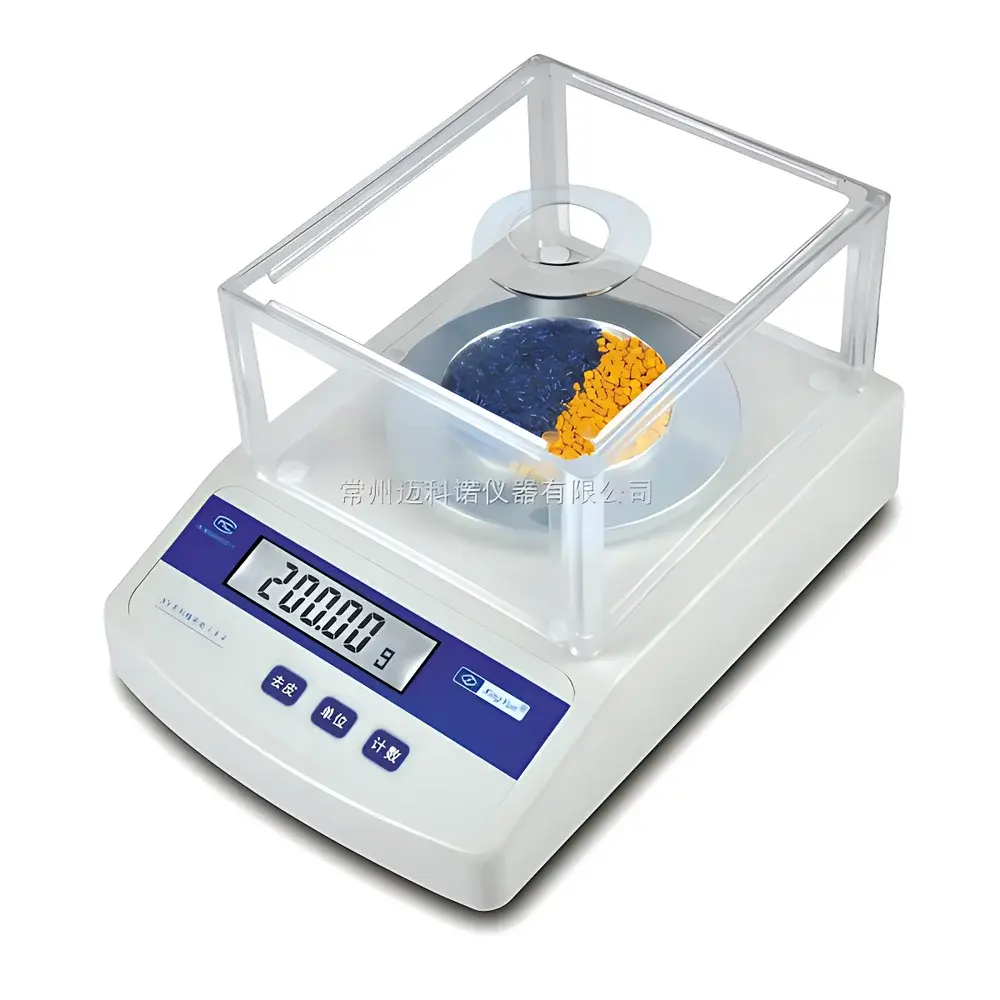
XY Scientific 1002C Precision Electronic Balance
| Origin | Zhejiang, China |
|---|---|
| Manufacturer Type | Authorized Distributor |
| Product Origin | Domestic (China) |
| Model | 1002C |
| Price Range | USD 570–700 (FOB) |
| Balance Type | Precision Laboratory Balance |
| Capacity | 100 g |
| Readability | 0.01 g |
| Pan Diameter | 130 mm |
| Power Supply | AC 220 V / DC 9 V |
| Display | Wide-View LCD |
| Units | g, oz, ct, lb |
| Interface | RS232 (optional) |
| Construction | Stainless Steel Pan, Powder-Coated Metal Base |
Overview
The XY Scientific 1002C Precision Electronic Balance is a compact, high-reproducibility laboratory balance engineered for routine mass measurement tasks requiring readability of 0.01 g and nominal capacity of 100 g. Based on electromagnetic force compensation (EMFC) transduction technology, the 1002C delivers stable, drift-compensated readings under variable ambient conditions typical of industrial QC labs, production floors, and educational environments. Its modular mechanical architecture—featuring a rigid powder-coated metal base and corrosion-resistant stainless steel weighing pan—ensures long-term mechanical stability and resistance to mechanical shock and chemical exposure during daily operation. Unlike analytical balances with sub-milligram resolution, the 1002C is optimized for applications where robustness, ease of operation, and rapid stabilization time outweigh ultra-high sensitivity requirements. It complies with general-purpose metrological principles outlined in OIML R 76-1 (Class II) for non-automatic weighing instruments, supporting traceable calibration using standard weights certified to ISO/IEC 17025-accredited laboratories.
Key Features
- Electromagnetic force compensation (EMFC) sensor system for consistent linearity and low hysteresis across the full 100 g range
- Detachable draft shield (optional accessory) enabling flexible configuration for open-bench or semi-controlled environments
- Wide-view LCD display with high-contrast backlighting, optimized for viewing angles up to ±60°—critical for ergonomic placement on crowded workbenches
- Dual-power capability: Operates seamlessly on AC 220 V mains or DC 9 V external adapter; compatible with optional rechargeable battery pack for mobile use
- Multi-unit conversion: Direct switching between grams (g), ounces (oz), carats (ct), and pounds (lb) without recalibration
- Standard tare and piece-counting functions—supporting batch verification of uniform components (e.g., screws, tablets, electronic parts) with automatic average-piece-weight calculation
- RS232 serial interface (optional) enables direct data export to LIMS, Excel, or custom QA databases; supports ASCII protocol for integration into automated reporting workflows
Sample Compatibility & Compliance
The 1002C accommodates samples up to 100 g with dimensions compatible with its 130 mm diameter stainless steel pan—suitable for powders, granules, packaged goods, small mechanical assemblies, and pre-weighed reagent vials. Its design meets basic environmental robustness requirements for non-classified industrial settings (IP42-rated enclosure). While not intended for ISO 17025 accredited calibration laboratories as a primary reference standard, it satisfies routine verification criteria per ASTM E898–22 (“Standard Practice for Verification of Weighing Equipment Used in Testing Laboratories”) and supports internal GLP documentation when used with documented calibration schedules and traceable standards. The balance does not include built-in audit trail or electronic signature capabilities, and therefore is not validated for FDA 21 CFR Part 11-compliant environments unless deployed with third-party data capture middleware.
Software & Data Management
No proprietary software is bundled with the 1002C. Data output via RS232 follows standard ASCII framing (9600 baud, 8N1), allowing compatibility with generic terminal emulators (e.g., Tera Term), LabVIEW drivers, or Python-based acquisition scripts using pySerial. Users may implement simple automation—for instance, triggering weight capture upon stable reading detection (via “stable” flag in serial stream) and appending timestamps in CSV format. For regulated environments, integration with validated electronic lab notebooks (ELNs) or MES systems requires validation of the entire data chain—including cable integrity, driver firmware version, and host system logging configuration. Optional battery operation introduces no additional software dependencies but mandates periodic voltage monitoring to prevent undervoltage-induced zero drift.
Applications
- Production line ingredient batching and formulation verification in food, pharmaceutical, and chemical manufacturing
- QC sampling for incoming raw material checks (e.g., verifying net weight of polymer pellets or metal shavings)
- Educational laboratory instruction in metrology fundamentals, density determination, and statistical process control (SPC)
- Field service operations requiring portable, mains-independent weighing—such as maintenance depots or warehouse audits
- Small-scale packaging quality assurance, including count-by-weight validation for blister packs or retail sachets
FAQ
What is the recommended calibration frequency for the 1002C in a production environment?
Calibration should be performed at startup, after relocation, following significant temperature shifts (>5 °C), and at least once per shift when used for critical weight-based release decisions.
Is the 1002C suitable for weighing hygroscopic or volatile samples?
Only when used with the optional draft shield and within controlled humidity (<60% RH); extended exposure to ambient air may affect stability for such materials.
Does the balance support internal calibration with motorized weights?
No—the 1002C requires external calibration using Class M2 or better certified weights; no internal calibration mechanism is present.
Can the RS232 interface transmit real-time weight data at high sampling rates?
Maximum update rate is 2 Hz under stable conditions; higher frequencies risk data loss due to fixed serial buffer size and lack of hardware flow control.
Is the stainless steel pan resistant to common laboratory solvents?
Yes—304-grade stainless steel resists ethanol, isopropanol, and dilute acids/bases; prolonged contact with halogenated solvents or strong oxidizers is not recommended.