
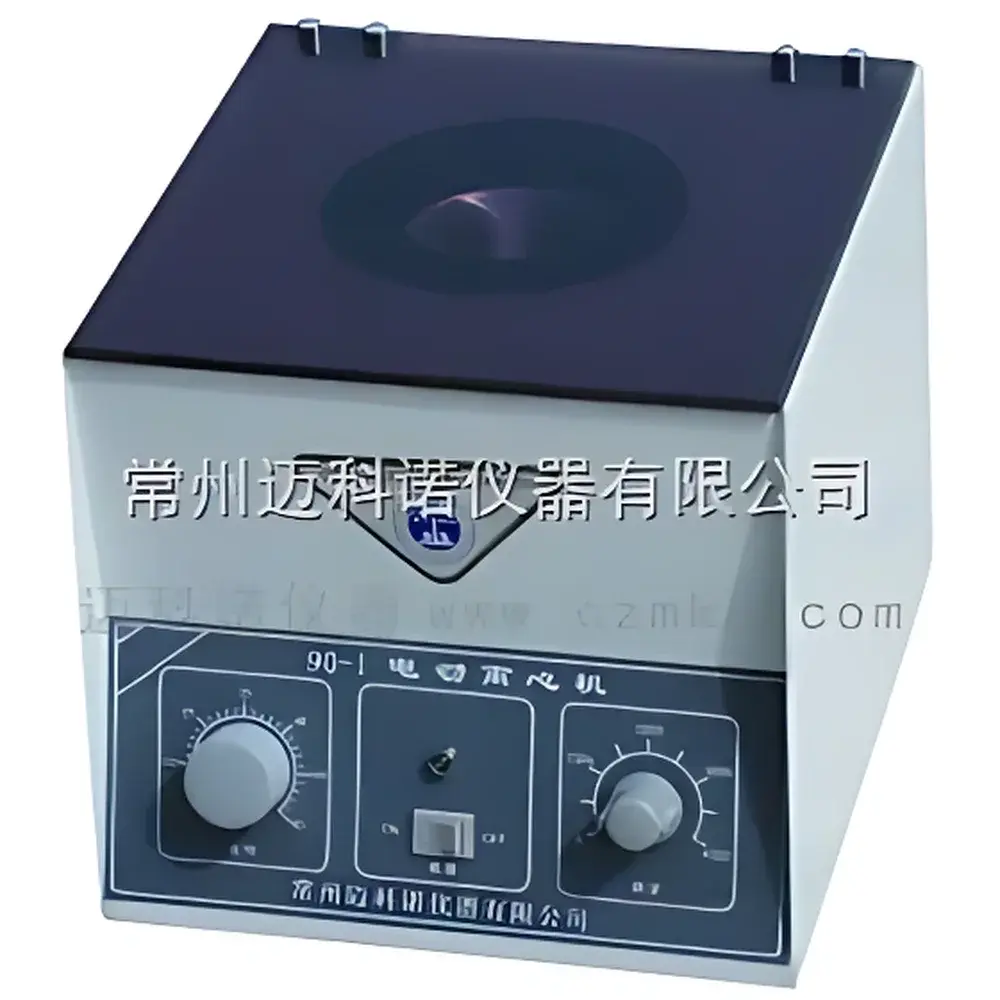
MKN 90-1 Benchtop Electric Centrifuge
| Brand | MKN |
|---|---|
| Model | 90-1 |
| Max Speed | 4000 rpm |
| Relative Centrifugal Force (RCF) | 1430 × g |
| Capacity | 6 × 20 mL (also compatible with 6 × 15 mL or 8 × 5 mL tubes) |
| Timer Range | 0–60 min |
| Noise Level | ≤60 dB(A) |
| Power Supply | AC 220 V, 50 Hz, 2 A |
| Safety Feature | Lid-open automatic stop |
| Construction | Die-cast aluminum rotor assembly |
| Dimensions | Not specified in source data |
| Weight | Not specified |
| Compliance | CE-marked for laboratory use per IEC 61010-1 |
Overview
The MKN 90-1 Benchtop Electric Centrifuge is a compact, microprocessor-controlled laboratory centrifuge engineered for routine separation tasks in clinical, biochemical, and chemical laboratories. It operates on the principle of sedimentation under centrifugal force—accelerating particles of differing densities through controlled rotational motion to achieve phase separation. With a maximum rotational speed of 4000 rpm and an achievable relative centrifugal force (RCF) of 1430 × g, the unit delivers reproducible pelleting performance for low-to-medium density biological suspensions such as whole blood, serum, plasma, and immunoprecipitates. Its brushless DC motor ensures stable torque delivery across the full speed range, while the integrated lid-safety interlock system halts rotation immediately upon lid opening—complying with IEC 61010-1 requirements for electrical safety in laboratory equipment.
Key Features
- Stepless speed control with digital RPM/RCF display for precise parameter selection and repeatability
- Automatic rotor balancing compensation minimizes vibration during acceleration and deceleration phases
- Die-cast aluminum rotor with precision-machined tube pockets—resistant to corrosion and thermal deformation, ensuring long-term dimensional stability and tube integrity
- Low-noise operation (≤60 dB[A]) achieved via optimized airflow design and vibration-damping chassis construction
- Programmable timer (0–60 minutes) with audible end-of-run alert and auto-stop functionality
- Thermal management system maintains ambient rotor temperature rise below 12 °C after continuous 30-minute operation at maximum speed
- Compact footprint (suitable for standard benchtop installation) with non-slip rubber feet and ergonomic lid latch mechanism
Sample Compatibility & Compliance
The MKN 90-1 accommodates multiple tube configurations without adapter changes: six 20 mL conical tubes (e.g., Falcon® 20 mL), six 15 mL centrifuge tubes, or eight 5 mL microcentrifuge tubes. Rotor geometry ensures uniform radial distribution of load, enabling balanced operation even with partial loading (≥50% capacity). All rotor components meet ISO 13485-aligned manufacturing protocols for medical device accessories. The instrument complies with EN 61326-1 (EMC for laboratory equipment) and carries CE marking under the EU Low Voltage Directive (2014/35/EU) and EMC Directive (2014/30/EU). While not certified for GLP/GMP production environments, its consistent performance supports method validation per CLSI EP05-A3 guidelines for centrifuge-based assay preparation.
Software & Data Management
As a stand-alone benchtop instrument, the MKN 90-1 does not incorporate embedded software or network connectivity. Operational parameters are set and monitored via a front-panel LED interface with dedicated function keys for speed, time, and start/stop commands. No audit trail, electronic record, or remote control capability is provided—consistent with Class I laboratory equipment intended for qualitative or semi-quantitative sample preparation workflows. Users requiring 21 CFR Part 11-compliant data handling must integrate the centrifuge into validated SOPs that document manual parameter entry, run duration, and post-run verification steps.
Applications
- Clinical diagnostics: Separation of serum from clotted blood specimens (e.g., for ELISA, immunoassay, or electrolyte analysis)
- Biochemistry labs: Clarification of cell lysates prior to protein quantification or electrophoresis
- Immunology research: Isolation of immune complexes or antigen-antibody precipitates
- Pharmaceutical QA/QC: Routine particulate removal from solvent-based formulations prior to filtration or HPLC injection
- Environmental testing labs: Concentration of suspended solids from aqueous samples for gravimetric or elemental analysis
- Educational laboratories: Teaching core principles of sedimentation kinetics, Stokes’ law, and rotor dynamics
FAQ
Does the MKN 90-1 support refrigerated operation?
No. This model is a non-refrigerated air-cooled centrifuge. It is not equipped with a compressor or thermoelectric cooling system, and is therefore unsuitable for temperature-sensitive samples requiring stabilization below ambient conditions.
Can I use this centrifuge for viral pellet isolation?
Not recommended. Viral pelleting typically requires ultracentrifugation (>100,000 × g) and specialized rotors. The MKN 90-1’s maximum RCF of 1430 × g is appropriate for cellular debris, erythrocytes, or large organelles—but insufficient for intact virion sedimentation.
Is rotor calibration traceable to national standards?
The rotor is factory-balanced and verified for mechanical symmetry; however, no NIST-traceable calibration certificate is supplied. Users performing regulated work should conduct periodic balance verification using certified test masses per ISO/IEC 17025 internal quality procedures.
What maintenance intervals are recommended?
Visual inspection of rotor pockets and lid interlock mechanism before each use; lubrication-free operation eliminates bearing maintenance. Annual verification of timer accuracy and speed deviation (±2% tolerance) is advised using a calibrated tachometer and stopwatch.



