
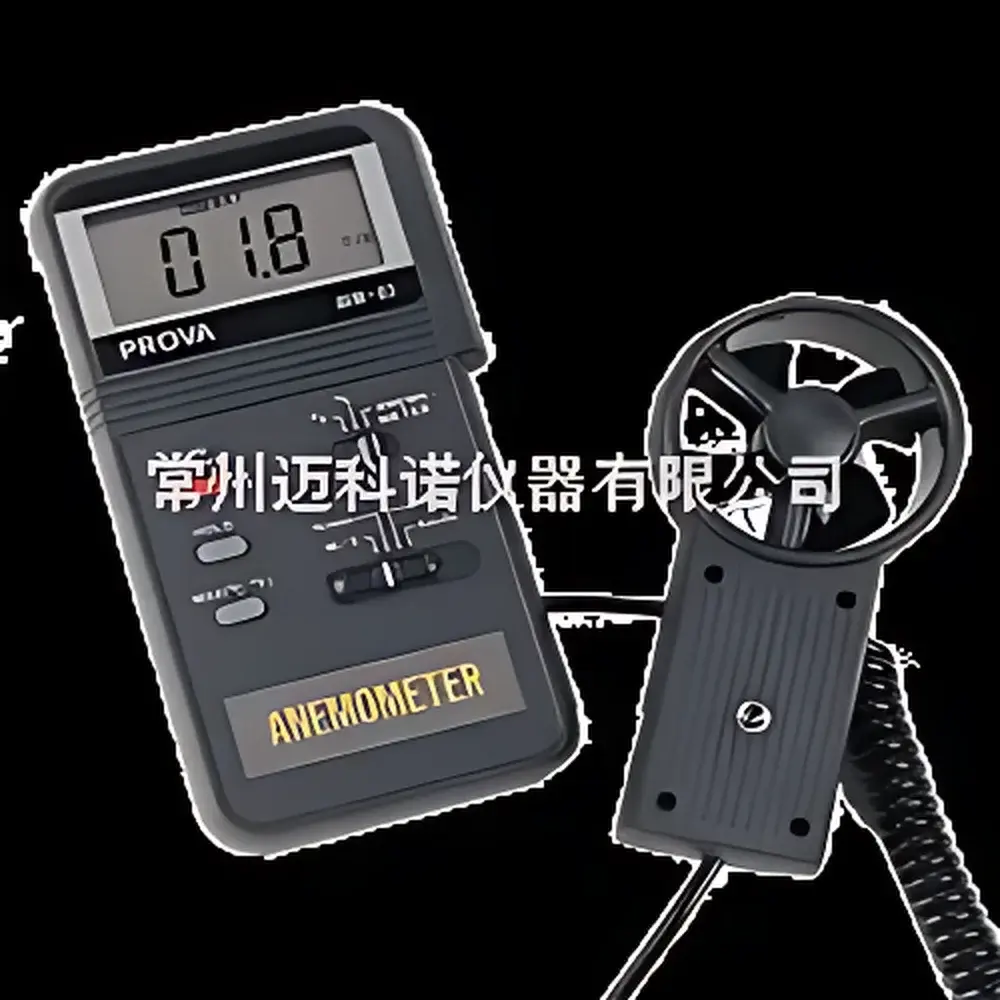
MKN AVM-03 Digital Anemometer with Integrated Air Temperature Sensor
| Brand | MKN |
|---|---|
| Model | AVM-03 |
| Measurement Principle | Propeller-based airflow velocity sensing with thermistor-based temperature detection |
| Velocity Range (m/s) | 0.3–45.0 |
| Resolution (m/s) | 0.1 |
| Accuracy (m/s) | ±3% or ±0.1 digit |
| Velocity Units | m/s, knots, ft/min, km/h |
| Temperature Range | 0–60°C (32–140°F) |
| Temperature Resolution | 0.1°C/°F |
| Temperature Accuracy | ±0.8°C / ±1.5°F |
| Power Supply | 9V alkaline battery (IEC 6LR61, 006P) |
| Current Consumption | 10 mA |
| Operating Environment | −10°C to +50°C, ≤85% RH (non-condensing), max operating pressure: 500 mbar to 2 bar |
| Display | 3½-digit LCD |
| Dimensions (L×W×H) | 168 × 90 × 31.3 mm |
| Weight | 500 g |
Overview
The MKN AVM-03 Digital Anemometer with Integrated Air Temperature Sensor is a handheld, propeller-type environmental measurement instrument engineered for reliable, real-time quantification of air velocity and ambient temperature in HVAC commissioning, indoor air quality (IAQ) assessments, laboratory ventilation validation, and industrial ductwork surveys. Its measurement principle relies on rotational dynamics: airflow drives a calibrated 52 mm diameter axial fan rotor, whose angular velocity is converted via optical or magnetic sensing into a proportional electrical signal. This analog output is digitized and linearized using embedded firmware calibrated against NIST-traceable reference standards. Simultaneously, a high-stability NTC thermistor mounted adjacent to the propeller hub captures ambient temperature with minimal self-heating error. The dual-sensor architecture enables concurrent acquisition—critical for calculating volumetric flow (e.g., CFM or m³/h) when cross-sectional area is known—and supports correction for air density variations in non-standard conditions.
Key Features
- 52 mm precision-machined, low-inertia propeller assembly optimized for sensitivity at low wind speeds (down to 0.3 m/s) while maintaining mechanical stability up to 45 m/s (≈162 km/h)
- Ergonomic, balanced housing design with textured grip and intuitive button layout minimizes operator fatigue during extended field use
- Multi-unit velocity display (m/s, knots, ft/min, km/h) with automatic unit conversion and consistent ±3% full-scale accuracy or ±0.1 digit—whichever is greater—across all ranges
- Independent temperature channel with 0.1°C resolution and ±0.8°C accuracy over 0–60°C, validated per IEC 60751 Class B tolerances
- Low-power 9V battery operation (IEC 6LR61) enabling >100 hours of continuous use at typical sampling intervals; auto-power-off after 10 minutes of inactivity
- Rugged ABS+PC housing rated IP54 for dust resistance and limited water splashing protection; operational under ambient pressures from 500 mbar to 2 bar (suitable for high-altitude or pressurized chamber applications)
Sample Compatibility & Compliance
The AVM-03 is designed for direct measurement of clean, dry, non-corrosive air streams. It is not intended for use in explosive atmospheres, saturated steam, particulate-laden exhaust ducts, or chemically aggressive environments (e.g., chlorine or ammonia). While it does not carry formal certification for hazardous locations (ATEX, IECEx), its construction complies with general safety requirements of IEC 61010-1 for hand-held electrical measuring equipment. For regulated environments—including ISO 14644 cleanrooms, ASHRAE 62.1-compliant HVAC verification, or GLP-aligned facility monitoring—the device supports documented calibration traceability when paired with an accredited external calibrator (e.g., wind tunnel or rotating vane standard). Its temperature sensor meets ASTM E2251-22 specifications for portable thermometers used in environmental testing.
Software & Data Management
The AVM-03 operates as a standalone, battery-powered instrument without Bluetooth, USB, or data logging capability. All measurements are displayed in real time on its 3½-digit LCD with polarity indication and unit suffix. No proprietary software, drivers, or cloud connectivity are required—or supported. This design prioritizes operational simplicity, electromagnetic compatibility (EMC) robustness, and immunity to firmware vulnerabilities common in connected devices. For users requiring audit trails or electronic records, manual transcription into validated spreadsheets or LIMS systems is recommended. When integrated into formal QA/QC workflows, the instrument should be included in a site-specific calibration schedule aligned with ISO/IEC 17025 or internal SOPs governing measurement equipment control.
Applications
- HVAC system balancing and airflow verification in commercial buildings per ASHRAE Guideline 12-2020
- Local exhaust ventilation (LEV) hood face velocity checks in laboratories (OSHA 1910.1450, ANSI/AIHA Z9.5)
- Validation of laminar flow cabinets and biosafety cabinets (NSF/ANSI 49)
- Industrial process air curtain performance assessment and drying oven uniformity mapping
- Outdoor microclimate studies in urban planning and green infrastructure evaluation
- Educational demonstrations of fluid dynamics principles, including Bernoulli’s equation and continuity effects
FAQ
What is the recommended calibration interval for the AVM-03?
For routine industrial use, annual calibration against a traceable standard is advised. In critical applications (e.g., pharmaceutical cleanroom certification), calibration before each use series—or per organizational SOP—is strongly recommended.
Can the AVM-03 measure air velocity in ducts with turbulent or swirling flow?
Yes—but results represent point velocity only. For representative duct average velocity, follow ISO 10780 or ASHRAE Fundamentals Chapter 43 guidance: take ≥16 evenly distributed traverse points across the duct cross-section and compute the arithmetic mean.
Is the temperature sensor affected by airflow during velocity measurement?
Minimal impact occurs due to the thermistor’s low thermal mass and proximity to the rotor hub, which provides partial convective shielding. However, for highest temperature accuracy in low-velocity (<1 m/s) or radiant environments, allow 30 seconds of stabilization before recording.
Does the AVM-03 meet FDA 21 CFR Part 11 requirements?
No—it lacks electronic record generation, user authentication, audit trail, or electronic signature capabilities. It is classified as a manual observation tool under Part 11 definitions.
What is the maximum allowable relative humidity for continuous operation?
85% RH non-condensing at temperatures between −10°C and +50°C. Prolonged exposure above this threshold may degrade LCD contrast and accelerate battery leakage risk.







