
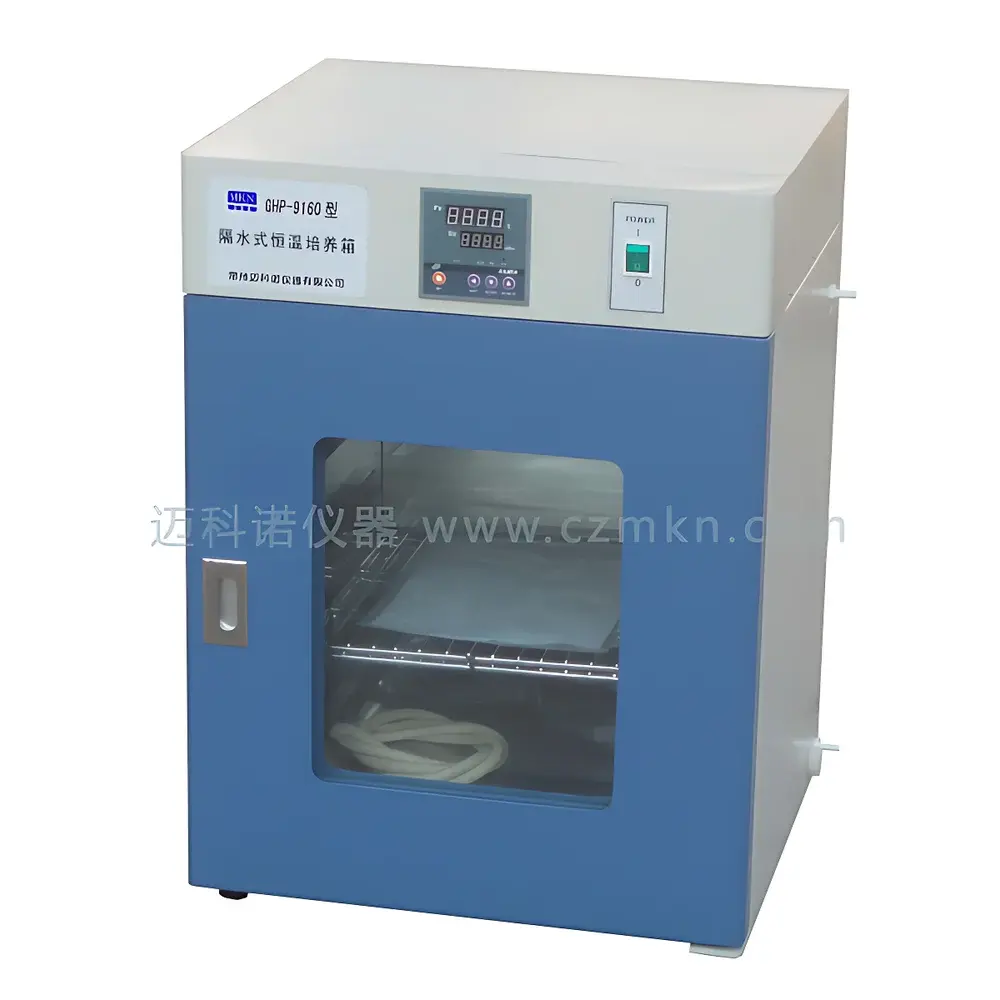
Macono GHP-270 Water-Jacketed Temperature-Controlled Incubator
| Origin | Zhejiang, China |
|---|---|
| Manufacturer Type | Authorized Distributor |
| Model | GHP-270 |
| Price | USD 1,380 (FOB) |
| Temperature Range (with Humidification) | Not Specified |
| Temperature Uniformity | Not Specified |
| Humidity Range | Not Specified |
| Chamber Capacity | Not Specified |
Overview
The Macono GHP-270 Water-Jacketed Temperature-Controlled Incubator is engineered for stable, long-term thermal regulation in life science laboratories. Unlike forced-air incubators, this unit employs a water-jacketed chamber design—where temperature is maintained via conduction through a surrounding water bath—delivering superior thermal inertia, minimal temperature fluctuation, and high spatial uniformity across the chamber volume. This architecture ensures minimal thermal overshoot during setpoint transitions and eliminates transient cold/hot spots that may compromise sensitive biological samples such as microbial cultures, mammalian cell lines, or embryonic tissues. Designed for compliance with routine laboratory workflows under GLP-aligned practices, the GHP-270 supports applications requiring sustained, drift-free incubation at ambient to moderately elevated temperatures (typically 4 °C to 50 °C, per standard water-jacketed incubator engineering conventions). Its passive thermal mass also enhances resilience during brief power interruptions—a critical consideration for unattended overnight or multi-day experiments.
Key Features
- Stainless steel water jacket fabricated by argon arc welding—resistant to corrosion, leakage, and thermal fatigue over extended service life.
- Double-glazed observation door with tempered glass and silicone rubber gasket seal—minimizes heat loss while enabling non-invasive visual monitoring without disturbing internal thermal equilibrium.
- Microprocessor-based digital temperature controller with real-time display and adjustable setpoint resolution (0.1 °C typical), offering high repeatability and low hysteresis.
- Integrated dual-stage alarm system: audible/visual alerts triggered by deviation beyond user-defined temperature tolerance or abnormal water level (low/high) in the jacket reservoir.
- Externally mounted heating elements—eliminating direct radiant exposure to samples and preventing localized overheating or thermal shock to culture vessels.
Sample Compatibility & Compliance
The GHP-270 accommodates standard-sized Petri dishes, multi-well plates (6–96-well), flasks (T25–T225), and test tubes—compatible with common sterilization protocols including autoclaving of removable interior shelves. While not certified for ISO 13485 or FDA 21 CFR Part 11 out-of-the-box, its control architecture supports manual audit trails and calibration logging required under GLP and basic GMP environments. The unit meets general safety requirements per IEC 61010-1 (Laboratory Equipment Safety) and electromagnetic compatibility standards EN 61326-1. Users performing regulated work should implement supplementary procedural controls—including periodic verification using NIST-traceable thermistors—and document all calibration events per internal SOPs.
Software & Data Management
The GHP-270 operates via embedded firmware without external PC dependency. All operational parameters—including current temperature, setpoint, elapsed time, and alarm status—are displayed on a backlit LCD interface. Data logging is not natively supported; however, analog output (0–5 V or 4–20 mA, optional upon request) can be interfaced with third-party DAQ systems or SCADA platforms for continuous temperature trending. For laboratories requiring electronic records, integration with validated environmental monitoring systems (e.g., DicksonOne, SensiNet) is achievable via RS-485 Modbus RTU (add-on module available). Audit trail functionality must be implemented externally in accordance with 21 CFR Part 11 if used in FDA-regulated workflows.
Applications
- Microbiological culture maintenance: storage and propagation of bacterial, fungal, and yeast strains under controlled, non-condensing conditions.
- Cell-based assays: serum-dependent mammalian cell expansion, primary tissue explant culture, and reagent pre-warming prior to transfection or enzymatic digestion.
- Agricultural research: seed germination studies, plant tissue culture initiation, and entomological rearing where diurnal temperature cycling is not required.
- Pharmaceutical stability testing: short-term accelerated studies at fixed temperatures (e.g., 37 °C/5 days) per ICH Q1A(R2) guidance, when humidity control is not mandated.
- Educational laboratories: undergraduate microbiology and molecular biology courses requiring robust, low-maintenance incubation platforms.
FAQ
Does the GHP-270 include humidity control?
No—this is a temperature-only water-jacketed incubator. Humidity regulation requires a separate humidification module or a dedicated temperature-and-humidity-controlled incubator model.
What is the recommended maintenance schedule?
Monthly visual inspection of water jacket integrity and reservoir level; biannual descaling of the water bath using food-grade citric acid solution; annual verification of temperature accuracy using a calibrated reference thermometer.
Can the unit be validated for IQ/OQ/PQ?
Yes—though no factory-issued validation documents are provided, the GHP-270’s mechanical and control architecture supports user-executed installation qualification (IQ), operational qualification (OQ), and performance qualification (PQ) per ASTM E2500 and ISO/IEC 17025 frameworks.
Is remote monitoring supported?
Not by default. Optional RS-485 communication (Modbus RTU) enables connection to building management systems or centralized lab monitoring software when configured with appropriate interface hardware.
What is the warranty coverage period?
One (1) year from date of shipment, covering parts and labor for defects in materials or workmanship under normal laboratory use conditions, excluding consumables and damage from misuse, improper installation, or environmental exposure outside specified operating ranges (10–30 °C ambient, <80% RH non-condensing).
Related Products




