
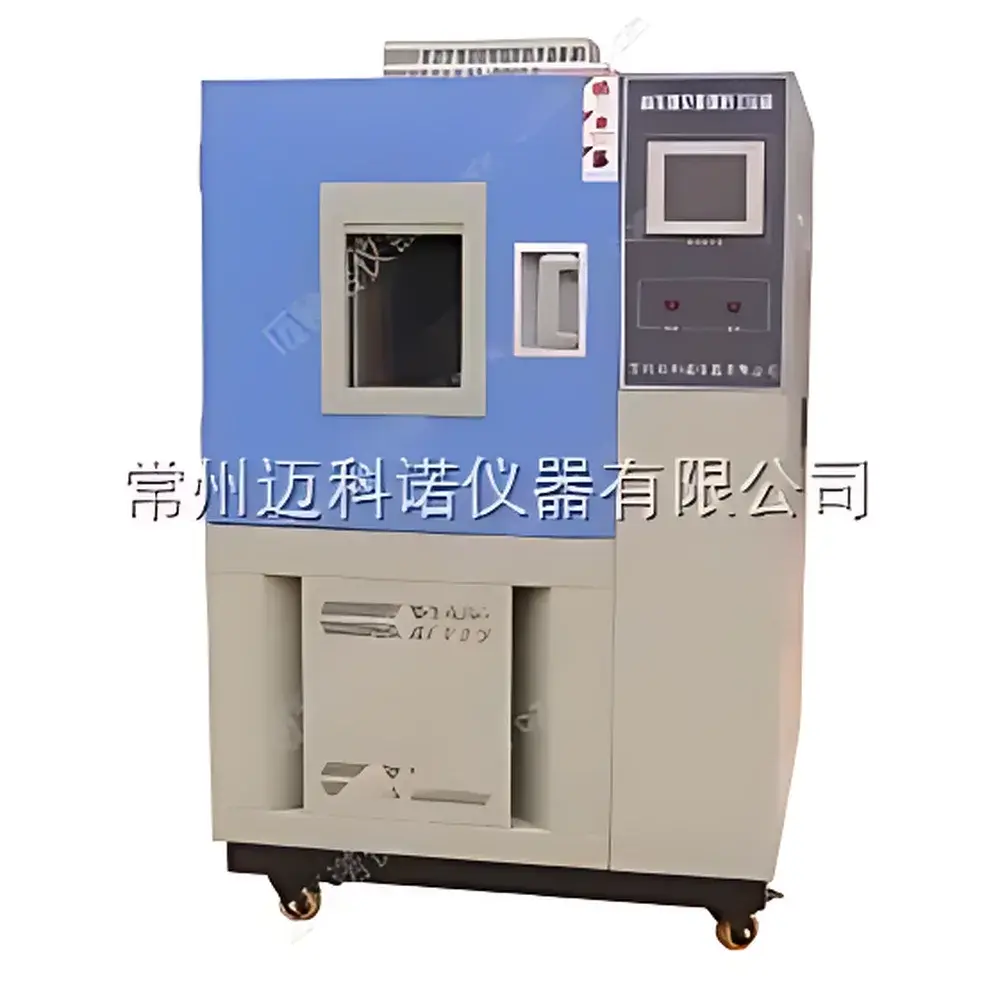
GDWJ Series High-Low Temperature Alternating Test Chamber
| Origin | Zhejiang, China |
|---|---|
| Manufacturer Type | Authorized Distributor |
| Origin Category | Domestic (China) |
| Model | GDWJ-B |
| Temperature Range | −20/−40/−60 °C to 100 °C |
| Temperature Uniformity | ≤ ±2 °C |
| Temperature Fluctuation | ≤ ±0.5 °C |
| Heating Rate | ≥ 2–3 °C/min |
| Cooling Rate | ≤ 1 °C/min |
| Internal Dimensions (W×D×H) | 400×500×500 mm / 500×650×700 mm / 700×800×900 mm / 800×1000×1000 mm / 1000×1000×1000 mm |
| Insulation | Ultra-fine Glass Fiber + Rigid Polyurethane Foam |
| Heating System | Nickel-Chromium Alloy Heaters with Stainless Steel Finned Radiators |
| Cooling System | Multi-stage Diaphragm Evaporator (Finned, Segmented) |
| Air Circulation | Single-loop, Extended-shaft, Low-noise Stainless Steel Centrifugal Fan |
| Refrigeration Configuration | Single-stage or Cascade (Dual-compressor) System (Air- or Water-cooled) |
| Compressor | Hermetic “Tecumseh” (France) Compressor |
| Controller | Fuji Electric (Japan) or Honeywell PID Digital Controller |
| Sensor | PT100 Platinum Resistance Thermometer |
| Safety Protections | Leakage Current Protection, Overtemperature Cut-off, Fast-acting Fuse, Compressor High-pressure Protection |
| Standard Accessories | Double-layer Tempered Glass Observation Window (250×300 mm), Ø25 mm Cable Port, Two Adjustable Stainless Steel Sample Shelves, LED Interior Lighting |
| Power Supply | 380 V AC, 50 Hz, 3-phase 4-wire |
Overview
The GDWJ Series High-Low Temperature Alternating Test Chamber is an engineered environmental simulation system designed for rigorous thermal cycling and static temperature exposure testing of industrial components and materials. It operates on the principle of forced-air convection combined with precision-controlled heating and cascade or single-stage refrigeration, enabling stable, repeatable, and traceable thermal profiles across defined operational envelopes. This chamber supports standardized thermal stress evaluation per internationally recognized test protocols—including IEC 60068-2-1 (Cold), IEC 60068-2-2 (Dry Heat), MIL-STD-810H Method 502.7 (Low Temperature), and Method 501.7 (High Temperature)—and complies fully with GB/T 2423.1–2023 and GB/T 2423.2–2023 (China National Standards equivalent to IEC 60068-2-1 & -2). Its BTC (Balance Temperature Control) algorithm dynamically modulates heating output in coordination with refrigeration capacity to minimize overshoot and stabilize setpoints with high fidelity—critical for evaluating thermal expansion mismatch, solder joint integrity, polymer embrittlement, and sealant performance under alternating thermal loads.
Key Features
- Stainless steel interior chamber (SUS304) with corrosion-resistant, electropolished finish; outer enclosure constructed from either SUS304 brushed stainless steel or high-grade cold-rolled steel with durable epoxy-polyester powder coating
- BTC (Balance Temperature Control) logic ensures rapid thermal equilibrium and exceptional setpoint stability (≤ ±0.5 °C fluctuation) without manual intervention
- Intelligent refrigeration path selection automatically engages optimal compressor stage(s) based on target temperature and ramp direction—enhancing energy efficiency and extending system service life
- Multi-segmented finned evaporator and nickel-chromium alloy finned heaters provide uniform heat distribution and precise thermal gradient management
- Extended-shaft centrifugal fan with stainless steel impeller delivers consistent airflow (≥ 1.2 m/s at working volume center) and low acoustic emission (< 65 dB(A)) during operation
- Dual-safety architecture includes independent overtemperature cutoff (mechanical and electronic), compressor high-pressure cutout, leakage current protection, and fast-blow fuse integration
Sample Compatibility & Compliance
The GDWJ chamber accommodates a broad range of sample geometries—from PCB assemblies and automotive ECUs to aerospace composite panels and medical device housings—within five standard internal volume configurations (from 100 L to 1000 L). Its construction adheres to GB 10592–2008 (Technical Requirements for Temperature Chambers), while its operational validation supports compliance with GLP/GMP documentation requirements, including audit-ready temperature mapping (per ISO 17025 Annex A.3) and calibration traceability to NIM (National Institute of Metrology, China). The chamber satisfies environmental qualification prerequisites for ISO 9001:2015 and IATF 16949:2016 quality management systems and is routinely deployed in validation protocols aligned with FDA 21 CFR Part 11 for electronic record integrity when integrated with compliant data acquisition software.
Software & Data Management
Equipped with Fuji or Honeywell programmable controllers featuring 10-segment ramp-soak profiles, real-time trend logging, and USB/RS485 communication interfaces, the GDWJ enables seamless integration into centralized lab data networks. Optional PC-based software provides full-cycle data export (CSV/Excel), alarm event timestamping, user-level access control, and automated report generation—including deviation analysis against predefined acceptance criteria. All temperature recordings are time-stamped with millisecond resolution and support 21 CFR Part 11-compliant electronic signatures when paired with validated third-party SCADA platforms.
Applications
This chamber serves critical roles in product development and quality assurance workflows across multiple sectors: accelerated aging of lithium-ion battery modules under −40 °C to 85 °C cycles; thermal shock screening of MEMS sensors per JEDEC JESD22-A104; validation of avionics housing seals under MIL-STD-810H thermal vacuum pre-conditioning; verification of optical lens adhesives under cyclic humidity-free thermal stress; and long-term reliability assessment of power electronics encapsulants per IPC-9701. Its reproducible thermal profiles make it suitable for comparative studies in material science labs evaluating coefficient of thermal expansion (CTE) mismatches in multi-layer ceramic substrates.
FAQ
What temperature ranges are available for the GDWJ series?
Standard models support lower limits of −20 °C, −40 °C, or −60 °C, with upper limits fixed at 100 °C. Custom variants extend to 150 °C or −70 °C upon request.
Is the chamber compatible with remote monitoring and networked lab infrastructure?
Yes—equipped with RS485 Modbus RTU and optional Ethernet/IP interfaces, it integrates with building management systems (BMS) and enterprise LIMS via OPC UA or MQTT protocols.
How is temperature uniformity verified and documented?
Uniformity is validated using a 9-point sensor array per IEC 60068-3-5, with full mapping reports provided as part of factory acceptance testing (FAT) and optional IQ/OQ/PQ qualification packages.
Can the GDWJ chamber be used for thermal shock testing?
While optimized for controlled ramp-and-soak cycling, it is not configured for two-zone liquid-to-air or air-to-air thermal shock per IEC 60068-2-14; dedicated thermal shock chambers are recommended for such applications.
What maintenance intervals are recommended for the refrigeration system?
Compressor oil and refrigerant charge verification are advised every 24 months; evaporator coil cleaning and controller calibration every 12 months—both supported by certified field service engineers.



