
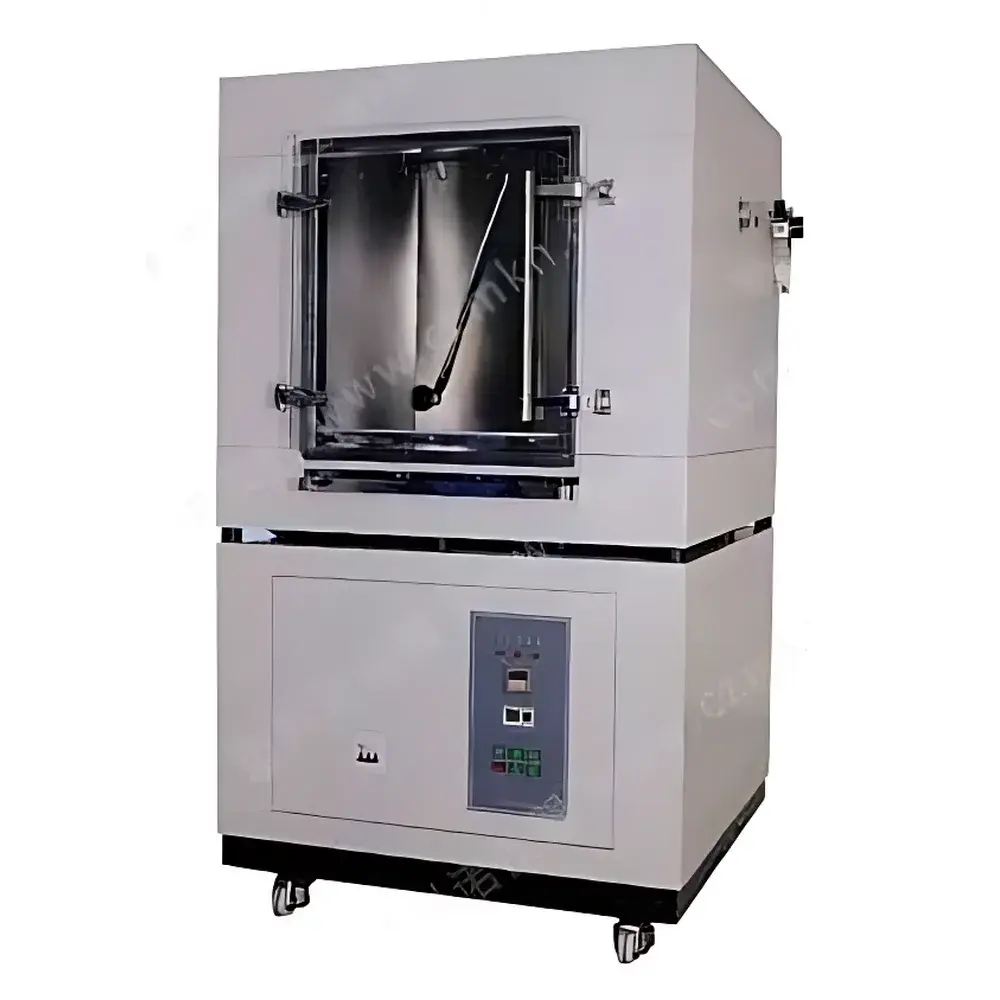
Sand and Dust Test Chamber SC-200
| Origin | Zhejiang, China |
|---|---|
| Manufacturer Type | Distributor |
| Origin Category | Domestic |
| Model | SC-200 |
| Quotation | Upon Request |
| Inner Chamber Material | Stainless Steel |
| Outer Shell | Powder-Coated Steel |
| Viewing Window | Tempered Glass |
| Temperature Range | 15–35 °C |
| Relative Humidity | 45–75% RH |
| Dust Concentration | 2–4 kg/m³ |
| Sieve Mesh | Nominal Wire Diameter 50 µm, Nominal Aperture 75 µm |
| Test Dust Types | Dry Talcum Powder, Silicate Cement, Fly Ash |
| Controller | Moeller (Germany) Programmable Logic Controller (PLC) |
| Control Functions | Cyclic Blowing (On/Off), Vibration Timing, Predefined Total Test Duration, Power Cycling (On/Off/On) |
| Electrical Components | Schneider Contactors & Switches (France), Fuji Time Relays, Panasonic Dust-Resistant Sockets |
| Dust Blowing Mode | Continuous or Periodic |
Overview
The Sand and Dust Test Chamber SC-200 is an engineered environmental test system designed to evaluate the ingress protection (IP) performance of enclosures, components, and finished products under controlled airborne particulate exposure. It operates on the principle of forced convection dust suspension—generating a reproducible, gravity-settling dust cloud within a sealed chamber to simulate real-world desert, industrial, or off-road conditions. The chamber complies with internationally referenced standards including GB/T 2423.37–1989 (equivalent in scope to IEC 60068-2-68), GB 4208–2008 (IP Code for Degrees of Protection Provided by Enclosures), and GB 10485–2007 (Dust Ingress Testing Method). Its primary purpose is to assess sealing integrity, mechanical resistance to abrasive particle penetration, and functional reliability of devices subjected to long-term dust accumulation—particularly critical for automotive subsystems, outdoor electronics, aerospace ground support equipment, and industrial control housings.
Key Features
- Robust dual-layer construction: mirror-finished stainless steel inner chamber for corrosion resistance and easy cleaning; powder-coated carbon steel outer shell for structural durability and thermal stability.
- Tempered glass observation window with integrated anti-dust sealing gasket enables real-time visual monitoring without compromising chamber integrity.
- Moeller (Germany) PLC-based control system provides precise sequencing logic for multi-stage test profiles—including programmable blow duration, rest intervals, vibration activation timing, and total cycle count.
- Integrated dust dispersion mechanism ensures uniform suspension of standardized test media (e.g., talcum powder per ISO 12103-1 A2, fly ash, or silicate cement) at a controlled concentration of 2–4 kg/m³.
- Calibrated 50 µm wire diameter / 75 µm aperture stainless steel sieve ensures consistent particle size distribution during dust introduction—critical for repeatability across laboratories and production QA checkpoints.
- Electrical interface components meet industrial-grade ingress protection requirements: Schneider contactors (IP65-rated), Fuji time relays with ±0.1 s timing accuracy, and Panasonic dust-resistant sockets rated IP54 or higher.
Sample Compatibility & Compliance
The SC-200 accommodates samples up to 200 L internal volume (chamber dimensions optimized for typical automotive lighting assemblies, instrument clusters, ECU housings, door latch mechanisms, and steering column modules). It supports both static and dynamic test configurations—samples may be mounted on fixed shelves or secured to optional vibration platforms (compatible with IEC 60068-2-64). All operational parameters align with regulatory frameworks applicable to product certification: compliance documentation supports IP5X/IP6X validation per GB 4208–2008 (identical to IEC 60529), dust resistance verification per USP for medical device packaging, and environmental qualification per MIL-STD-810H Method 510.6 (Sand and Dust). The chamber’s temperature and humidity operating envelope (15–35 °C, 45–75% RH) reflects ambient-condition testing requirements defined in ISO 16750-4 and SAE J1211.
Software & Data Management
While the SC-200 utilizes a hardware-based Moeller PLC controller without embedded PC software, its I/O architecture supports external data logging via RS485 Modbus RTU protocol. Integration with third-party SCADA systems (e.g., Ignition, Siemens Desigo CC, or LabVIEW) enables automated test sequence execution, timestamped event logging (blow start/stop, vibration trigger, power state transitions), and audit-trail generation compliant with GLP and GMP Annex 11 requirements. Optional analog output modules provide continuous monitoring of chamber pressure differential and dust suspension density. All controller programs are password-protected and version-controlled; configuration backups can be exported to USB memory for traceability during FDA 21 CFR Part 11–aligned audits.
Applications
- Automotive: Validation of headlamp and taillamp seals, HVAC actuator housings, battery management system (BMS) enclosures, and infotainment display front bezels against fine particulate ingress.
- Industrial Electronics: IP rating verification for motor drives, PLC cabinets, explosion-proof junction boxes, and remote I/O modules deployed in mining or cement plant environments.
- Consumer Appliances: Dust resistance testing of smart home hubs, robotic vacuum cleaner docking stations, and outdoor-rated power tools.
- Aerospace & Defense: Qualification of avionics cooling ducts, UAV sensor housings, and ground vehicle electronic control units per MIL-STD-810H.
- Medical Devices: Evaluation of dust sealing integrity for portable diagnostic equipment, infusion pump casings, and wearable telemetry housings per IEC 60601-1 Clause 11.3.
FAQ
What test standards does the SC-200 directly support?
It is configured and validated for GB/T 2423.37–1989, GB 4208–2008 (IP5X/IP6X), and GB 10485–2007. Equivalent international alignments include IEC 60068-2-68 and ISO 20653:2013.
Can the chamber operate with alternative dust types beyond talcum powder?
Yes—provided the material meets specified particle size distribution (passing through 75 µm mesh) and exhibits low hygroscopicity and non-reactivity with stainless steel surfaces. Users must validate dust consistency per ISO 12103-1 prior to qualification runs.
Is vibration functionality built-in or optional?
Vibration capability is available as a factory-installed option using electromagnetic shakers synchronized with the PLC timer; base configuration supports only dust blowing and dwell cycles.
How is dust concentration monitored and maintained during testing?
Concentration is set volumetrically at initiation using calibrated mass dosing; real-time optical particle counters (OPC) may be added externally via ported access for ISO 21501-4–compliant monitoring.
Does the SC-200 include calibration documentation traceable to national standards?
Yes—each unit ships with a factory calibration certificate for temperature, humidity, timer accuracy, and sieve mesh verification, traceable to CNAS-accredited reference laboratories.



