
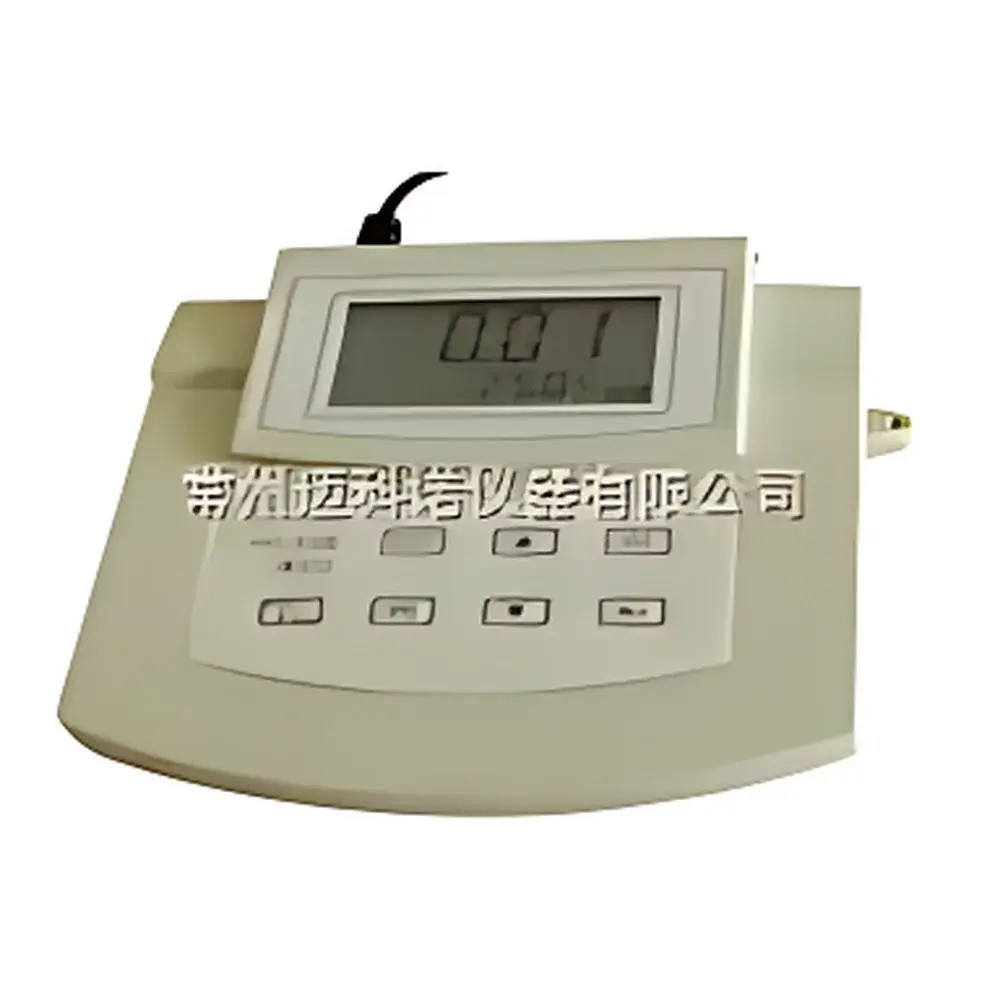
PXS-215 Fluoride Ion Concentration Meter
| Origin | Zhejiang, China |
|---|---|
| Manufacturer Type | Distributor |
| Origin Category | Domestic (China) |
| Model | PXS-215 |
| Pricing | Upon Request |
| Sample Introduction Method | Manual Immersion |
| Sensitivity | Not Specified |
| Spectral Library | Not Applicable |
Overview
The PXS-215 Fluoride Ion Concentration Meter is a dedicated potentiometric analytical instrument engineered for precise quantification of fluoride ion activity in aqueous solutions. It operates on the principle of ion-selective electrode (ISE) potentiometry, utilizing a fluoride-specific ion-selective electrode—typically based on a lanthanum fluoride (LaF₃) single-crystal membrane—to generate a Nernstian response proportional to the logarithm of free F⁻ activity. The meter integrates a microprocessor-controlled measurement circuit to convert the measured potential difference (in mV) into calibrated pF (–log[F⁻]) and direct fluoride concentration ([F⁻], in mol/L or mg/L) values. Designed for routine laboratory, environmental monitoring, and water quality control applications, the PXS-215 delivers stable, reproducible readings across a defined operational temperature range and conforms to fundamental electrochemical measurement practices aligned with ISO 10523 (water quality — determination of pH) and ASTM D1293 (standard test method for pH of water). Its compact benchtop architecture supports both manual and automatic temperature compensation—critical for minimizing thermal drift in ISE measurements—ensuring traceable data integrity under standard laboratory conditions.
Key Features
- Microprocessor-based digital control system enabling intuitive operation and real-time dual-parameter display (pF and [F⁻] concentration)
- Integrated temperature compensation: automatic mode when connected to a compatible Pt1000 or thermistor temperature probe; manual mode with user-defined setpoint (5.0–45.0 °C)
- Dual-range measurement capability: pF from 1.00 to 6.00 (corresponding to [F⁻] ≈ 0.1 mol/L down to 1 µmol/L) and mV from –1800 to +1800 mV for raw electrode potential diagnostics
- High-resolution digital readout with 0.01 pF resolution and ±0.02 pF ±1 digit electronic unit accuracy
- Benchtop form factor (200 × 210 × 70 mm) weighing only 1.0 kg, optimized for space-constrained labs and field-deployable setups
- Stability performance: ≤ ±0.02 pF drift over 3 hours under controlled ambient conditions (5–40 °C, RH ≤ 80 %, no magnetic interference)
Sample Compatibility & Compliance
The PXS-215 is intended for use with clear, low-turbidity aqueous samples—including drinking water, groundwater, wastewater effluents, and industrial process streams—where fluoride exists predominantly as free F⁻ ions. It is not suitable for highly viscous, suspended, or strongly chelated matrices without prior sample pretreatment (e.g., ionic strength adjustment with TISAB buffer, filtration, or distillation). While the instrument itself does not carry CE, UKCA, or FDA 510(k) certification, its functional design adheres to general principles outlined in ISO/IEC 17025 for competence of testing and calibration laboratories. Users are responsible for validating method suitability per their internal QA/QC protocols and applicable regulatory frameworks such as EPA Method 300.0 (for fluoride in drinking water) or ISO 10304-1 (determination of anions by liquid chromatography).
Software & Data Management
The PXS-215 operates as a standalone hardware unit with no embedded software, cloud connectivity, or PC interface. All measurement data remain visible only on the front-panel LCD display and are not stored internally or exportable. For regulated environments requiring audit trails, users must implement external documentation procedures—such as manual logbook entries or integration with LIMS via secondary data capture (e.g., camera-based reading or RS-232/USB-to-serial adapters, if retrofitted). Though the device lacks native 21 CFR Part 11 compliance features (e.g., electronic signatures, secure user authentication), it may be incorporated into GLP/GMP workflows when paired with documented SOPs governing calibration frequency, electrode maintenance, and environmental monitoring.
Applications
- Drinking water quality assurance per WHO guideline values (1.5 mg/L) and national standards (e.g., GB/T 5750.5–2006 in China)
- Environmental monitoring of fluoride contamination in surface and groundwater near industrial zones or geothermal areas
- Pharmaceutical excipient testing where residual fluoride must be verified below threshold limits
- Educational laboratories for teaching potentiometric analysis, Nernst equation derivation, and ion-selective electrode fundamentals
- Quality control in fluoridated salt production and dental product formulation
FAQ
Does the PXS-215 support data logging or USB output?
No—the instrument provides only real-time visual readouts and has no internal memory, serial port, or digital interface.
Is a fluoride ISE electrode included with the meter?
The PXS-215 is sold as a meter-only unit; the fluoride-selective electrode and reference electrode must be procured separately and are not bundled.
What calibration standards are recommended?
Standard calibration is performed using at least two certified fluoride standard solutions (e.g., 10⁻² M and 10⁻⁴ M NaF in TISAB buffer), following a two-point bracketing method per ISO 17025 calibration requirements.
Can the PXS-215 measure other anions?
No—it is functionally configured exclusively for fluoride ion detection; electrode interchange requires separate ISE compatibility verification and recalibration—not supported by default firmware.
What is the expected service life of the LaF₃ crystal electrode?
Under proper storage (dry, dark, room temperature) and routine conditioning (soaking in 10⁻³ M NaF), the crystal membrane typically maintains Nernstian response for 12–24 months, depending on usage frequency and sample matrix aggressiveness.





