
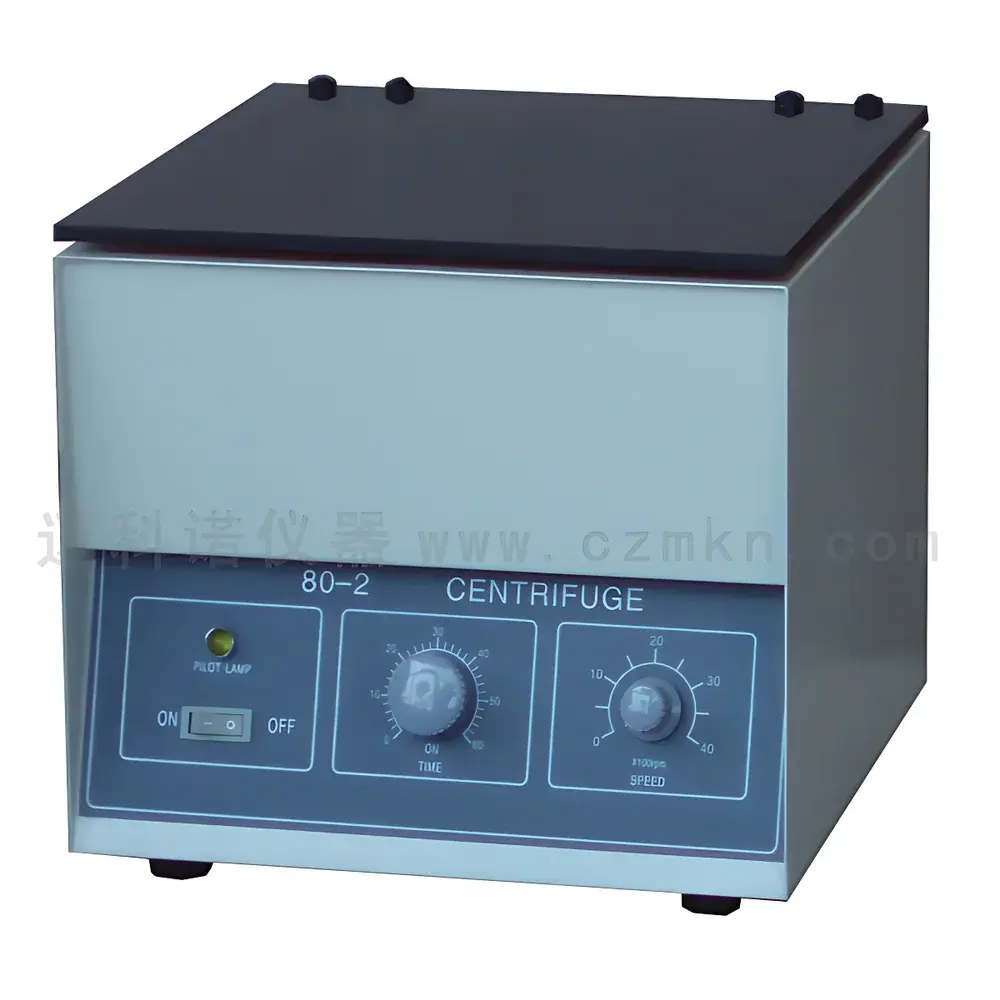
MKN 80-2 Benchtop Centrifuge
| Brand | MKN |
|---|---|
| Model | 80-2 |
| Maximum Speed | 4000 rpm |
| Relative Centrifugal Force (RCF) | 2325 × g |
| Capacity | 12 × 20 mL |
| Timer Range | 0–60 min |
| Noise Level | ≤60 dB(A) |
| Power Supply | AC 220 V, 50 Hz, 2 A |
| Construction | Aluminum Alloy Rotor Chamber |
| Compliance | Designed for GLP-compliant routine laboratory workflows |
Overview
The MKN 80-2 Benchtop Centrifuge is a compact, general-purpose centrifugal separation instrument engineered for reliable density-based fractionation of liquid-phase samples in clinical, biochemical, and research laboratory environments. It operates on the principle of sedimentation under controlled rotational acceleration—utilizing centrifugal force to accelerate the natural gravitational settling of suspended particles or immiscible phases according to their mass, density, and hydrodynamic radius. Unlike ultracentrifuges or refrigerated high-speed models, the 80-2 is optimized for routine, non-refrigerated applications such as serum/plasma separation, immunoprecipitation pellet recovery, and basic cell harvesting—where precise temperature control is not required but mechanical stability, operational safety, and reproducible RCF delivery are essential.
Key Features
- Variable speed control (0–4000 rpm) with analog dial interface enabling fine-tuned optimization across diverse sample viscosities and particle sizes.
- Fixed-angle aluminum alloy rotor designed for mechanical durability and thermal stability; minimizes microcentrifuge tube deformation and ensures consistent rotor balance over extended operation cycles.
- Integrated mechanical timer (0–60 minutes) with automatic shut-off function to prevent over-centrifugation and preserve sample integrity.
- Low-noise brushless motor assembly (<60 dB[A]) and vibration-dampened base construction ensure quiet operation suitable for shared lab spaces and proximity to sensitive instrumentation.
- Compact footprint (designed for standard benchtop deployment) and lightweight chassis facilitate repositioning between workstations without requiring dedicated mounting or structural reinforcement.
- Compliance-ready design: rotor geometry and speed calibration support traceable documentation for internal SOPs and audit-readiness under GLP-aligned quality systems.
Sample Compatibility & Compliance
The MKN 80-2 accommodates standard conical-bottom polypropylene or glass centrifuge tubes up to 20 mL volume per position (12-position capacity). It is routinely employed for processing whole blood (to isolate serum or plasma), antibody-antigen complexes, bacterial cell pellets, and colloidal suspensions where sedimentation equilibrium is reached within minutes at moderate RCF. While not certified to ISO 13485 or FDA 21 CFR Part 11 out-of-the-box, its mechanical repeatability and fixed-parameter operation align with foundational requirements for QC/QA workflows in diagnostic laboratories operating under CLIA or CAP guidelines. Users deploying the instrument in regulated environments are advised to perform periodic speed verification using an external tachometer and document rotor usage history per internal maintenance protocols.
Software & Data Management
The MKN 80-2 is a manually operated, non-digital instrument with no embedded firmware, data logging, or network connectivity. All operational parameters—including speed, time, and run initiation—are set via physical controls. This architecture eliminates software validation overhead and supports environments where regulatory simplicity, cybersecurity constraints, or legacy infrastructure compatibility are prioritized. For laboratories requiring electronic recordkeeping, integration is achieved externally via manual entry into LIMS or ELN platforms using documented run logs (date, operator ID, sample ID, rpm, duration, rotor lot number). No proprietary drivers or vendor-specific software installation is required.
Applications
- Clinical diagnostics: Separation of serum from clotted blood specimens prior to ELISA, electrophoresis, or immunoassay analysis.
- Biochemistry labs: Recovery of precipitated proteins or nucleic acid complexes following ammonium sulfate or ethanol precipitation steps.
- Microbiology: Harvesting bacterial or yeast cultures for downstream lysis, genomic DNA extraction, or viability assessment.
- Quality control testing: Clarification of reagent solutions, removal of particulate contaminants from calibration standards, and consistency checks of suspension homogeneity.
- Educational settings: Demonstration of sedimentation kinetics, Stokes’ law principles, and relative centrifugal force calculations in undergraduate laboratory curricula.
FAQ
What is the maximum relative centrifugal force (RCF) achievable with the MKN 80-2?
The instrument delivers a maximum RCF of 2325 × g at 4000 rpm with the standard 12 × 20 mL rotor configuration.
Is the rotor autoclavable?
The aluminum alloy rotor is not autoclavable; cleaning is recommended with 70% ethanol or mild detergent followed by air drying. Avoid abrasive agents or prolonged exposure to strong oxidizers.
Does the centrifuge include imbalance detection or automatic shutdown?
It features passive mechanical balance compensation but lacks active imbalance sensing. The unit will operate only when loaded symmetrically; significant imbalance may cause excessive vibration and should be corrected before initiating rotation.
Can this model accommodate microcentrifuge tubes (1.5/2.0 mL)?
No—the rotor is configured exclusively for 20 mL conical tubes. Adapters for smaller formats are not supplied or validated by the manufacturer.
What maintenance is required for long-term reliability?
Routine inspection of rotor threads, lubrication of lid hinge mechanism every 6 months, and annual verification of speed accuracy using a calibrated handheld tachometer are recommended practices.



