
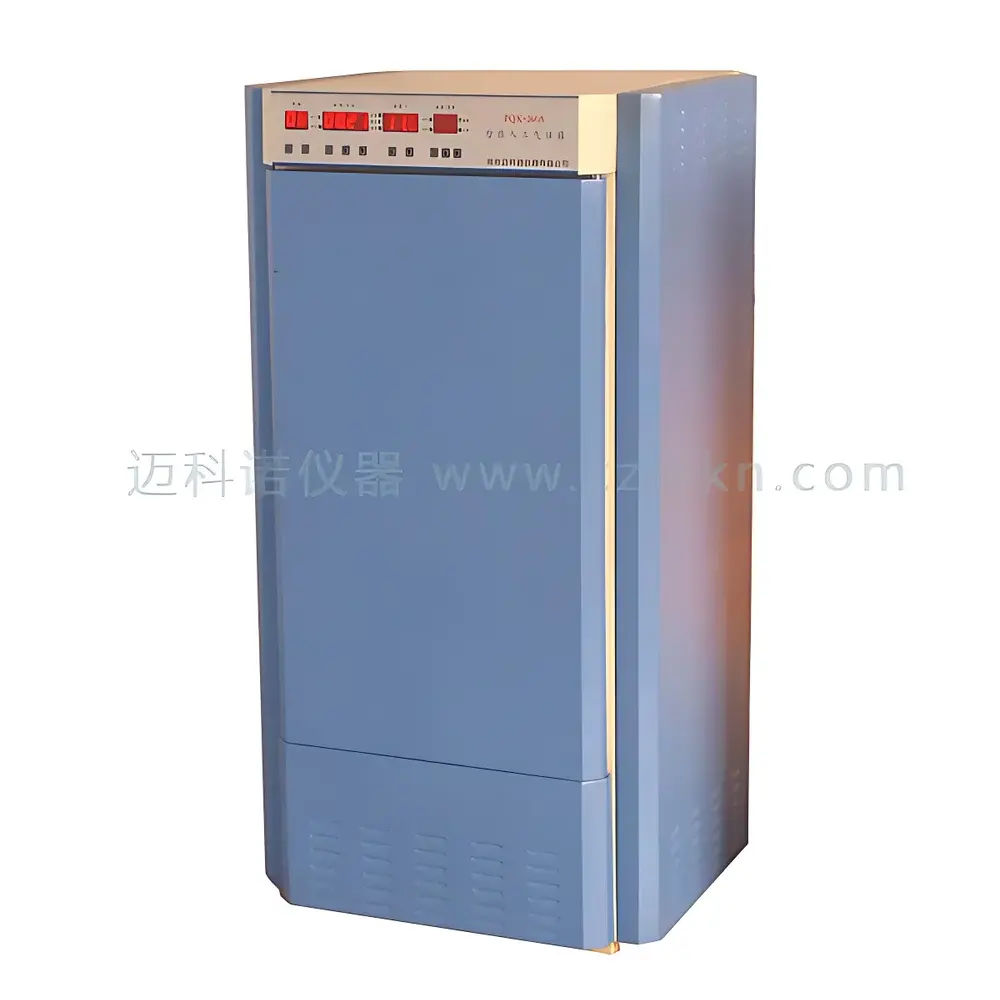
MKN RQX-160 Plant Growth Chamber
| Brand | MKN |
|---|---|
| Origin | Zhejiang, China |
| Model | RQX-160 |
| Capacity | 160 L |
| Power Supply | AC 220 V ±10%, 50 Hz ±2% |
| Temperature Control Range | 5–50 °C (dark), 10–50 °C (full illumination) |
| Temperature Accuracy | ±1 °C |
| Temperature Uniformity | ±1 °C |
| Humidity Range | 50–90 %RH |
| Humidity Control Accuracy | ±5 %RH |
| Illumination Intensity | ≥5000 lux (adjustable) |
| Operating Ambient Temperature | 0–40 °C |
| Ambient Relative Humidity | ≤85 %RH |
| Chamber Construction | Painted steel exterior, stainless steel interior, polyurethane foam insulation |
| Air Circulation | Dedicated forced-air system with balanced airflow distribution |
| Safety Features | Compressor delay protection, power interruption recovery logic |
| Warranty | 12 months from date of shipment |
Overview
The MKN RQX-160 Plant Growth Chamber is a precision-engineered environmental simulation system designed for controlled plant physiology, photobiology, and long-term biological incubation studies. It operates on a dual-mode thermoregulatory principle—combining Peltier-assisted or compressor-based active cooling with resistive heating—and integrates humidity control via ultrasonic misting or evaporative saturation, depending on configuration. The chamber maintains stable, programmable microclimates by continuously monitoring and adjusting air temperature, relative humidity, and photosynthetically active radiation (PAR)-weighted illumination intensity across the entire 160 L working volume. Its architecture complies with fundamental requirements for GLP-compliant environmental testing environments, supporting reproducible experimental conditions essential for peer-reviewed botanical research, seed germination assays, stress response phenotyping, and preclinical agrochemical evaluation.
Key Features
- Microprocessor-based digital controller with LED display for real-time monitoring of temperature, humidity, and light intensity—enabling intuitive parameter setting and stable setpoint retention.
- Double-wall construction featuring high-density polyurethane foam insulation (≥35 mm thickness) minimizes thermal bridging and ensures low energy consumption under continuous operation.
- Stainless steel inner chamber (AISI 304 grade) provides corrosion resistance, ease of decontamination, and compliance with ISO 14644-1 Class 7 cleanroom-compatible surface finish standards.
- Optically clear double-glazed observation door with low-emissivity coating reduces condensation and maintains internal thermal integrity during visual inspection.
- Asymmetric axial fan array with adjustable airflow baffles delivers uniform temperature distribution (±1 °C) and laminar air movement—critical for eliminating stratification in multi-tier plant trays.
- Three-stage illumination system with configurable white LED arrays (5000–6500 K CCT) supports spectral tuning for photomorphogenesis studies; output is dimmable from 0 to ≥5000 lux at shelf level.
- Compressor protection circuitry includes automatic restart delay (≥3 minutes) and thermal cut-off safeguards to extend service life and prevent refrigerant cycling damage.
Sample Compatibility & Compliance
The RQX-160 accommodates standard growth vessels including Petri dishes, Magenta boxes, hydroponic rafts, and modular tray systems up to 380 × 280 × 120 mm per shelf (three adjustable shelves included). Its humidity control range (50–90 %RH) meets ASTM E104-22 requirements for hygrothermal exposure testing, while temperature stability aligns with ISO 20360-1:2020 specifications for laboratory incubators used in biological safety applications. The unit is CE-marked per Directive 2014/30/EU (EMC) and 2014/35/EU (LVD), and its firmware architecture supports audit-ready logging when integrated with external data acquisition systems compliant with FDA 21 CFR Part 11 Annex 11 principles.
Software & Data Management
While the RQX-160 operates via standalone front-panel control, it features an RS-485 serial interface (Modbus RTU protocol) for integration into centralized lab management platforms. Optional PC software enables time-scheduled parameter ramping (e.g., diurnal temperature/humidity cycles), event-triggered data export (CSV), and alarm history review. All logged parameters—including timestamped min/max/mean values for each sensor channel—are stored onboard for ≥30 days. When connected to validated networked systems, the chamber supports electronic signature workflows and immutable audit trails required under GxP-regulated environments.
Applications
- Controlled-environment phenotyping of crop genotypes under drought, heat, or photoperiod stress regimes.
- In vitro propagation and callus induction requiring precise thermo-hygrometric coordination.
- Mycological culture maintenance where CO₂-independent humidity stabilization is critical.
- Toxicity screening of pesticides or heavy metals using standardized OECD 208 or EPA 712-C-96-005 test protocols.
- Seed viability and dormancy studies governed by ISTA Rules for Seed Testing (Section 5.3).
- Algal biomass production optimization under variable light quality and irradiance conditions.
FAQ
What is the maximum allowable ambient operating temperature for continuous use?
The chamber is rated for uninterrupted operation at ambient temperatures between 0 °C and 40 °C, provided relative humidity remains below 85 %RH and ventilation clearance (≥10 cm on all sides) is maintained.
Can the illumination spectrum be customized beyond standard white LEDs?
The base model uses fixed-color-temperature white LEDs; however, OEM spectral reconfiguration (e.g., red/blue ratio tuning) is available upon request with minimum order quantity and extended lead time.
Is remote monitoring supported out of the box?
No built-in Wi-Fi or Ethernet module is included; remote access requires integration via RS-485 Modbus to third-party SCADA or LabVIEW-based supervision systems.
Does the unit comply with IEC 61000-4 electromagnetic immunity standards?
Yes—tested per IEC 61000-4-2 (ESD), -4-3 (radiated RF), and -4-4 (electrical fast transients), with performance criteria A (no degradation of function) verified during factory acceptance testing.
What documentation is supplied for regulatory validation?
Each unit ships with a Factory Calibration Certificate (traceable to NIST standards), IQ/OQ checklist templates, and electrical safety test reports per IEC 61010-1:2010 Ed.3.



