
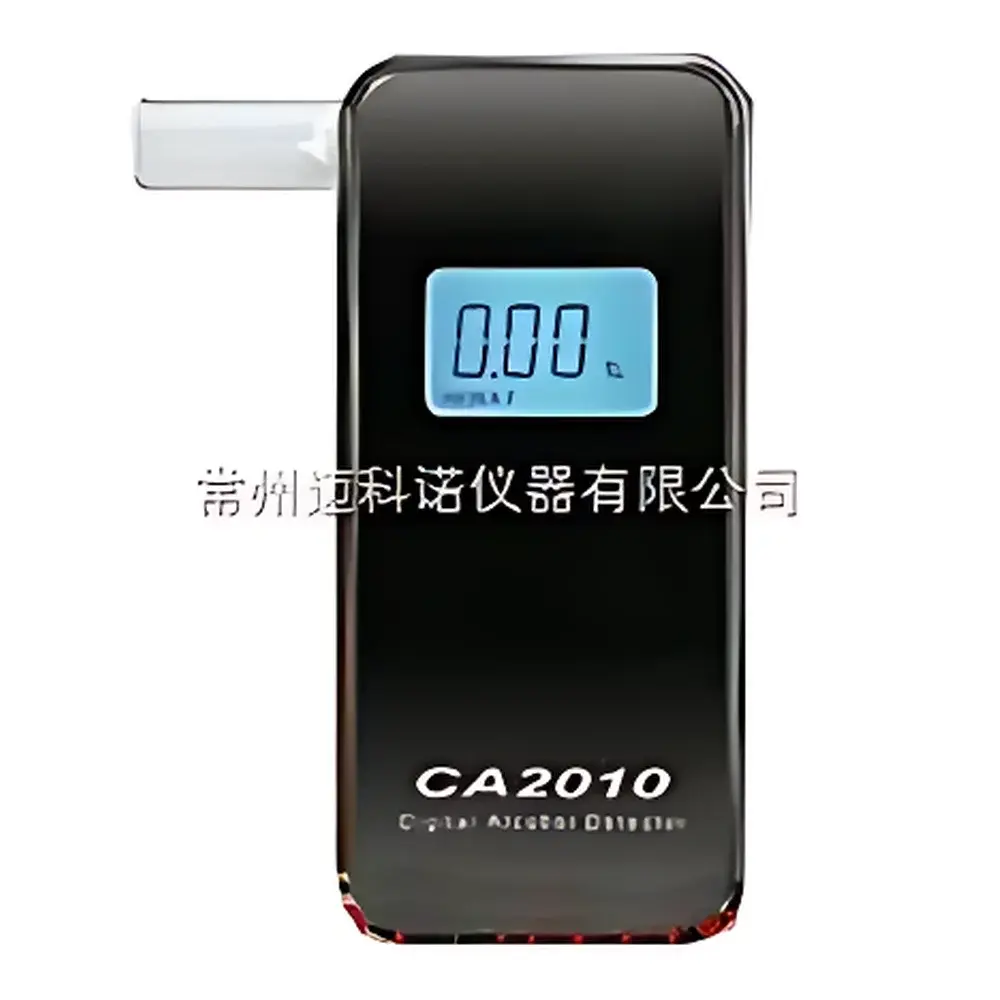
Alcohol Breathalyzer CA2010 – High-Selectivity Semiconductor Sensor-Based Ethanol Analyzer
| [Origin | Zhejiang, China |
|---|---|
| Manufacturer Type | Authorized Distributor |
| Origin Category | Domestic (PRC) |
| Model | CA2010 |
| Pricing | Available Upon Request] |
Overview
The Alcohol Breathalyzer CA2010 is a portable, field-deployable ethanol concentration analyzer engineered for rapid, non-invasive breath alcohol testing in law enforcement, workplace safety, transportation compliance, and occupational health screening applications. It operates on the principle of selective catalytic oxidation of ethanol vapor on a proprietary metal oxide semiconductor (MOS) sensing element—specifically formulated ceramic-based tin dioxide (SnO₂) doped with transition-metal catalysts. Unlike conventional broad-spectrum MOS sensors, this patented sensor exhibits exceptional specificity to ethanol due to optimized surface chemistry and thermal modulation, minimizing cross-sensitivity to common interferents including acetaldehyde, acetone, isopropanol, cigarette smoke volatiles, and food-derived esters. The device complies with fundamental performance criteria outlined in ISO 8570:2019 (Breath alcohol analyzers — Requirements and test methods) for preliminary screening devices and supports traceable measurement integrity through user-accessible calibration verification.
Key Features
- Proprietary high-selectivity semiconductor ethanol sensor with ≥3,000 measurement cycles lifetime
- Real-time breath flow monitoring: detects insufficient or interrupted exhalation (≥1.5 s minimum continuous flow required); triggers audible/visual “Err” alert if flow deviates
- On-device calibration verification function: guides users through reference gas-free accuracy check using internal stability algorithms; prompts recalibration recommendation when drift exceeds ±0.08 mg/mL at 1.00 mg/mL BAC
- Dual-color backlit LCD display (blue/red): 3-digit resolution, auto-switching to red backlight + “WARN” icon + audible alarm at ≥0.50 mg/mL BAC
- Rapid operational readiness: 20-second warm-up time; 3–5 second response time to steady-state ethanol concentration; full sensor recovery within 30 seconds post-test
- Ergonomic titanium-coated ABS housing (56 × 123 × 23 mm; 111 g with battery and mouthpiece)
- Hygienic design: disposable, replaceable mouthpieces included (3 standard units); compatible with optional sterilizable or single-use variants
- Power flexibility: 9V alkaline battery (≥300 tests per charge) or 12V DC automotive cigarette lighter adapter; auto-power-off after 10 s of display hold or 30 s of inactivity; low-battery indicator
Sample Compatibility & Compliance
The CA2010 is validated for human alveolar air sampling via standardized breath collection using disposable polypropylene mouthpieces. It measures ethanol concentration expressed as blood alcohol concentration (BAC) equivalents in mg/mL, derived from the established 2100:1 blood-to-breath partition ratio. While not intended for evidential-grade forensic reporting under U.S. DOT 49 CFR Part 40 or UK Home Office Type Approval protocols, it meets functional requirements for preliminary screening per EN 15964:2011 (Alcohol interlocks — Performance requirements and test procedures) Annex A. Device firmware logs no raw data but retains last 10 test timestamps and result flags (pass/fail relative to 0.50 mg/mL threshold) for audit review. All materials comply with RoHS 2011/65/EU and REACH SVHC regulations.
Software & Data Management
The CA2010 operates as a standalone hardware instrument with embedded firmware—no external software, drivers, or cloud connectivity required. Calibration verification data and operational status (e.g., sensor health index, battery voltage, warm-up completion) are communicated exclusively via the LCD interface and audible tones. No data export, USB interface, or PC synchronization capability is implemented, ensuring compliance with environments requiring air-gapped operation (e.g., secure facilities, mobile patrol units). Audit trails are limited to visual confirmation of pass/fail outcomes and real-time display retention—consistent with GLP-aligned field screening workflows where documentation occurs manually or via integrated body-worn camera systems.
Applications
- Pre-shift and random alcohol screening in transportation fleets (bus, taxi, logistics), construction sites, and offshore energy operations
- Law enforcement roadside preliminary assessment prior to evidential breath or blood testing
- Corporate wellness programs and HR-led substance misuse prevention initiatives
- Emergency medical triage support in ambulances or urgent care settings where rapid intoxication estimation informs clinical decision-making
- Training and calibration verification for certified breath test operators maintaining proficiency under state or national regulatory frameworks
FAQ
What does the “Err” message indicate during testing?
It signals inconsistent or sub-threshold exhalation flow—typically caused by short bursts, pauses, or weak blowing. Users must maintain steady exhalation for ≥1.5 seconds without interruption.
How often should the sensor be recalibrated?
Recalibration is recommended after every 200 tests or quarterly—whichever occurs first—or immediately following the instrument’s calibration verification prompt.
Can the CA2010 be used for legal evidence submission?
No. It is designated for preliminary screening only and does not meet evidential-grade certification standards such as U.S. NHTSA Conforming Product List (CPL) or UK Home Office approval.
Is the device suitable for use in cold environments?
Operational range is specified from 10 °C to 40 °C. Below 10 °C, response time may increase and baseline stability may degrade; condensation inside the airflow path must be avoided.
Does the CA2010 require periodic firmware updates?
No. The device contains fixed-function firmware with no upgradable components or network interfaces.







