
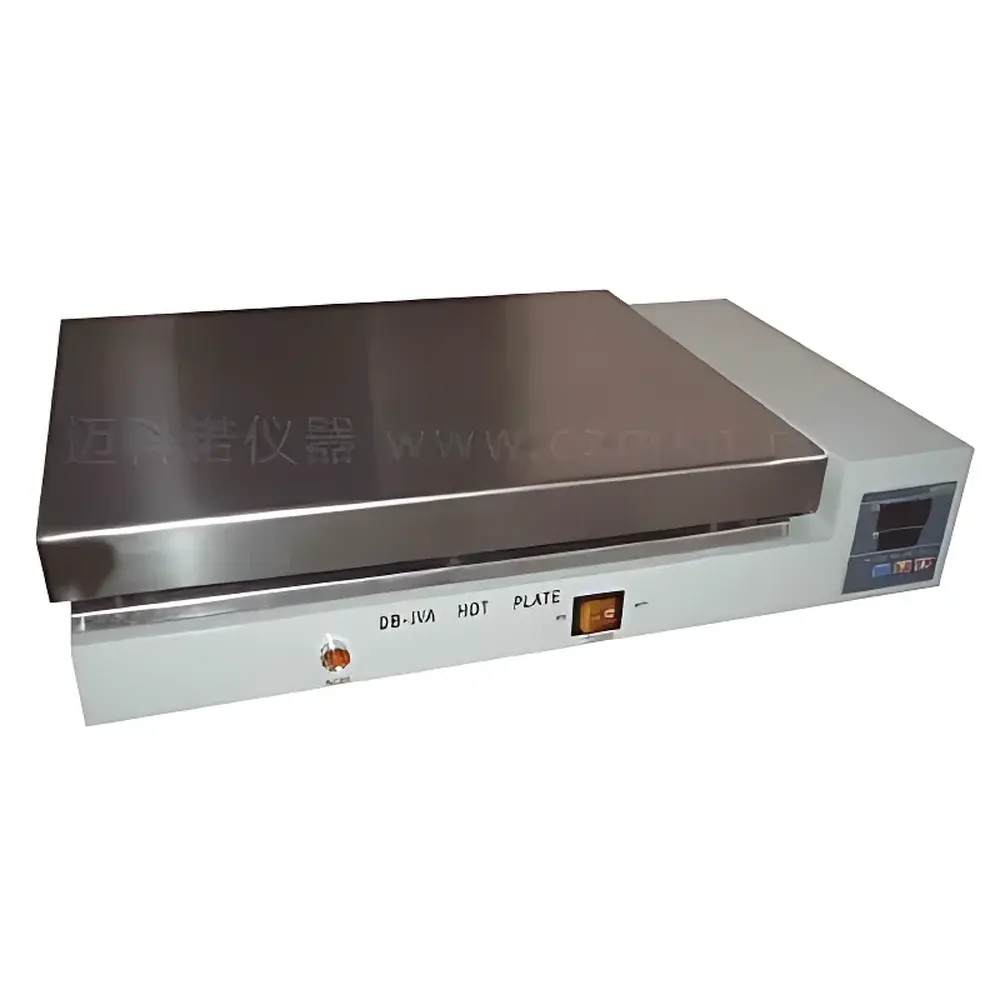
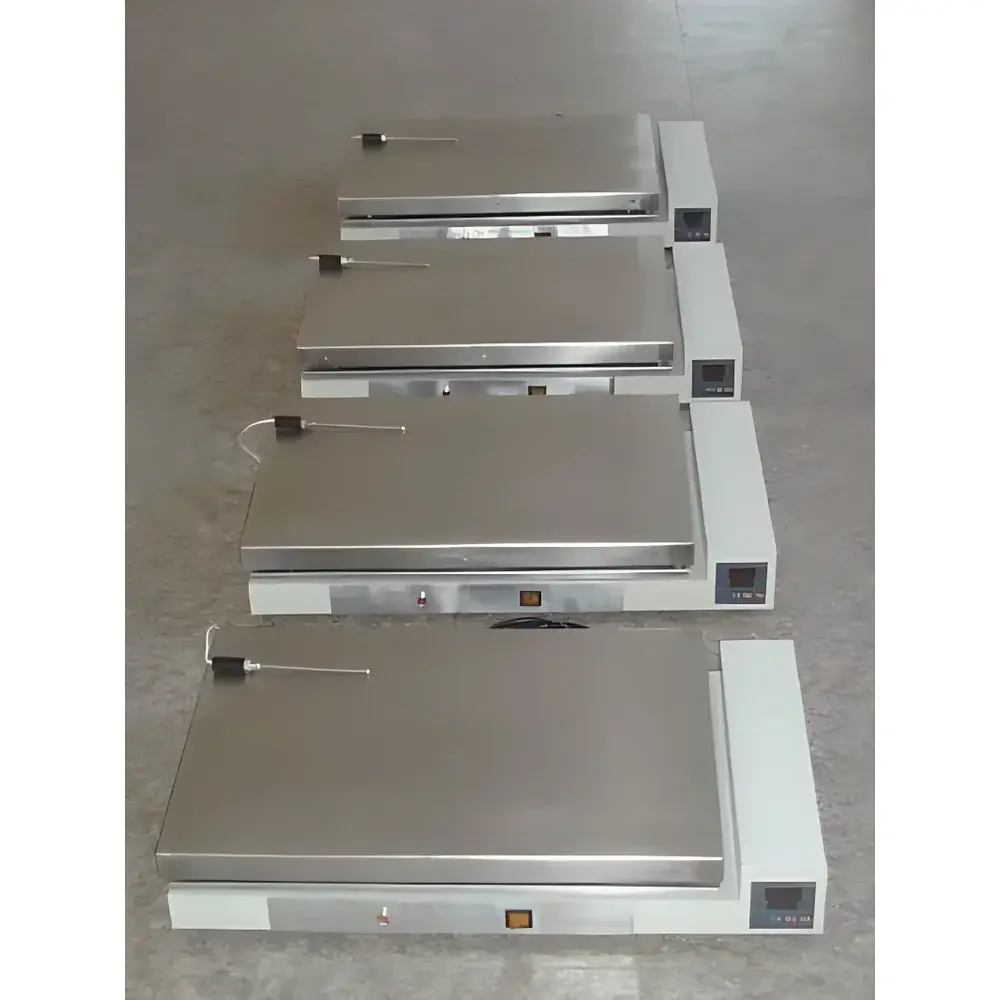
MKN DB-A Series Temperature-Controlled Stainless Steel Electric Heating Plate
| Brand | MKN |
|---|---|
| Origin | Jiangsu, China |
| Model | DB-A Series |
| Power Options | 1000 W / 1500 W / 2000 W / 3000 W |
| Voltage/Frequency | AC 220 V, 50 Hz |
| Temperature Range | Ambient to 300 °C |
| Temperature Accuracy | ±1 °C |
| Working Surface | Thickened 304 Stainless Steel |
| Surface Dimensions (DB-IIA to DB-VA) | 25×16 cm to 60×40 cm |
| Heating Technology | Far-Infrared Silicon Carbide (SiC) Element |
Overview
The MKN DB-A Series Temperature-Controlled Stainless Steel Electric Heating Plate is a precision-engineered laboratory heating platform designed for reproducible, uniform thermal treatment of samples during sample preparation, digestion, evaporation, drying, and controlled-temperature incubation protocols. Unlike conventional resistive coil plates, this series employs far-infrared silicon carbide (SiC) heating elements—engineered for rapid thermal response, minimal power loss, and exceptional spatial temperature homogeneity across the entire working surface. The SiC-based heating architecture delivers stable heat flux with negligible thermal lag, enabling precise ramp-and-hold temperature profiles essential for standardized methods in environmental analysis, pharmaceutical QC, clinical diagnostics, and academic research laboratories. Its robust construction centers on a thickened, electropolished 304 stainless steel top plate—resistant to corrosion from acids, alkalis, and organic solvents commonly encountered in wet chemistry workflows. All models comply with IEC 61000-6-3 (EMC emissions) and IEC 61000-6-2 (immunity), and are built to meet general safety requirements per IEC 61010-1 for laboratory electrical equipment.
Key Features
- Far-infrared silicon carbide (SiC) heating elements ensure fast warm-up (typically <15 min to 300 °C), low thermal inertia, and ±1 °C temperature stability at setpoint.
- Thickened 304 stainless steel working surface—electropolished for chemical resistance, ease of cleaning, and long-term dimensional stability under repeated thermal cycling.
- Digital PID temperature controller with LED display enables intuitive setpoint entry, real-time temperature monitoring, and adjustable ramp rates (where applicable in advanced variants).
- Over-temperature protection circuit automatically cuts power if sensor feedback exceeds user-defined safety limit (default: 320 °C), preventing thermal runaway and protecting both sample integrity and operator safety.
- Non-slip rubber feet and reinforced chassis provide mechanical stability during extended operation; no external cooling fan required—passive convection design minimizes electromagnetic interference in sensitive instrumentation environments.
- Modular power rating options (1000–3000 W) and scalable surface dimensions (25×16 cm to 60×40 cm) support flexible integration into fume hoods, laminar flow cabinets, or benchtop workflows without compromising thermal performance.
Sample Compatibility & Compliance
The DB-A Series accommodates standard laboratory vessels—including borosilicate glass beakers, quartz crucibles, PTFE digestion vessels, and ceramic evaporating dishes—without risk of warping or surface adhesion. Its flat, non-porous stainless steel surface ensures compatibility with ASTM D5291 (elemental analysis by XRF), EPA Method 3050B (acid digestion of sediments), and ISO 11466 (extraction of trace metals from soils). While not certified for GLP/GMP production environments, the instrument supports audit-ready documentation when used within validated laboratory SOPs. It meets CE marking requirements for electrical safety (EN 61010-1) and electromagnetic compatibility (EN 61326-1), and its materials conform to RoHS Directive 2011/65/EU restrictions on hazardous substances.
Software & Data Management
The base DB-A Series operates via standalone digital control with no embedded software or data logging capability—intentionally designed for simplicity, reliability, and regulatory transparency in regulated labs where unvalidated firmware poses validation overhead. For users requiring electronic recordkeeping, optional RS-485 interface modules (sold separately) enable integration with third-party SCADA systems or LIMS platforms compliant with FDA 21 CFR Part 11 when paired with validated communication drivers and audit-trail-enabled host software. All temperature setpoints and operational status can be monitored remotely via analog 0–10 V or 4–20 mA output signals (configurable upon request).
Applications
- Acid digestion of environmental matrices (soils, sludges, plant tissues) prior to ICP-OES or AAS analysis.
- Controlled evaporation of solvent extracts in pesticide residue testing (AOAC 2007.01, EN 15662).
- Drying of filter papers, gravimetric precipitates, or lyophilized standards in quality control laboratories.
- Pre-heating reagents and reaction mixtures in synthetic chemistry and enzymatic assays.
- Supporting hotplate-stirrer hybrid configurations when mounted beneath magnetic stirrers with external temperature probes (e.g., PT100 input).
- Calibration verification of thermocouples and RTDs using fixed-point reference blocks placed directly on the heated surface.
FAQ
What is the maximum continuous operating temperature?
The DB-A Series is rated for continuous operation up to 300 °C; sustained use above this threshold may degrade SiC element lifespan and compromise temperature accuracy.
Is the heating surface compatible with hydrofluoric acid (HF)?
No—while 304 stainless steel resists most mineral acids, it is not resistant to HF. Use PTFE-coated or quartz inserts when handling HF-containing digestions.
Can the unit be used inside a Class II biosafety cabinet?
Yes—provided adequate clearance (≥10 cm) is maintained around all sides for passive heat dissipation and airflow is not obstructed by vessel placement.
Does the DB-A Series include a calibration certificate?
Factory calibration is performed against NIST-traceable references; a Certificate of Conformance (CoC) is supplied with each unit. ISO/IEC 17025 calibration certificates are available upon request (additional lead time and fee apply).
What maintenance is required?
Routine cleaning with mild detergent and deionized water; avoid abrasive pads or chloride-based cleaners. Inspect SiC element integrity annually if used >4 h/day at >250 °C.



