
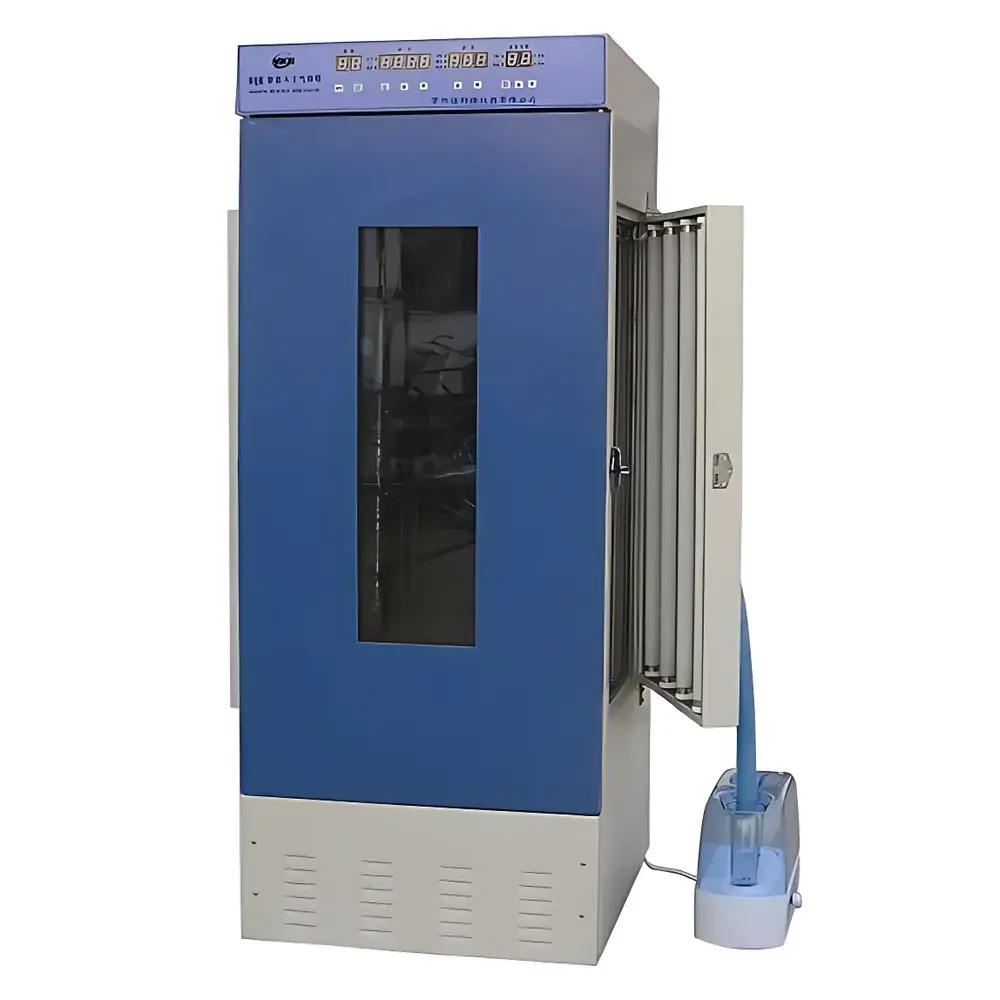
MKN RQX-160 Intelligent Plant Growth Chamber
| Brand | MKN |
|---|---|
| Model | RQX-160 |
| Capacity | 160 L |
| Power Supply | AC 220 V ±10%, 50 Hz ±2% |
| Temperature Control Range | 10–50 °C (with full illumination), 5–50 °C (dark) |
| Temperature Accuracy | ±1 °C |
| Temperature Uniformity | ±1 °C |
| Humidity Range | 50–90 %RH |
| Humidity Control Accuracy | ±5 %RH |
| Illumination Intensity | ≥5000 lx (adjustable) |
| Operating Ambient Temperature | 0–40 °C |
| Operating Ambient Relative Humidity | ≤85 %RH |
| Construction | Powder-coated steel exterior, stainless steel interior chamber |
| Insulation | Polyurethane foam |
| Lighting | Integrated LED or fluorescent lamp system with glass observation door |
| Air Circulation | Optimized forced-air convection system |
| Safety Features | Compressor delay start, power interruption protection |
| Warranty | 12 months from commissioning |
Overview
The MKN RQX-160 Intelligent Plant Growth Chamber is a precision-engineered environmental simulation system designed for reproducible, long-term cultivation of plants, algae, fungi, bacteria, and other photoautotrophic or photomorphogenic organisms under tightly controlled temperature, humidity, and light conditions. Based on the principle of active climate regulation—combining Peltier-assisted or compressor-based thermoelectric cooling/heating, capacitive or resistive humidity sensing with PID-driven vapor generation, and spectrally balanced illumination—the chamber delivers stable, programmable microenvironments essential for phenotypic screening, stress response studies, seed germination assays, circadian rhythm investigations, and controlled-environment agriculture (CEA) research. Its architecture adheres to ISO 17025-aligned calibration traceability principles for environmental parameters and supports GLP-compliant experimental documentation when integrated with validated software.
Key Features
- Triple-parameter microprocessor control system with independent PID algorithms for temperature, relative humidity, and light intensity—enabling simultaneous multi-stage program scheduling (e.g., day/night cycles with ramped transitions).
- High-fidelity LED or fluorescent lighting array delivering ≥5000 lx at working height, with dimmable output and optional spectral tuning (e.g., red/blue ratio adjustment) to simulate natural photoperiods or induce specific photobiological responses.
- Forced-air convection system with rear-mounted centrifugal blower and perforated baffle plate—ensuring temperature uniformity ≤±1 °C across the entire 160 L working volume (measured per ASTM E145-22 Annex A3).
- Double-wall construction with 60 mm thick polyurethane insulation (thermal conductivity λ ≈ 0.022 W/m·K) and magnetic-seal double-glazed observation door—minimizing thermal bridging and condensation while enabling non-invasive monitoring.
- Corrosion-resistant 304 stainless steel inner chamber (electropolished finish, Ra ≤ 0.8 µm) and powder-coated cold-rolled steel outer housing—meeting ISO 8573-1 Class 3 particulate cleanliness requirements for low-bioburden environments.
- Integrated safety architecture including compressor anti-short-cycling delay (≥3 min), over-temperature cut-off (10 °C above setpoint), and mains voltage fluctuation tolerance (±10 %)—designed for uninterrupted operation in shared laboratory infrastructure.
Sample Compatibility & Compliance
The RQX-160 accommodates standard plant growth vessels (e.g., Magenta boxes, square petri dishes, hydroponic trays up to 28 cm × 28 cm footprint) and microbial culture plates without airflow obstruction. Its internal dimensions (500 × 450 × 700 mm W×D×H) support vertical stacking of tiered shelving (optional). The chamber complies with IEC 61000-6-3 (EMC emissions), IEC 61000-6-2 (immunity), and UL 61010-1 safety standards. Humidity and temperature sensors are factory-calibrated against NIST-traceable references; calibration certificates are available upon request. For regulated environments, the system supports 21 CFR Part 11-compliant audit trails when paired with MKN’s optional GxP Data Logger Suite (v3.2+).
Software & Data Management
Local operation uses a 4.3-inch capacitive touchscreen interface with multilingual firmware (English, German, Spanish, Chinese). Real-time parameter logging (1-min intervals, 30-day buffer) is stored internally and exportable via USB 2.0 to CSV. Optional Ethernet/WiFi connectivity enables remote monitoring and control through MKN’s web-based PlantEnviro™ Platform—supporting role-based user access, alarm SMS/email notifications (SMTP/TLS), and integration with LIMS via RESTful API. All data files include embedded metadata (timestamp, operator ID, protocol ID, sensor serial numbers) to satisfy ALCOA+ data integrity criteria.
Applications
- Plant physiology: Photoperiodic flowering induction, vernalization studies, drought/stress acclimation protocols.
- Microbial ecology: Controlled co-culture experiments under defined light spectra to assess phototrophic–heterotrophic interactions.
- Seed science: Standardized germination testing per ISTA Rules (Section 6.2) and OECD Seed Health Testing Guidelines.
- Biomass production: Optimization of microalgae (Chlorella, Spirulina) growth kinetics under variable PAR and nutrient regimes.
- Educational labs: Hands-on teaching of environmental physiology, circadian biology, and experimental design fundamentals.
- Quality control: Stability testing of botanical extracts, probiotic cultures, or light-sensitive pharmaceutical intermediates per ICH Q1A(R2).
FAQ
What is the maximum sustainable illumination intensity at shelf level?
The chamber achieves ≥5000 lx at 15 cm below the lamp plane under full-output mode; intensity decreases by ~12 % per 10 cm vertical distance due to inverse-square law effects.
Can the humidity system operate independently of temperature control?
Yes—humidity setpoints can be maintained within 50–90 %RH across the full temperature operating range (5–50 °C), with no cross-interference between subsystems.
Is third-party validation support available for IQ/OQ/PQ protocols?
MKN provides template qualification documents (DQ/IQ/OQ) aligned with ISO 13485 and GMP Annex 15; site-specific PQ execution requires certified field service engineers.
How often does the humidity sensor require recalibration?
Under normal use, annual recalibration against saturated salt solutions (e.g., Mg(NO₃)₂ for 54 %RH, NaCl for 75 %RH) is recommended per ISO/IEC 17025 Clause 7.7.
Does the unit meet noise emission limits for quiet laboratory zones?
Acoustic pressure level is ≤52 dB(A) at 1 m distance during steady-state operation—compliant with ISO 7779 and EU Directive 2000/14/EC Stage II limits.




