
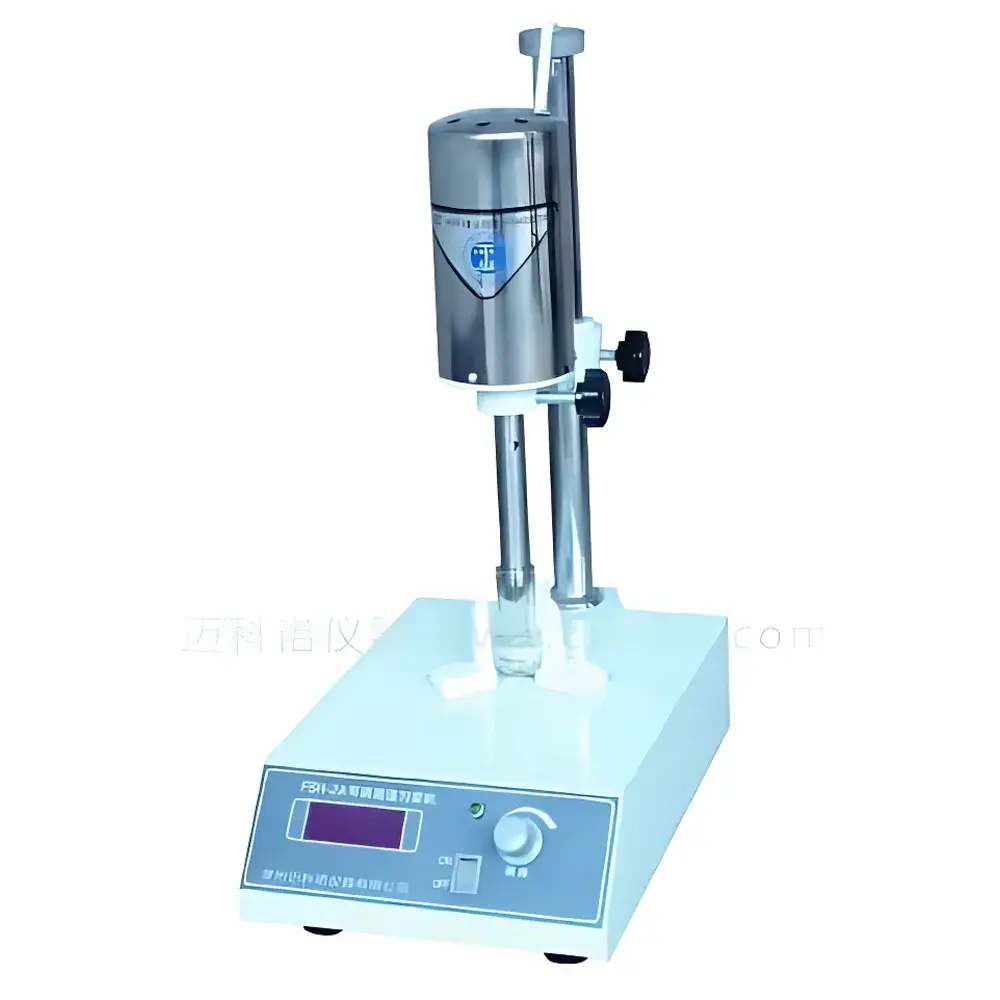
MKN FSH-2A Adjustable High-Speed Homogenizer
| Brand | MKN |
|---|---|
| Model | FSH-2A |
| Max Speed (Small Probe) | 25,000 rpm |
| Max Speed (Large Probe) | 22,000 rpm |
| Max Speed (with Large Probe in Glass Vessel) | 20,000 rpm |
| Probe Dimensions | Small — L122 × Φ11.5 mm |
| Compatible Vessel Capacities | 5 mL, 10 mL, 15 mL, 20 mL |
| Continuous Operation Limit | <5 min |
| Power Rating | 185 W |
| Input Voltage | 220 V ±10%, 50 Hz |
| Origin | Jiangsu, China |
| Distribution Type | Authorized Distributor |
Overview
The MKN FSH-2A Adjustable High-Speed Homogenizer is a precision-engineered laboratory instrument designed for rapid, reproducible mechanical disruption of biological tissues and soft cellular matrices. Operating on the principle of high-shear rotor-stator homogenization, the system delivers controlled kinetic energy through rotating probes immersed directly into sample vessels—enabling efficient cell lysis, tissue homogenization, and subcellular fractionation. As an upgraded successor to the FSH-1 platform, the FSH-2A integrates a silicon-controlled rectifier (SCR) speed control circuit, offering stepless rotational speed adjustment across its full operational range. Real-time speed verification is achieved via integrated optoelectronic tachometry, ensuring traceable and stable rotational output under variable load conditions. Its compact footprint, intuitive front-panel LED display, and ergonomic probe handling make it suitable for routine use in molecular biology labs, quality control environments, and academic research settings where consistent sample preparation is critical prior to downstream analysis (e.g., protein extraction, nucleic acid isolation, or metabolite profiling).
Key Features
- Stepless speed regulation via SCR-based electronic control, enabling precise RPM selection from zero to maximum rated speed.
- Optoelectronic tachometer with digital LED readout for real-time, non-contact speed monitoring—calibrated against ISO 2789:2022 reference standards for rotational instrumentation.
- Dual-probe configuration: interchangeable small-diameter (Φ11.5 mm) and large-diameter (Φ17.5 mm) stainless-steel rotor-stator assemblies optimized for viscosity and sample volume matching.
- Thermally stabilized 185 W induction motor with overload protection and low-noise brushless operation—engineered for repeatable torque delivery during short-duration, high-intensity cycles.
- Front-panel interface with clear digitized RPM display and tactile speed-adjustment knob—designed for glove-compatible operation in biosafety cabinets or laminar flow hoods.
- Compliance-ready design: CE-marked per EN 61000-6-2 (EMC immunity) and EN 61000-6-4 (EMC emissions); electrical safety certified to IEC 61010-1:2010.
Sample Compatibility & Compliance
The FSH-2A supports standardized glass homogenizing vessels (5–20 mL capacity), including borosilicate tubes conforming to ASTM E2503-19 specifications for laboratory glassware dimensional tolerance. It is routinely employed in the preparation of mammalian liver, muscle, plant fruit pulp, and cultured cell suspensions—materials commonly processed under GLP-aligned workflows for biomarker assay development. While not intended for sterilizable inline integration, all wetted probe surfaces are autoclavable (121 °C, 20 min, gravity cycle), supporting reuse in low-risk applications. The device meets essential requirements for inclusion in FDA-regulated analytical method validation protocols when paired with documented calibration records and maintenance logs per 21 CFR Part 11 Annex 11 data integrity guidelines.
Software & Data Management
The FSH-2A operates as a standalone analog-controlled instrument without embedded firmware or digital connectivity. All operational parameters—including setpoint RPM, run duration, and probe type—are manually configured and recorded externally. For laboratories requiring audit-trail compliance, users are advised to integrate the unit into electronic lab notebook (ELN) systems via manual entry or barcode-scanned protocol templates. Calibration certificates for tachometric verification may be generated using third-party optical tachometers traceable to NIST SRM 2034, and retention of these records satisfies ISO/IEC 17025:2017 clause 7.7.1 for equipment verification documentation.
Applications
- Routine homogenization of soft-tissue samples (e.g., rodent liver, porcine muscle, leaf mesophyll) prior to Western blotting or ELISA quantification.
- Preparation of uniform cell lysates from suspension cultures (e.g., CHO, HEK293) for enzymatic activity assays.
- Disruption of yeast and bacterial pellets in plasmid extraction workflows where mechanical lysis complements chemical treatment.
- Generation of stable emulsions and suspensions in formulation development for pharmaceutical excipient screening.
- Supporting ASTM D4052-22 density measurement protocols by ensuring homogeneous phase distribution in viscous bio-oil samples prior to pycnometry.
FAQ
What is the recommended duty cycle for continuous operation?
The FSH-2A is rated for intermittent use with a maximum continuous runtime of 5 minutes per cycle. Allow ≥10 minutes of cooling between successive runs to maintain motor thermal stability and probe bearing longevity.
Can the FSH-2A be used with plastic centrifuge tubes?
Only rigid-walled borosilicate glass vessels rated for high-speed homogenization are recommended. Polycarbonate or polypropylene tubes may fracture under shear stress and are not supported.
Is speed calibration traceable to national standards?
While the built-in optoelectronic tachometer provides internal consistency, external verification using NIST-traceable handheld tachometers (e.g., Extech 461923) is required for ISO/IEC 17025-compliant calibration.
Does the unit support regulatory-compliant electronic recordkeeping?
No native data export or network interface is provided. Compliance with 21 CFR Part 11 requires manual transcription of operating parameters into validated ELN or LIMS platforms.
What maintenance intervals are recommended?
Inspect probe threads and stator alignment quarterly; lubricate motor bearings annually using ISO VG 32 synthetic oil; replace carbon brushes every 2,000 operational hours or as indicated by commutation noise.



