
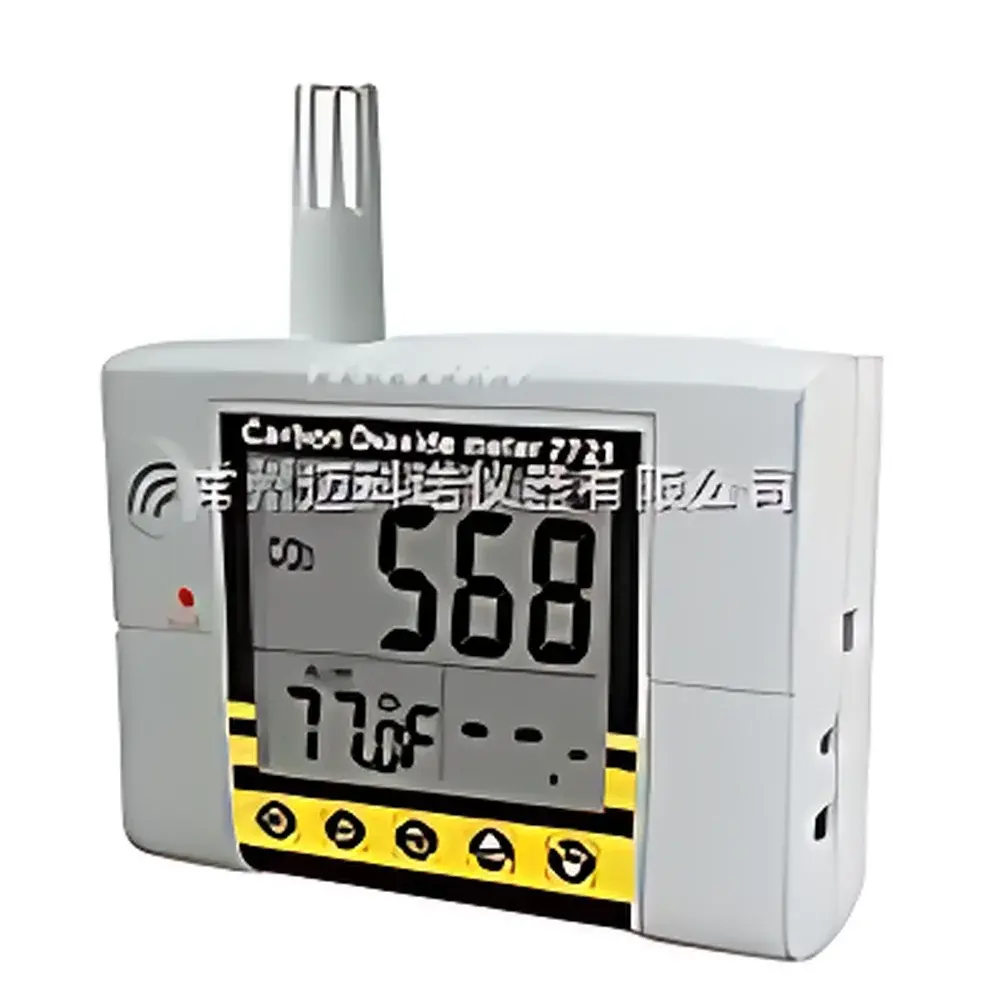
AZ7722/AZ77232 Wall-Mounted NDIR Carbon Dioxide Analyzer
| Origin | Zhejiang, China |
|---|---|
| Manufacturer Type | Authorized Distributor |
| Regional Origin | Domestic (PRC) |
| Model | AZ7722 / AZ77232 Wall-Mounted CO₂ Analyzer |
| Instrument Type | Online Fixed-Installation Gas Analyzer |
| Detection Target | Single-Gas (CO₂) |
| CO₂ Range | 0–2000 ppm (AZ7722) / 0–5000 ppm (AZ77232) |
| Accuracy | ±50 ppm ±5% (0–2000 ppm) / ±30 ppm ±5% (0–5000 ppm) |
| Humidity Range | 0.0–99.0 %RH (±3 %RH accuracy) |
| Temperature Range | −10 to +60 °C (±0.6 °C accuracy) |
| Resolution | 1 ppm CO₂ / 0.1 °C / 0.1 %RH |
| Warm-up Time | ≤30 s |
| Operating Environment | 0–50 °C, 0–95 %RH (non-condensing) |
| Storage Environment | −20–60 °C, 0–99 %RH (non-condensing) |
| Dimensions | 130 × 85 × 60 mm (L×W×T) |
| Output Interface | RS232 serial port (2-second data output interval) |
| Display | Backlit LCD with simultaneous CO₂, temperature, humidity, dew point, and wet-bulb temperature readouts |
| Alarm | Visual (LED) and audible (buzzer) threshold alerts |
| Data Logging | Onboard real-time recording capability |
| Power Supply | AC adapter (included) |
Overview
The AZ7722 and AZ77232 are wall-mounted, fixed-position carbon dioxide analyzers engineered for continuous ambient air quality monitoring in indoor environments such as office buildings, schools, laboratories, cleanrooms, HVAC control zones, and controlled agricultural facilities. These instruments utilize non-dispersive infrared (NDIR) spectroscopy—a mature, industry-standard optical absorption technique—to quantify CO₂ concentration with high selectivity and long-term stability. The dual-wavelength NDIR sensor architecture minimizes cross-sensitivity to water vapor and common atmospheric interferents, ensuring reliable measurements across variable humidity conditions. Unlike portable or handheld CO₂ meters, the AZ7722/AZ77232 series is designed for permanent installation, featuring a compact industrial enclosure (130 × 85 × 60 mm), DIN-rail compatible mounting brackets, and a robust thermal management system enabling stable operation within 0–50 °C ambient range. The integrated microprocessor performs real-time compensation for temperature and relative humidity—both measured concurrently using calibrated capacitive RH and thermistor-based temperature sensors—thereby enhancing measurement fidelity without requiring external environmental correction.
Key Features
- True NDIR sensing principle with factory-calibrated dual-wavelength detection for CO₂-specific quantification
- Simultaneous measurement of CO₂ (ppm), ambient temperature (°C/°F), relative humidity (%RH), dew point (°C), and wet-bulb temperature (°C)
- High-resolution backlit LCD display supporting concurrent multi-parameter visualization
- Configurable visual and audible alarm thresholds for CO₂, temperature, and humidity deviations
- RS232 serial interface providing ASCII-formatted data packets at 2-second intervals for integration into BMS, SCADA, or custom logging systems
- Onboard data recording functionality supporting time-stamped CO₂, temperature, and RH values
- Rapid thermal stabilization: full operational readiness achieved within ≤30 seconds after power-on
- Low-drift design validated through extended burn-in and temperature-compensated signal processing
- Compliant with IEC 61000-4 electromagnetic immunity standards for industrial indoor deployment
Sample Compatibility & Compliance
The AZ7722/AZ77232 is intended for sampling undiluted, non-corrosive, particle-free indoor air. It is not rated for use in explosive atmospheres (ATEX/IECEx), high-dust environments, or applications involving condensable vapors, aggressive gases (e.g., Cl₂, NH₃, SO₂), or aerosol-laden airstreams. For HVAC duct or ceiling diffuser installations, optional sample draw kits with particulate filtration and condensate traps are recommended. While not certified to ISO 12830 or EN 13725, the instrument’s NDIR methodology aligns with the physical principles referenced in ISO 7726 (ergonomics of thermal environments) and ASHRAE Standard 62.1 (ventilation for acceptable indoor air quality). Its accuracy specification meets typical requirements for demand-controlled ventilation (DCV) verification per ANSI/ASHRAE Guideline 1 and supports documentation under LEED IEQ Credit 1 (Outdoor Air Delivery Monitoring).
Software & Data Management
The analyzer communicates via standard RS232 protocol at configurable baud rates (default: 9600 bps, 8N1). An optional Windows-compatible PC software package (sold separately) enables real-time graphing, CSV export, alarm event logging, and user-defined calibration offset adjustments. All data transmissions include UTC timestamps synchronized to the device’s internal RTC. The firmware implements basic audit-trail functionality—recording date/time stamps for alarm activation, configuration changes, and manual zero-point initiation—supporting GLP-aligned recordkeeping where formal 21 CFR Part 11 compliance is not mandated. No cloud connectivity or remote firmware update capability is embedded; all configuration remains local and non-networked, preserving data integrity and cybersecurity posture in regulated facilities.
Applications
- Indoor air quality (IAQ) monitoring in commercial and institutional buildings for ASHRAE-compliant ventilation optimization
- Real-time CO₂ feedback control of HVAC fresh-air dampers in demand-controlled ventilation (DCV) systems
- Environmental validation in pharmaceutical manufacturing support areas (e.g., packaging rooms, corridors) per EU GMP Annex 1 guidance
- Occupancy estimation and space utilization analytics in smart building infrastructure
- Greenhouse climate control systems requiring precise CO₂ enrichment management
- Educational laboratory demonstrations of gas sensing principles and environmental parameter interdependence
- Baseline IAQ assessment during post-construction indoor air testing (e.g., prior to occupancy certification)
FAQ
What is the recommended calibration frequency for the AZ7722/AZ77232?
For routine indoor monitoring applications, annual zero and span calibration using certified CO₂ gas standards (e.g., 1000 ppm in N₂) is advised. In critical environments subject to regulatory review (e.g., GxP labs), semi-annual calibration with documented traceability to NIST or equivalent national metrology institutes is recommended.
Can the device operate unattended for extended periods?
Yes—the analyzer is designed for continuous 24/7 operation when powered via its included AC adapter. Internal thermal regulation and low-power NDIR optics ensure stable baseline performance over months of uninterrupted service, provided ambient conditions remain within specified operating limits.
Is field recalibration possible without specialized equipment?
A manual zero-point adjustment function is accessible via front-panel menu, allowing users to initiate auto-zero in CO₂-free air (e.g., outdoor ambient or bottled zero air). Span calibration requires certified gas and cannot be performed without external reference standards.
Does the unit comply with FDA 21 CFR Part 11 requirements?
No—the device lacks electronic signature capability, role-based access control, and immutable audit logs required for Part 11 compliance. It may serve as a data source in Part 11–compliant systems if interfaced through validated middleware with appropriate procedural controls.
What maintenance is required beyond calibration?
Periodic inspection of the optical window for dust accumulation and cleaning with lens-grade tissue and isopropyl alcohol is recommended every 6 months. No consumables (e.g., filters, lamps, electrolytes) require scheduled replacement.







