
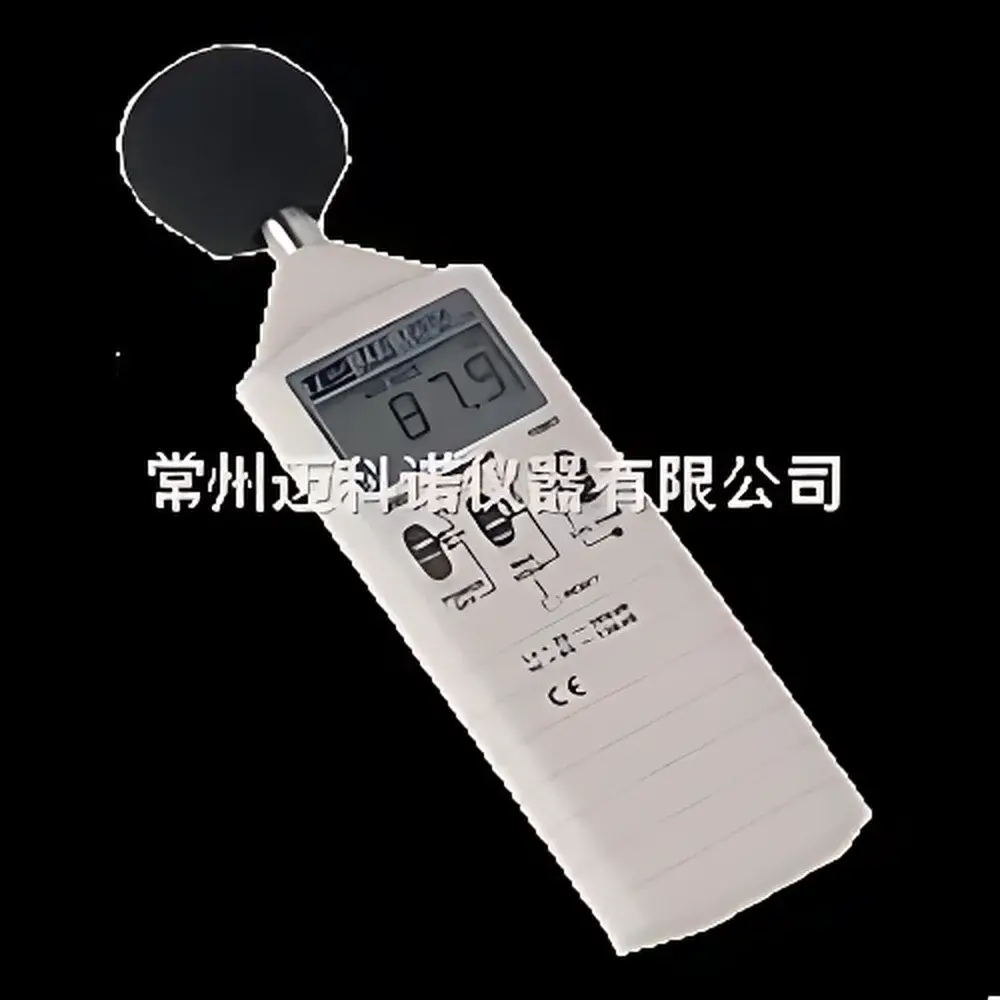
TES-1350R Digital Sound Level Meter with RS232 Interface
| Origin | Zhejiang, China |
|---|---|
| Manufacturer Type | Distributor |
| Origin Category | Domestic (China) |
| Model | TES-1350R Digital Sound Level Meter (RS232) |
| Pricing | Upon Request |
| Resolution | 0.1 dB |
| Max Hold Function | Yes |
| Output Interface | RS232 serial port |
| Compliance | IEC 651 Type 2 |
| Measurement Ranges | A-weighted Low: 35–100 dBA |
| A-weighted High | 65–130 dBA |
| C-weighted Low | 35–100 dBC |
| C-weighted High | 65–130 dBC |
| Frequency Range | 31.5 Hz to 8 kHz |
| Accuracy | ±2 dB |
| Dynamic Range | 65 dB |
| Weighting Networks | A and C |
| Time Weightings | Fast and Slow |
| Max Hold Decay Rate | <1 dB/3 min |
| Microphone Type | Polarized electret condenser |
| Internal Calibration | 94.0 dB @ 1 kHz |
| AC Output | ~0.65 Vrms per range, 600 Ω impedance |
| DC Output | ~10 mV/dB (nominal), 100 Ω impedance |
| Operating Temp/Humidity | 0–40 °C, <80% RH |
| Storage Temp/Humidity | −10–60 °C, <70% RH |
| Display | 3½-digit LCD |
| Power Supply | One 9 V alkaline battery |
| Dimensions | 240 × 68 × 25 mm (L×W×H) |
| Weight | 215 g |
| Accessories | Carrying case, test rod, 9 V battery, instruction manual, windscreen, PC software, RS232 cable |
Overview
The TES-1350R Digital Sound Level Meter is a portable, IEC 651 Type 2–compliant acoustic measurement instrument engineered for field and laboratory-based environmental noise assessment. It operates on the principle of sound pressure level (SPL) quantification using a polarized electret condenser microphone, transducing airborne acoustic energy into proportional electrical signals processed through analog-to-digital conversion and real-time digital signal conditioning. Designed for regulatory screening and occupational health monitoring, the meter supports dual weighting networks (A and C), dual time constants (Fast and Slow), and automatic maximum value retention—enabling reliable capture of transient and steady-state noise events across industrial, municipal, and educational environments. Its compact form factor, low power consumption, and RS232 interface facilitate integration into long-term monitoring workflows and data logging systems compliant with ISO 1996-2 (acoustics — description, measurement and assessment of environmental noise) and OSHA 1910.95 (occupational noise exposure).
Key Features
- IEC 651 Type 2 certified performance for general-purpose sound level measurement
- Dual-range measurement capability: Low range (35–100 dB) and High range (65–130 dB) in both A- and C-weighting configurations
- 0.1 dB resolution with real-time digital display and Max Hold function (decay rate <1 dB/3 min)
- Frequency response spanning 31.5 Hz to 8 kHz, optimized for human hearing sensitivity and broad-spectrum environmental noise profiling
- Integrated 94.0 dB internal calibration source at 1 kHz for rapid verification prior to measurement sessions
- Simultaneous AC and DC analog outputs: AC output (~0.65 Vrms per range, 600 Ω) for oscilloscope or external recorder connection; DC output (~10 mV/dB nominal, 100 Ω) for direct analog data acquisition
- RS232 serial interface enabling bidirectional communication with Windows-based PCs using included configuration and data logging software
- Robust mechanical design: 215 g lightweight housing (240 × 68 × 25 mm), IP54-rated dust/moisture resistance during operation, and extended battery life via single 9 V alkaline cell
Sample Compatibility & Compliance
The TES-1350R is suitable for measuring airborne sound pressure levels from diverse sources including HVAC systems, traffic noise, construction equipment, factory machinery, and classroom acoustics. Its A-weighting network approximates the 40-phon equal-loudness contour, making it appropriate for assessing potential hearing damage risk in occupational settings per ISO 9612 and ANSI S1.25. C-weighting provides flat response down to 31.5 Hz, supporting evaluation of low-frequency noise impact (e.g., transformer hum, ventilation rumble). The instrument meets IEC 651:1979 Type 2 specifications for amplitude accuracy (±2 dB), linearity, and temporal response. While not certified to IEC 61672 (the successor standard), its metrological behavior aligns with legacy Type 2 use cases where formal accreditation is not mandated—such as preliminary surveys, compliance screening, and internal QA/QC documentation under GLP-aligned protocols.
Software & Data Management
The bundled Windows-compatible software enables real-time data streaming, timestamped logging, and post-processing visualization (time-history plots, statistical histograms, Leq/Lmax/Lmin export). Raw RS232 data packets include measurement mode, weighting, time constant, current reading, and Max Hold status—structured for parsing into CSV or database formats. The software supports user-defined averaging intervals (1 s to 1 hr), configurable alarm thresholds, and batch export for audit trails. All data files retain embedded metadata (date/time stamp, operator ID, location tag), satisfying basic traceability requirements under ISO/IEC 17025 Clause 7.5.2 (control of records) and facilitating alignment with internal document control policies. No proprietary drivers are required; standard Windows COM port enumeration applies.
Applications
- Workplace noise mapping and OSHA/NIOSH-compliant exposure assessments
- Municipal environmental noise baseline studies and complaint investigations
- Building acoustics verification (e.g., STC/IIC pre-compliance checks)
- Educational demonstrations of sound physics and decibel scale interpretation
- Preventive maintenance monitoring of rotating equipment (fans, pumps, compressors)
- Construction site noise mitigation verification against local ordinances
- Audio system installation validation and loudspeaker coverage uniformity testing
FAQ
Is the TES-1350R compliant with current international standards such as IEC 61672?
No—the TES-1350R conforms to IEC 651:1979 Type 2, a superseded but still widely accepted specification for general-purpose sound level meters. It is not certified to IEC 61672-1:2013, which mandates stricter tolerances and additional functionality (e.g., impulse response, Z-weighting). Users requiring formal accreditation should verify applicability with their local regulatory authority.
Can the RS232 output be used for continuous unattended logging?
Yes—when connected to a PC running the included software or third-party serial logging tools (e.g., RealTerm, PuTTY with logging enabled), the meter transmits readings at user-selectable intervals (default: 1 sample/sec). External power via regulated 9 V DC adapter is recommended for extended deployments to avoid battery depletion.
What is the purpose of the C-weighting setting?
C-weighting attenuates frequencies below ~100 Hz less aggressively than A-weighting, preserving low-frequency content essential for evaluating structural vibration transmission, transformer noise, and sub-harmonic components in industrial environments.
Does the instrument support external calibration with a pistonphone?
While the TES-1350R includes a 94.0 dB internal calibrator, it lacks a dedicated microphone input jack for external pistonphone coupling. Field calibration requires verification against a traceable reference sound source per ISO 17195, followed by adjustment of the instrument’s offset if deviation exceeds ±1.5 dB.
Is the DC output linear across the full measurement range?
The DC output is nominally 10 mV/dB, calibrated at mid-scale (e.g., 80 dB). Linearity deviation is ≤±0.5 dB over the central 40 dB span (60–100 dB); users performing precision analog integration should apply empirical correction curves derived from factory calibration reports.







