
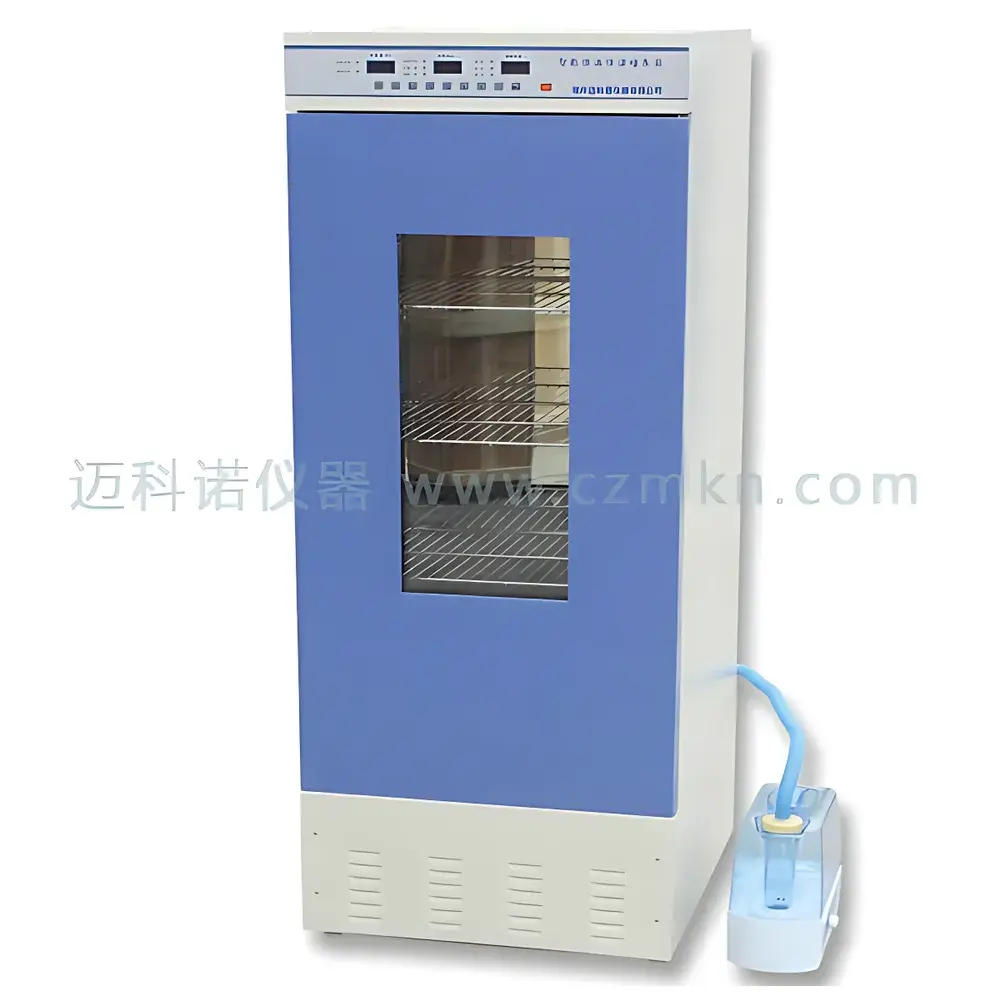
MaikeNuo MJX-160 Digital Mold Incubator
| Origin | Zhejiang, China |
|---|---|
| Manufacturer Type | Distributor |
| Origin Category | Domestic (China) |
| Model | MJX-160 |
| Price | USD 1,520 (approx.) |
| Temperature Range | 5–50 °C |
| Temperature Uniformity | ±1 °C |
| Humidity Range | 45–90 %RH |
| Humidity Control Accuracy | ±5 %RH |
| Capacity | 160 L |
| Power Supply | AC 220 V ±10 %, 50 Hz ±2 % |
| Operating Environment | 0–40 °C, ≤85 % RH (non-condensing) |
| Insulation | Polyurethane Foam |
| Interior Material | Stainless Steel (304) |
| Exterior Finish | Powder-Coated Carbon Steel |
| Viewing Window | Double-Layer Hollow Glass |
| Air Circulation | Dedicated Forced-Air System with Adjustable Fan Speed |
Overview
The MaikeNuo MJX-160 Digital Mold Incubator is a precision-engineered environmental chamber designed specifically for controlled fungal cultivation, mycological research, and long-term microbial growth studies requiring stable temperature and humidity regulation. Unlike standard general-purpose incubators, this unit integrates dual independent control loops for temperature and relative humidity—critical for reproducible sporulation, hyphal development, and strain preservation in Aspergillus, Penicillium, Fusarium, and other filamentous fungi. Its operation relies on Peltier-assisted or compressor-based cooling (model-dependent configuration), combined with PID-controlled resistive heating and ultrasonic or evaporative humidification. The chamber maintains ISO 14644-1 Class 7 cleanroom-compatible internal conditions, minimizing airborne contamination during extended incubation cycles. It complies with fundamental requirements outlined in ISO 21527-1 (microbiological methods for molds and yeasts) and supports GLP-aligned experimental workflows in academic, pharmaceutical, and environmental testing laboratories.
Key Features
- Dual-parameter microprocessor control system with LED digital display for real-time monitoring of temperature (5–50 °C) and relative humidity (45–90 %RH).
- Integrated UV-C germicidal lamp (254 nm) mounted inside the working chamber, enabling periodic decontamination between runs without disassembly.
- Forced-air circulation architecture with adjustable fan speed ensures uniform thermal distribution (±1 °C at setpoint) and consistent moisture dispersion across the full 160 L volume.
- High-efficiency polyurethane foam insulation (≥60 mm thickness) minimizes thermal bridging and reduces energy consumption during prolonged operation.
- Stainless steel (AISI 304) interior chamber and powder-coated carbon steel exterior provide corrosion resistance, ease of cleaning, and compliance with laboratory hygiene standards.
- Double-layer hollow glass door with anti-fog coating enables unobstructed visual observation while maintaining thermal integrity and reducing condensation.
- Compressor protection circuitry includes automatic power cut-off and delayed restart (≥3 minutes) to prevent mechanical stress during voltage fluctuations or frequent cycling.
Sample Compatibility & Compliance
The MJX-160 accommodates standard microbiological consumables including Petri dishes (up to 150 mm diameter), multi-well plates, slant tubes, and liquid culture flasks—configured on three adjustable stainless steel shelves. Its humidity control range (45–90 %RH) meets ASTM D3273 and ISO 846 criteria for mold resistance testing of building materials and polymers. While not certified to IEC 61000-4 electromagnetic compatibility standards out-of-the-box, the unit operates reliably in typical Class B laboratory environments. It supports documentation practices aligned with FDA 21 CFR Part 11 when paired with external data loggers (e.g., Vaisala viewLinc or Testo Saveris), though native electronic audit trail functionality is not embedded.
Software & Data Management
This incubator operates via an embedded standalone controller with no built-in PC connectivity or cloud interface. All operational parameters—including setpoints, runtime duration, UV activation schedule, and alarm history—are retained locally in non-volatile memory. For regulatory traceability, users are advised to integrate external validation-grade data loggers compliant with EN 12830 and calibrated per ISO/IEC 17025. The controller supports manual calibration offset adjustment for temperature and humidity sensors, facilitating routine verification against NIST-traceable reference standards. No proprietary software installation or driver dependencies are required; parameter changes are executed exclusively via front-panel tactile buttons with immediate LED feedback.
Applications
- Mycological taxonomy and strain maintenance under defined water activity (aw) conditions.
- Accelerated mold growth testing for packaging materials, textiles, and construction products per ISO 846 and JIS Z 2911.
- Environmental monitoring of indoor air quality (IAQ) sample plates in HVAC commissioning and remediation verification.
- Pharmaceutical stability studies involving moisture-sensitive biologicals (e.g., lyophilized vaccines, enzyme formulations).
- Academic teaching labs conducting fungal life cycle demonstrations, antifungal susceptibility assays (CLSI M38), and spore germination kinetics.
- Ecotoxicology assessments where fungal endpoints (e.g., Trichoderma viride respiration inhibition) serve as soil health indicators.
FAQ
Does the MJX-160 support programmable ramp-soak profiles?
No. It provides only static setpoint control for temperature and humidity; time-based profile programming is not available.
Is the UV lamp intensity validated or measurable?
The lamp output is fixed and not field-calibratable. Users should verify surface irradiance (µW/cm²) using a calibrated UV-C radiometer before critical sterilization protocols.
Can the unit operate continuously for >30 days without maintenance?
Yes—provided ambient conditions remain within specification (0–40 °C, ≤85 % RH) and the humidification reservoir is refilled every 48–72 hours depending on setpoint and load.
What is the recommended calibration frequency for routine GLP use?
Temperature and humidity sensors should be verified quarterly using traceable references; full recalibration is advised annually or after any physical impact or firmware reset.
Are replacement shelves or custom trays available?
Standard AISI 304 stainless steel shelves are replaceable; custom perforated or wire-mesh trays can be fabricated upon request with lead time confirmation.




