
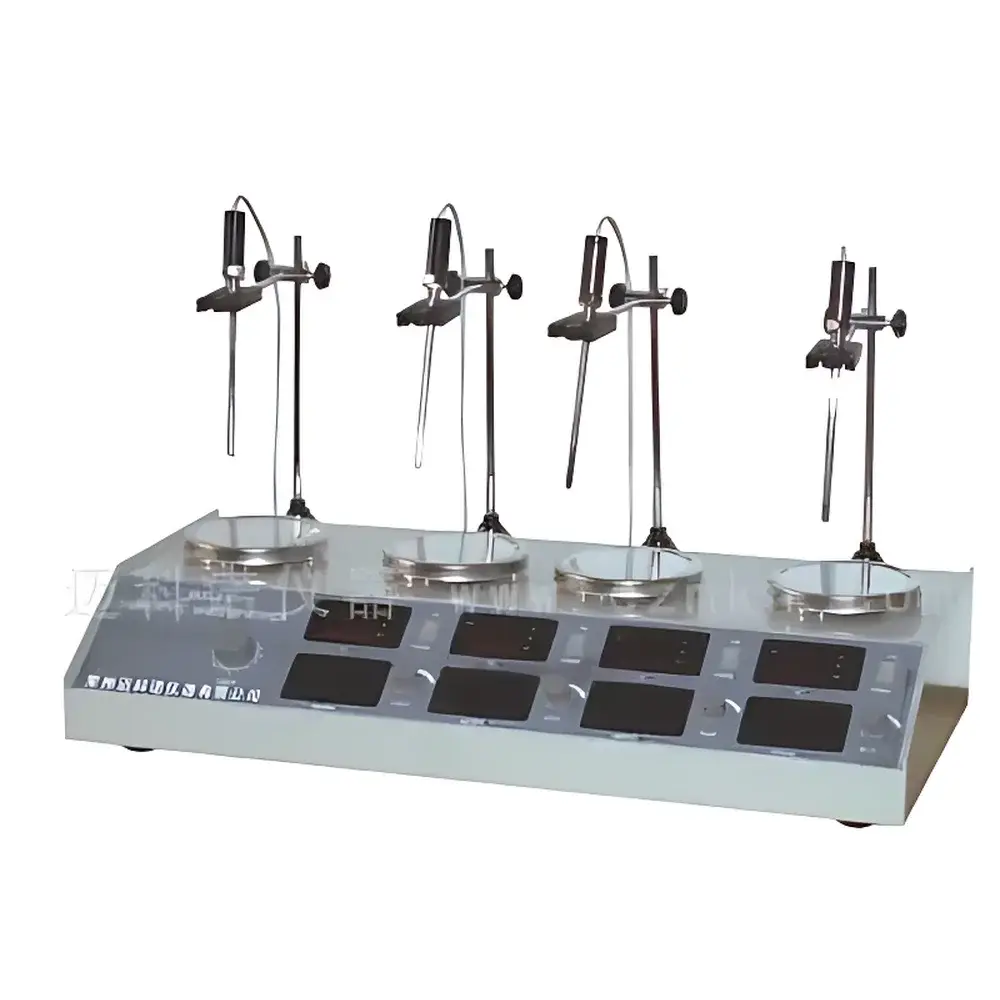
MKN HJ-4A Four-Position Digital Display Magnetic Stirrer with Independent Temperature Control
| Brand | MKN |
|---|---|
| Model | HJ-4A |
| Type | Magnetic Stirrer |
| Max. Stirring Volume per Position | 2 L |
| Total Max. Volume | 8 L |
| Speed Range | 0–2000 rpm (digital display, continuously adjustable) |
| Temp. Control Range | RT to 100 °C (digital PID control, ±0.5 °C accuracy) |
| Power Supply | 220 V ±10%, 50–60 Hz |
| Motor Power | 25 W × 4 |
| Heating Power | 200 W × 4 |
| Timer Range | 0–120 min |
| Stir Bar Compatibility | PTFE-coated, high-strength NdFeB magnets |
| Certifications | CE-marked, compliant with IEC 61010-1 for laboratory electrical safety |
Overview
The MKN HJ-4A Four-Position Digital Display Magnetic Stirrer is a precision-engineered benchtop instrument designed for simultaneous, independent thermal and mechanical agitation of up to four samples. It operates on the principle of magnetic coupling—where rotating permanent magnets beneath the ceramic-coated heating plate induce synchronized rotation of PTFE-encapsulated stir bars inside sealed or open vessels. Unlike overhead stirrers, this system eliminates mechanical shaft penetration, enabling contamination-free mixing in closed containers and reducing maintenance requirements. Its dual digital displays—one for speed and one for temperature—provide real-time, position-specific feedback, supporting reproducible experimental conditions across parallel reaction setups. The unit integrates DC brushless motors for low-noise operation (<45 dB(A)), extended service life, and consistent torque delivery across the full 0–2000 rpm range, even at low speeds critical for sensitive suspensions or viscous media.
Key Features
- Four independent stirring positions with fully decoupled speed and temperature control—each channel features dedicated digital LED displays for rpm and °C.
- Ceramic-coated aluminum heating plates offering uniform thermal distribution (±1.5 °C across surface), rapid heat-up (≤15 min to 100 °C), and chemical resistance to common solvents and acids.
- PTFE/Alnico composite stir bars included (10 mm × 30 mm and 15 mm × 40 mm); optimized for high torque transmission and stability up to 100 °C in aqueous, organic, and mildly corrosive media.
- PID-based temperature regulation with auto-tuning capability ensures stable setpoint maintenance (±0.5 °C typical deviation under load) and prevents overshoot during ramping.
- Programmable timer (0–120 min) with audible end-of-cycle alert; supports unattended operation while maintaining GLP-compliant process logging via external data acquisition interfaces.
- Overheat protection circuitry (cut-off at 120 °C) and motor stall detection prevent hardware damage during prolonged use or dry-heating events.
Sample Compatibility & Compliance
The HJ-4A accommodates standard laboratory glassware including beakers (50–2000 mL), Erlenmeyer flasks, and jacketed reactors with flat-bottom geometries. Its low-profile design allows integration beneath fume hoods or within temperature-controlled enclosures. All electrical components conform to IEC 61010-1:2010 (Edition 3) for safety in laboratory environments. While not intrinsically rated for explosive atmospheres, it meets EMC directive 2014/30/EU and RoHS 2011/65/EU material restrictions. For regulated quality systems, the device supports traceable calibration via external thermocouple verification and speed validation using optical tachometry—procedures aligned with ISO/IEC 17025 method validation requirements.
Software & Data Management
The HJ-4A operates as a standalone instrument without embedded firmware or proprietary software. However, its analog voltage outputs (0–5 V DC corresponding to actual rpm and temperature per channel) are compatible with third-party data loggers (e.g., NI DAQ, Keysight 34972A) for time-synchronized multi-parameter recording. When integrated into validated workflows, these signals enable audit-trail generation per FDA 21 CFR Part 11 when paired with compliant electronic lab notebook (ELN) platforms. No internal memory or network interface is provided—ensuring deterministic behavior and eliminating cybersecurity attack surfaces common in connected instruments.
Applications
- Parallel synthesis of catalysts, nanoparticles, and polymer precursors requiring identical thermal-mechanical histories across replicates.
- Standardization of dissolution testing per USP , where four USP Apparatus 2 vessels are simultaneously controlled under identical hydrodynamic and thermal conditions.
- Buffer preparation and reagent equilibration in QC labs, especially where pH-sensitive or oxygen-labile solutions demand inert, sealable vessel operation.
- Microbiological media sterilization support (pre-autoclave mixing) and enzymatic assay setup under tightly controlled incubation temperatures.
- Educational laboratories conducting comparative kinetics experiments—e.g., monitoring reaction rates across varying [substrate] or T while maintaining identical agitation intensity.
FAQ
Can the HJ-4A stir viscous solutions such as 50% glycerol/water mixtures?
Yes—its high-torque DC motors maintain stable rotation up to 1000 rpm in fluids with dynamic viscosity ≤ 1000 mPa·s at 25 °C, provided appropriately sized stir bars (e.g., 15 mm × 40 mm) are used.
Is calibration documentation provided with the unit?
No factory calibration certificate is included; users must perform initial verification using NIST-traceable thermometers and calibrated tachometers per their internal SOPs.
Does the unit support external temperature probe input for jacketed reactor control?
No—the built-in sensor measures plate surface temperature only; for vessel-core temperature feedback, a separate PID controller with external probe input is required.
What is the expected service life under continuous 8-hour daily operation?
With proper ventilation and periodic cleaning of heating plate debris, the unit demonstrates >50,000 hours MTBF based on component lifetime analysis of motors and solid-state relays.
Are replacement stir bars available in custom geometries or magnetic strengths?
MKN offers OEM-specified stir bars in diameters from 6 mm to 20 mm and lengths up to 60 mm, with optional SmCo magnets for applications above 150 °C (consult technical support for compatibility).



