
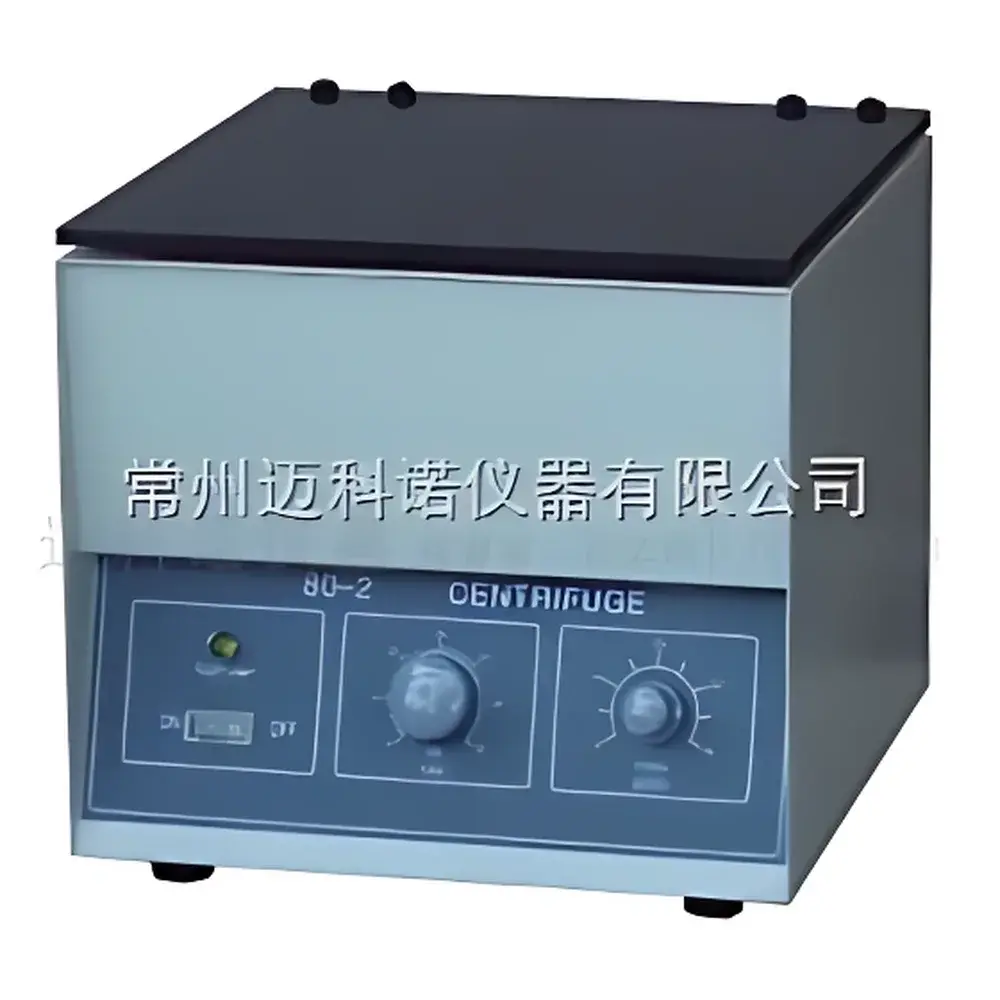
MKN 80-2 Benchtop Centrifuge
| Brand | MKN |
|---|---|
| Model | 80-2 |
| Max Speed | 4000 rpm |
| Relative Centrifugal Force (RCF) | 2325 × g |
| Capacity | 12 × 20 mL |
| Timer Range | 0–60 min |
| Noise Level | ≤60 dB(A) |
| Power Supply | AC 220 V, 50 Hz, 2 A |
| Construction | Die-cast aluminum rotor chamber and precision-balanced aluminum rotor |
| Compliance | Designed to meet general laboratory safety and electromagnetic compatibility (EMC) requirements per IEC 61010-1 |
Overview
The MKN 80-2 benchtop centrifuge is a compact, microprocessor-controlled laboratory instrument engineered for routine sedimentation and phase separation tasks in clinical, biochemical, and research settings. It operates on the principle of centrifugal force generation via high-precision rotational motion—accelerating suspended particles at defined angular velocities to induce differential sedimentation based on density, size, and shape. Unlike ultracentrifuges or refrigerated models, the 80-2 is optimized for ambient-temperature, low-to-medium RCF applications where rapid sample clarification, serum/plasma separation, or particulate pelleting is required. Its fixed-angle aluminum rotor ensures mechanical stability and thermal dissipation during extended operation, while the brushless DC motor delivers consistent torque across the full speed range without carbon brush wear or electrical noise.
Key Features
- Microprocessor-based speed and time control with digital LED display for real-time monitoring of rpm, elapsed time, and remaining countdown
- Stepless (infinite) speed adjustment from 0 to 4000 rpm, enabling precise optimization for diverse sample viscosities and densities
- Automatic rotor imbalance detection and shutdown—halts operation if vibration exceeds ISO 1940-1 G2.5 tolerance thresholds
- Integrated mechanical timer (0–60 minutes) with auto-stop function; no battery backup required, ensuring long-term reliability without drift
- Die-cast aluminum rotor chamber and anodized aluminum rotor—corrosion-resistant, non-magnetic, and compatible with common disinfectants including 70% ethanol and 0.5% sodium hypochlorite
- Low-noise design (≤60 dB[A] at 1 m distance) achieved through dynamic balancing, vibration-damping feet, and optimized airflow pathways
- Thermal management system limits housing surface temperature rise to <15 °C above ambient after 60 min continuous operation at max speed
Sample Compatibility & Compliance
The MKN 80-2 accommodates standard conical-bottom polypropylene or glass centrifuge tubes (10–20 mL), including common formats such as Falcon® 20 mL and Corning® 15 mL tubes when used with appropriate adapters. It supports both single-use and reusable tube configurations under GLP-aligned workflows. While not certified for biosafety level (BSL)-2 containment or aerosol-tight sealing, its sealed rotor chamber meets IEC 61010-1 Clause 7.3.2 for protection against accidental spill ingress during normal operation. The device complies with CE marking requirements for electrical safety (EN 61010-1) and EMC (EN 61326-1), and is routinely validated in hospital labs for use in CLIA-waived serum separation protocols per CLSI GP44-A4 guidelines.
Software & Data Management
As a stand-alone electromechanical instrument, the MKN 80-2 does not incorporate embedded software or network connectivity. All operational parameters are set manually via front-panel controls, eliminating firmware update dependencies or cybersecurity exposure vectors. For laboratories requiring audit trails, users may integrate the centrifuge into electronic lab notebooks (ELNs) via manual entry or barcode-scanned protocol templates. The absence of digital data logging aligns with environments where FDA 21 CFR Part 11 compliance is not mandated—for example, academic teaching labs or preliminary QC screening where handwritten logbooks satisfy internal SOPs.
Applications
- Routine separation of whole blood into serum or plasma layers for immunoassay preparation
- Pelleting of bacterial cultures (e.g., E. coli DH5α) prior to lysis buffer resuspension
- Clarification of crude enzyme extracts or cell lysates prior to chromatographic analysis
- Sedimentation of precipitated proteins or nucleic acid complexes following ammonium sulfate or ethanol precipitation
- Removal of insoluble debris from tissue homogenates in histopathology preprocessing
- Pre-analytical processing of urine sediments or cerebrospinal fluid (CSF) specimens in diagnostic microbiology
FAQ
Is the MKN 80-2 suitable for use with infectious samples?
No—this model lacks a sealed rotor or biocontainment certification. It must be operated within a certified biosafety cabinet when handling BSL-2 or higher agents.
Can I calibrate the speed or timer independently?
Speed calibration requires traceable tachometer verification against NIST-traceable standards; timer accuracy is factory-set and not user-adjustable per IEC 61010-1 Annex D.
What maintenance intervals are recommended?
Rotor inspection every 6 months for stress corrosion or pitting; lubrication-free motor design eliminates scheduled grease replacement.
Does the centrifuge support angled or horizontal rotors?
Only the fixed-angle 12-place aluminum rotor (20° tilt) is supplied; no swing-bucket or PCR plate carriers are available for this platform.
Is it compliant with ISO/IEC 17025 for accredited testing labs?
Yes—when paired with documented calibration records, preventive maintenance logs, and operator training verification, it satisfies clause 6.4.3 (equipment suitability) for non-critical separation steps.



