
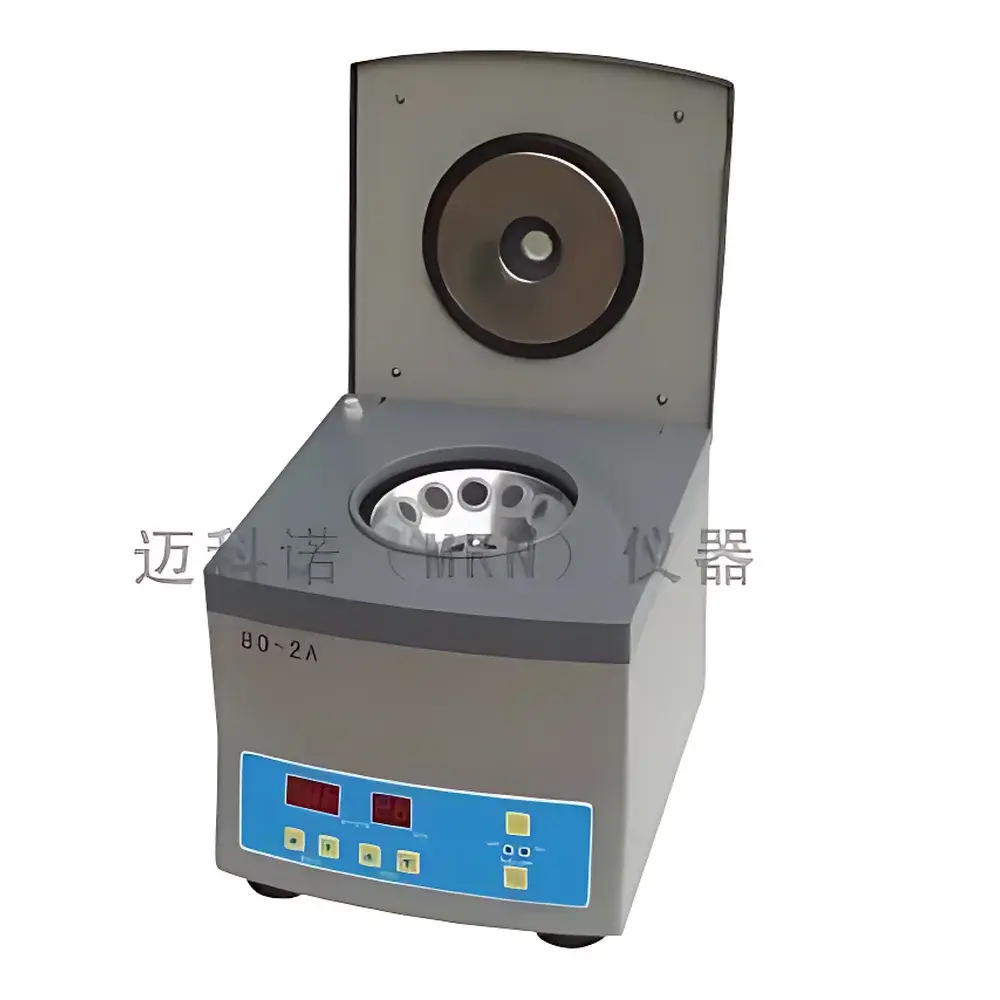
MKN 80-2A Digital Display Electric Centrifuge
| Brand | MKN |
|---|---|
| Model | 80-2A |
| Max Speed | 0–4000 rpm |
| Relative Centrifugal Force (RCF) | 2325 × g |
| Capacity | 12 × 20 mL (or 12 × 15 mL) |
| Timer Range | 0–99 min |
| Power | 135 W |
| Noise Level | ≤60 dB(A) |
| Supply Voltage | AC 220 V, 50 Hz, 2 A |
Overview
The MKN 80-2A Digital Display Electric Centrifuge is a compact, benchtop centrifuge engineered for routine separation tasks in life science, clinical, pharmaceutical, and environmental laboratories. It operates on the principle of sedimentation under controlled centrifugal force—accelerating particle settling based on density, size, and shape differences within heterogeneous liquid samples. Designed for reliability in high-throughput environments, the unit delivers consistent RCF up to 2325 × g at its maximum rotational speed of 4000 rpm, enabling efficient pelleting of cellular components, precipitates, and suspended particulates. Its robust construction features a high-strength polymer rotor chamber and a precision-balanced brushless DC motor, ensuring stable operation and extended service life. The device complies with general safety requirements for Class I electrical laboratory equipment per IEC 61010-1 and meets electromagnetic compatibility standards EN 61326-1.
Key Features
- Digital LED display showing real-time rotational speed (rpm) and remaining run time—enabling precise parameter monitoring and reproducible protocol execution.
- Microprocessor-based control system with intuitive touch-sensitive panel interface for seamless setting of speed, time, and acceleration/deceleration profiles.
- Integrated mechanical door lock and safety interlock switch—prevents lid opening during operation and automatically halts rotation if the lid is unlatched or improperly closed.
- Built-in imbalance detection and automatic shutdown mechanism—halts operation immediately upon detecting rotor load asymmetry exceeding safe thresholds, protecting both sample integrity and instrument longevity.
- Low-noise design (<60 dB[A] at rated speed) achieved through optimized airflow dynamics and vibration-dampening chassis architecture—suitable for shared lab spaces and quiet environments.
- Compact footprint (W × D × H ≈ 280 × 320 × 270 mm) and lightweight construction (≈12.5 kg)—ideal for space-constrained workbenches without compromising capacity (12 × 20 mL or 12 × 15 mL).
Sample Compatibility & Compliance
The 80-2A accommodates standard conical-bottom polypropylene or glass centrifuge tubes (15 mL and 20 mL), as well as compatible swing-out buckets and adapters for alternate tube formats. It supports common aqueous suspensions, buffered saline solutions, serum, plasma, cell culture supernatants, and environmental water extracts. While not certified for biosafety level (BSL)-2+ containment, it is suitable for non-pathogenic, low-risk biological samples when used with sealed tubes and appropriate PPE. The centrifuge conforms to general-purpose laboratory equipment requirements under ISO/IEC 17025-aligned quality management practices and supports GLP documentation workflows via manual log recording of operational parameters.
Software & Data Management
This model operates as a standalone instrument without onboard data logging or PC connectivity. All operational parameters—including set speed, timer value, and actual runtime—are displayed and retained only during active use. For auditability in regulated environments (e.g., QC labs following USP or internal SOPs), users are advised to record settings manually in lab notebooks or electronic lab notebooks (ELNs). No firmware updates or remote diagnostics are supported; calibration verification is performed using traceable tachometers per manufacturer-recommended intervals (typically semi-annually or after 500 operating hours).
Applications
- Routine blood fractionation: separation of serum/plasma from whole blood in clinical and veterinary diagnostics.
- Precipitate recovery in analytical chemistry workflows—including protein precipitation, nucleic acid extraction, and dye removal steps.
- Clarification of microbial cultures, fermentation broths, and food homogenates prior to downstream analysis (e.g., HPLC, spectrophotometry).
- Environmental sample processing: sedimentation of suspended solids from wastewater or soil leachates for gravimetric or elemental analysis.
- Educational use in undergraduate biology and chemistry laboratories—demonstrating principles of centrifugal force, sedimentation velocity, and phase separation.
FAQ
What is the maximum relative centrifugal force (RCF) achievable with this centrifuge?
The MKN 80-2A generates a maximum RCF of 2325 × g at 4000 rpm with the standard 12-position rotor.
Can this centrifuge accommodate 50 mL tubes?
No—it is designed exclusively for 15 mL and 20 mL conical tubes; no optional rotors or adapters for larger volumes are available.
Is the unit compliant with FDA 21 CFR Part 11 requirements?
No—this is a non-networked, non-auditable device without electronic records or electronic signatures; manual documentation is required for regulatory submissions.
Does the centrifuge include rotor calibration documentation?
Calibration certificates are not supplied by default but can be requested at time of order; field verification using a calibrated handheld tachometer is recommended prior to first use.
What maintenance is required to ensure long-term performance?
Routine cleaning of the rotor chamber and lid gasket with 70% ethanol, biannual inspection of the door latch mechanism, and annual verification of speed accuracy constitute the manufacturer’s minimal maintenance protocol.



