
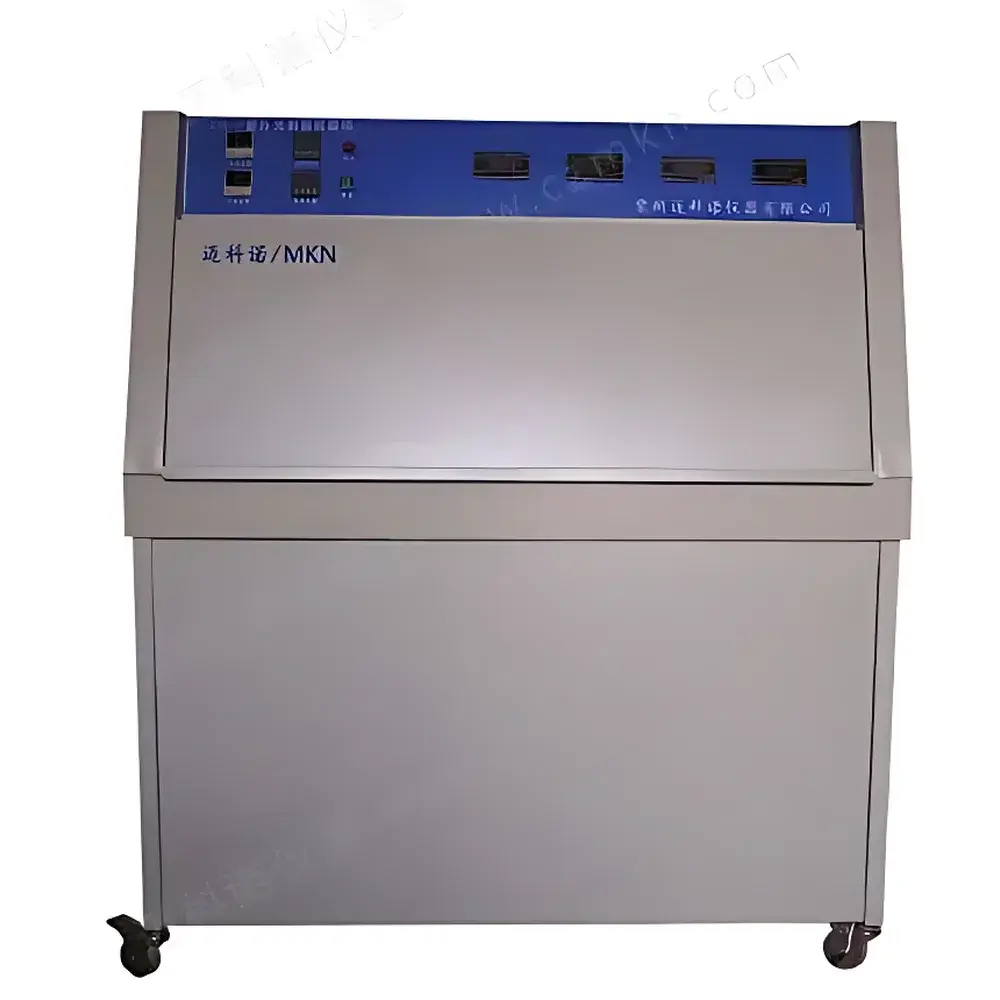
MKN ZN-P UV Weathering Test Chamber
| Brand | MKN |
|---|---|
| Origin | Jiangsu, China |
| Model | ZN-P |
| Chamber Interior Dimensions (W×D×H) | 450 × 1170 × 500 mm |
| External Dimensions (D×W×H) | 500 × 1380 × 1480 mm |
| Temperature Range | RT+10°C to 70°C |
| Humidity Range | 75–98% RH |
| UV Source | 8 × UVA/UVB fluorescent lamps (280–400 nm) |
| Lamp-to-Specimen Distance | 55 ± 3 mm |
| Lamp Spacing | 100 mm |
| Sample Holder | AISI 304 stainless steel |
| Standard Specimen Size | 75 × 150 × 1.5 mm |
| Exposure Modes | Condensation + Radiation |
| Humidification Method | Electric steam generator |
| Control System | Fuji high-precision temperature/humidity controller + Moeller programmable logic controller (PLC) |
| Construction | Stainless steel interior, powder-coated exterior |
| Safety Protections | Leakage circuit breaker, SSR overload protection, interlocked lamp chamber door, overtemperature alarm, grounding, low-water cutoff |
Overview
The MKN ZN-P UV Weathering Test Chamber is an engineered environmental simulation system designed to accelerate the evaluation of material degradation under controlled ultraviolet (UV) radiation, thermal stress, and cyclic humidity exposure. Unlike xenon arc or carbon arc systems, this chamber employs fluorescent UV lamps emitting within the 280–400 nm spectral range—covering both UVA (315–400 nm) and UVB (280–315 nm) bands—to replicate the most photochemically aggressive portion of terrestrial solar irradiance. The chamber integrates UV irradiation with precise temperature regulation (RT+10°C to 70°C), high-humidity conditioning (75–98% RH), and programmed condensation cycles to emulate real-world outdoor aging mechanisms such as photolysis, hydrolysis, thermal oxidation, and moisture-induced microcracking. Its design adheres to the metrological validation requirements specified in GB/T 5170.9—China’s national standard for calibration methods of environmental testing equipment—ensuring traceable performance verification for laboratory and industrial QA/QC applications.
Key Features
- Eight strategically arranged UVA/UVB fluorescent lamps provide uniform irradiance distribution across the test area; lamp positioning (55 ± 3 mm from specimen surface, 100 mm center-to-center spacing) ensures reproducible radiant exposure per ISO 4892-3 and ASTM G154.
- Balance-type heating and humidification control (BTHC) architecture enables stable, coupled regulation of temperature and relative humidity without overshoot or hysteresis—critical for simulating diurnal moisture cycling and dew formation.
- AISI 304 stainless steel interior chamber and sample rack resist corrosion from prolonged UV exposure and condensate accumulation, supporting long-term operational integrity and minimizing cross-contamination between test cycles.
- Integrated electric steam humidification system delivers rapid, contamination-free RH ramping and sustained saturation during condensation phases—eliminating mineral deposits common with ultrasonic or pan-based methods.
- Multi-layer safety architecture includes lamp chamber door interlock, solid-state relay (SSR) overload protection, ground-fault circuit interruption (GFCI), low-water cutoff, and independent overtemperature alarm—meeting IEC 61000-6-2 EMC and IEC 61000-6-4 emission compliance thresholds.
Sample Compatibility & Compliance
The ZN-P accommodates flat-panel specimens up to 75 × 150 × 1.5 mm on its standardized stainless-steel rack, supporting routine comparative testing of coatings, automotive trim, architectural sealants, polymer films, and textile finishes. Its exposure methodology aligns with key international standards including ASTM D4329 (fluorescent UV exposure of plastics), ISO 4892-3 (plastics—methods of exposure to laboratory light sources), and JIS D 0205 (automotive paint durability). While not certified to FDA 21 CFR Part 11 out-of-the-box, the Fuji controller and Moeller PLC support audit-ready data logging when configured with external timestamped storage and user-access controls—facilitating GLP/GMP-aligned validation protocols.
Software & Data Management
The chamber operates via a dual-control architecture: a Fuji PXR series temperature/humidity controller handles analog process loops with ±0.3°C/±2% RH accuracy, while a Moeller PS4-101 PLC manages sequence logic for UV-on/off cycles, condensation timing, dark periods, and safety interlocks. Real-time setpoint tracking, deviation alarms, and cycle completion signals are accessible through front-panel LCD display and dry-contact outputs. For extended data retention, optional RS-485 Modbus RTU interface enables integration with third-party SCADA or LIMS platforms—supporting automated report generation, trend analysis, and electronic batch records compliant with ISO/IEC 17025 documentation requirements.
Applications
This chamber is routinely deployed in R&D laboratories and production QA departments for predictive lifetime assessment of organic materials subject to outdoor service conditions. Typical use cases include evaluating UV stabilizer efficacy in polyolefin compounds, quantifying gloss loss and chalking in acrylic-based architectural coatings, assessing adhesion retention of pressure-sensitive tapes after accelerated weathering, and screening pigment fade resistance in automotive interior trims. Its ability to decouple UV dose from thermal load—via independent lamp power control and chamber ambient regulation—enables mechanistic studies of synergistic photochemical–hydrolytic degradation pathways.
FAQ
What UV spectral bands does the ZN-P simulate, and how are they selected?
The chamber uses commercially available UVA-340 or UVB-313 fluorescent lamps—selected per test standard requirements—to replicate either solar-spectrum-weighted UV (UVA-340) or highly accelerated short-wave UV (UVB-313).
Can the ZN-P perform cyclic exposure protocols with alternating UV and condensation phases?
Yes—the Moeller PLC supports fully programmable multi-step cycles, including UV irradiation, dark condensation, and humidity-soak segments, with independent duration and setpoint control for each phase.
Is calibration documentation provided with the unit?
Each unit ships with factory calibration certificates for temperature and humidity sensors, traceable to national metrology institutes per GB/T 5170.9 procedures.
What maintenance intervals are recommended for optimal lamp output stability?
UV lamps require replacement every 1,600–2,000 hours of operation; chamber calibration verification is advised quarterly or before critical qualification runs.
Does the system meet international electrical safety standards for export?
The unit conforms to IEC 61000 electromagnetic compatibility requirements and incorporates CE-marked components; final regional certification (e.g., UL, UKCA) requires local notified body assessment.



