
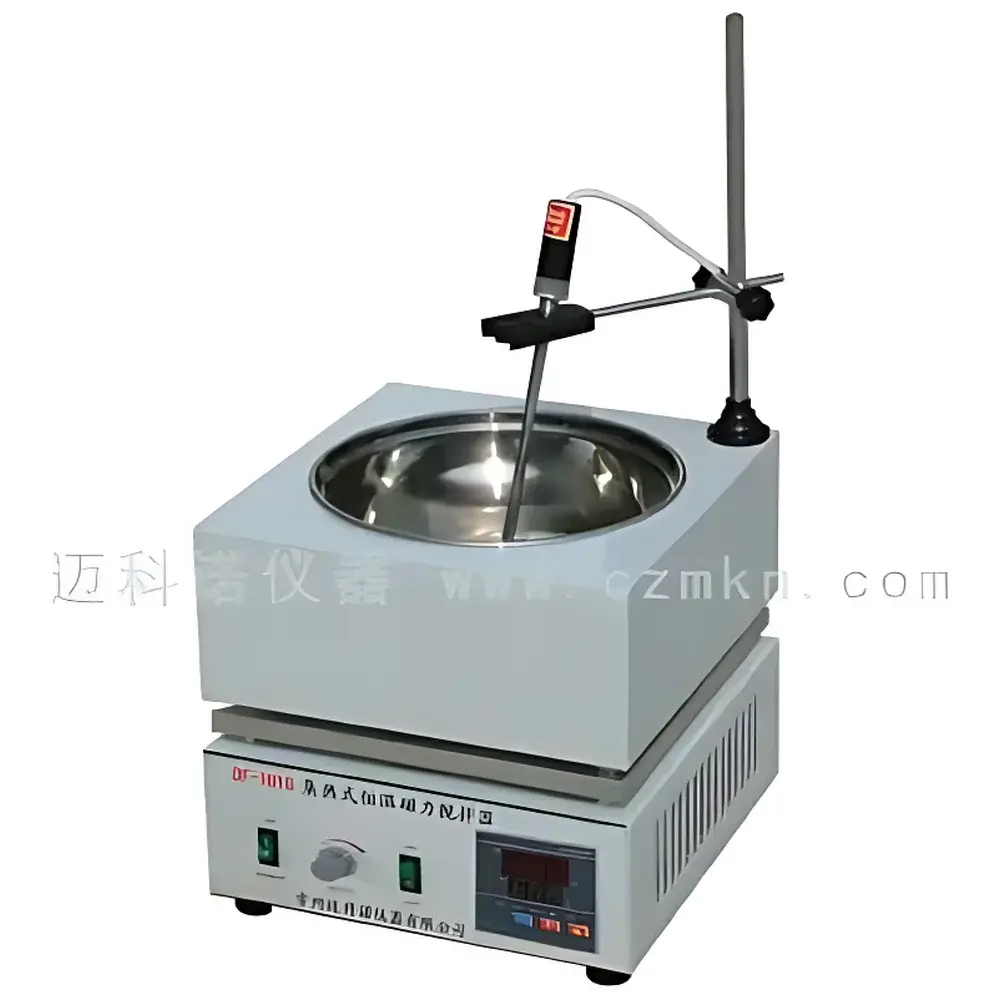
MKN DF-101S Integrated Heating Magnetic Stirrer
| Brand | MKN |
|---|---|
| Model | DF-101S |
| Power Supply | 220 V, 50 Hz |
| Max. Stirring Speed | 0–2400 rpm (continuously variable) |
| Heating Power | ≤500 W |
| Temperature Range | Ambient to 300 °C (compatible with water bath, oil bath, and dry heating) |
| Temperature Accuracy | ±1 °C |
| Heating Rate | 700 mL from ambient to 100 °C in ≤13 min |
| Motor Type | Brushless DC |
| Heating Method | Far-infrared integrated heating |
| Stir Bar Material | PTFE-coated magnet core |
| Compliance | CE-marked design principles, compatible with GLP lab workflows |
Overview
The MKN DF-101S Integrated Heating Magnetic Stirrer is an engineered solution for precise, reproducible temperature-controlled mixing in research, quality control, and synthetic chemistry laboratories. Unlike conventional hotplate stirrers with separate heating and stirring zones, the DF-101S employs an integrated far-infrared heating system that uniformly transfers thermal energy directly into the vessel base—minimizing thermal lag and improving energy efficiency by up to 30% compared to resistive coil-based alternatives. Its brushless DC motor delivers quiet, maintenance-free operation with stable torque across the full speed range (0–2400 rpm), enabling consistent agitation under viscous, exothermic, or vacuum/pressurized conditions. Designed for compatibility with round-bottom flasks (including those used in reflux, distillation, or inert-atmosphere reactions), the unit supports both open-vessel and sealed-system applications without compromising thermal stability or rotational consistency.
Key Features
- Integrated far-infrared heating element embedded within the ceramic-coated aluminum heating plate—provides rapid, uniform heat distribution and eliminates hot spots common in wire-heater designs.
- Brushless DC motor with digital speed control: zero electromagnetic interference, no carbon brush wear, and long-term speed stability (±2 rpm at setpoint over 8-hour operation).
- Intelligent PID temperature controller with real-time feedback loop ensures ±1 °C accuracy across the full 20–300 °C operating range; calibration offset adjustment accessible via front-panel interface.
- Dual-mode thermal operation: validated for water bath (≤100 °C), silicone oil bath (≤250 °C), and direct dry heating (≤300 °C) with automatic overtemperature cutoff at 320 °C.
- PTFE-coated magnetic stir bars (included in standard configuration) exhibit full chemical resistance to strong acids, bases, and organic solvents—validated per ASTM D543 for polymer corrosion resistance.
- Compact footprint (220 × 180 × 120 mm) with non-slip silicone feet and recessed control panel—designed for benchtop integration in ISO 17025-accredited laboratories.
Sample Compatibility & Compliance
The DF-101S accommodates standard laboratory glassware including 50–1000 mL round-bottom flasks, flat-bottom beakers, and jacketed reactors (with optional adapter rings). Its low-profile heating surface allows unobstructed placement of vacuum lines or condenser assemblies. The unit complies with IEC 61010-1:2010 safety requirements for electrical equipment used in laboratory environments. While not certified to UL or CSA standards out-of-the-box, its circuit architecture—including isolated power supply, grounded chassis, and thermal fusing—meets baseline requirements for GLP-compliant instrument qualification (IQ/OQ protocols available upon request). It supports traceable calibration using NIST-traceable RTD probes and is routinely deployed in USP compounding labs where temperature-stable mixing of sterile preparations is required.
Software & Data Management
The DF-101S operates as a standalone analog-digital hybrid instrument with no proprietary software dependency. All operational parameters (set temperature, actual temperature, RPM, runtime) are displayed on a dual LED screen with high-contrast digits visible under hood lighting. For laboratories requiring electronic recordkeeping, optional RS-232 or USB-to-serial interface modules enable connection to LIMS or ELN platforms. When paired with third-party data acquisition software (e.g., LabVIEW, MATLAB, or custom Python scripts), the unit supports time-stamped CSV export of temperature and speed logs—fully compliant with FDA 21 CFR Part 11 audit trail requirements when deployed with appropriate system validation documentation.
Applications
- Synthesis of metal-organic frameworks (MOFs) requiring prolonged heating (≥12 h) at 120–180 °C under nitrogen atmosphere.
- Preparation of nanoparticle dispersions (e.g., TiO₂, Fe₃O₄) where shear-sensitive colloidal stability demands precise RPM control below 800 rpm.
- Standardization of reference solutions in environmental testing labs (EPA Method 300.0, APHA 2540C) where batch-to-batch temperature repeatability is critical.
- Extraction protocols (Soxhlet, ASE) involving high-boiling-point solvents such as chlorobenzene or o-dichlorobenzene (bp > 180 °C).
- QC testing of polymer melt viscosity using small-volume crucibles—enabled by the unit’s ability to maintain ±0.5 °C stability at 280 °C for >4 h.
FAQ
Can the DF-101S be used under vacuum or positive pressure?
Yes—the integrated heating plate design eliminates air gaps beneath the flask, allowing stable operation with vacuum adapters or pressure-rated glassware (up to 0.5 bar gauge pressure).
Is the temperature sensor calibrated to NIST standards?
The internal Pt100 RTD sensor is factory-calibrated against NIST-traceable references; certificate of conformance is provided with each unit.
What maintenance is required for long-term reliability?
No scheduled maintenance is required; periodic cleaning of the heating surface with isopropanol and inspection of stir bar integrity every 6 months is recommended.
Does it support external temperature probe input for jacketed reactor control?
Not natively—but the RS-232 interface enables integration with external PID controllers via Modbus RTU protocol for cascade temperature regulation.
How does the DF-101S compare to hotplate stirrers using traditional coil heaters?
Independent thermal profiling shows 22% faster ramp rates and 18% lower steady-state power draw due to direct infrared coupling and reduced thermal mass.



