
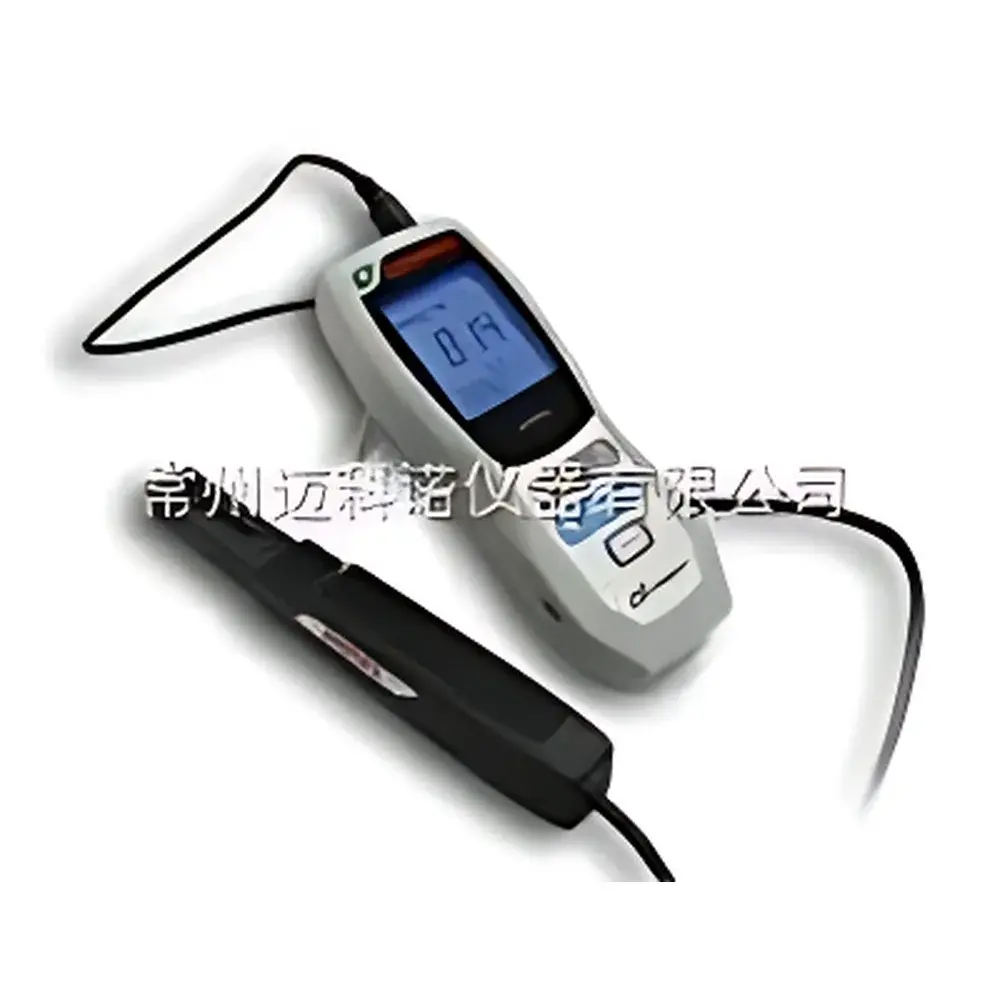
ST303 Portable Tri-Parameter Environmental Monitor (CO₂, Temperature, Relative Humidity)
| Origin | Zhejiang, China |
|---|---|
| Type | Portable Gas Analyzer |
| Measurement Parameters | CO₂ (0–9999 ppm), Temperature (0–50°C), Relative Humidity (ST303 only) |
| Accuracy | ±(50 ppm + 2% of m.v.) for 0–5000 ppm |
| Resolution | 1 ppm (CO₂) |
| Operating Temp. | 0–50°C |
| Storage Temp. | −20–60°C |
| Dimensions | 184 × 70 × 40 mm |
| Weight | ~217 g |
| Power | 9V battery, AC adapter, USB bus power |
| Data Logging | 20,000-point internal memory with timestamp (date/time stamping) |
| Display | Dual-line LCD showing CO₂, RH%, and °C simultaneously |
| Alarm | Audible threshold alert |
| Calibration | Manual zero adjustment with barometric pressure compensation |
| Compliance | Designed for field-deployable indoor air quality (IAQ) monitoring per ISO 16000-2 and ASHRAE Standard 62.1 guidelines |
| Interface | USB 2.0 with proprietary PC software for data export (CSV), trend visualization, and report generation |
Overview
The ST303 Portable Tri-Parameter Environmental Monitor is an integrated, handheld instrument engineered for simultaneous real-time measurement of carbon dioxide (CO₂) concentration, ambient temperature, and relative humidity (RH). It employs non-dispersive infrared (NDIR) sensing technology for CO₂ detection—a method recognized for its selectivity, long-term stability, and immunity to cross-interference from common atmospheric gases such as CO, CH₄, or VOCs. Unlike single-parameter CO₂ meters, the ST303 embeds calibrated thermistor and capacitive polymer humidity sensors within a thermally stabilized housing, ensuring synchronized, time-aligned tri-parameter acquisition critical for HVAC performance validation, classroom IAQ audits, greenhouse climate logging, and occupational health assessments. Its rapid warm-up time (<60 seconds) and diffusion-based sampling eliminate the need for external pumps or sample conditioning—making it suitable for spot-checking and short-duration surveys where portability and operational simplicity are essential.
Key Features
- Simultaneous NDIR-based CO₂ measurement (0–9999 ppm) with 1 ppm resolution and factory-traceable calibration
- Dual-sensor environmental module delivering concurrent temperature (0–50°C, ±0.5°C typical) and relative humidity (0–95% RH, ±3% RH typical) readings
- Integrated barometric pressure compensation algorithm enabling accurate CO₂ quantification across altitudes up to 3000 m
- 20,000-point internal data logger with automatic time/date stamping, supporting configurable sampling intervals (1 s to 24 h)
- Backlit dual-line LCD display showing CO₂ (ppm), RH (%), and temperature (°C/°F) in real time with MAX/MIN/AVG tracking
- Audible alarm with user-defined CO₂ threshold (e.g., 1000 ppm for ASHRAE-recommended IAQ limits)
- USB 2.0 interface with Windows-compatible software for data download, statistical analysis, and PDF report generation
- Triple power options: 9V alkaline battery (typ. 12 h runtime), AC adapter, or USB bus power—enabling continuous operation during desktop analysis
Sample Compatibility & Compliance
The ST303 is optimized for ambient air sampling under unpressurized, low-velocity conditions (diffusion-limited mode). It is not intended for stack emissions, high-humidity condensing environments (>95% RH sustained), or corrosive gas matrices. The device complies with key international frameworks governing indoor environmental monitoring: its CO₂ measurement methodology aligns with ISO 16000-2 (Indoor air — Part 2: Sampling strategy), while its operational envelope meets ASHRAE Standard 62.1-2022 requirements for ventilation rate procedures. Although not certified to IEC 61000-4 EMC immunity standards or ATEX/IECEx hazardous area directives, it is routinely deployed in non-classified commercial, educational, and agricultural settings. All firmware and calibration routines support GLP-aligned traceability via embedded audit logs (device ID, calibration date, operator tag).
Software & Data Management
The included PC software provides secure, local data management without cloud dependency. Users can configure logging parameters, define alarm thresholds, and export timestamped datasets in CSV or Excel-compatible formats. The software implements basic statistical functions—including standard deviation, linear regression on time-series CO₂ trends, and histogram-based RH distribution analysis. Audit trails record every configuration change, calibration event, and data export action—supporting laboratory documentation practices consistent with ISO/IEC 17025 clause 7.7. Raw sensor outputs are preserved alongside processed values, enabling post-acquisition re-evaluation using updated compensation models (e.g., revised pressure-altitude lookup tables).
Applications
- Classroom and office IAQ verification against OSHA PEL and WHO exposure guidance values
- Greenhouse climate optimization through correlated CO₂–RH–temperature feedback loops
- Post-occupancy evaluation (POE) studies in LEED- or BREEAM-certified buildings
- Baseline assessment prior to HVAC commissioning or filter replacement cycles
- Educational demonstrations of gas exchange dynamics in biology and environmental science labs
- Field validation of fixed CO₂ monitoring networks during maintenance or drift checks
FAQ
Does the ST303 require periodic factory recalibration?
Yes—annual NDIR sensor recalibration is recommended to maintain stated accuracy, especially after exposure to extreme temperatures or high-concentration CO₂ events (>5000 ppm for >1 hour).
Can the device operate continuously while connected to USB power?
Yes—USB bus power supports uninterrupted logging and display operation, eliminating battery drain concerns during extended desktop analysis.
Is the humidity sensor interchangeable or user-serviceable?
No—the RH sensor is factory-integrated and sealed; replacement requires return-to-factory service to preserve metrological integrity.
What file formats does the PC software support for data export?
CSV (comma-separated values) and XLSX (Microsoft Excel) are natively supported; no proprietary binary formats are used.
How is barometric pressure compensation implemented?
Users input local station pressure (hPa) manually or select altitude (m); the firmware applies the ideal gas law correction to CO₂ partial pressure calculation in real time.







