
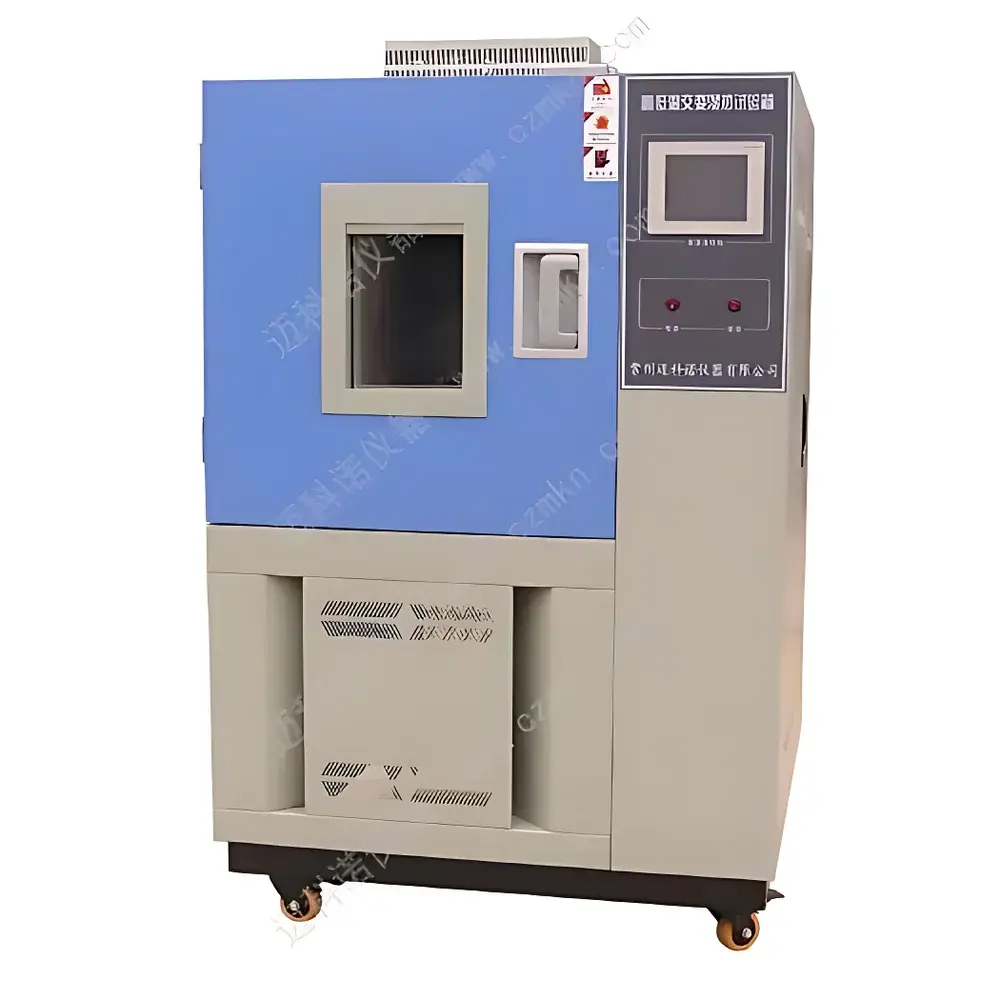
MKN GDS Series High-Low Temperature & Humidity Environmental Test Chamber
| Brand | MKN |
|---|---|
| Model | GDS Series |
| Temperature Range | -40 °C to +100 °C |
| Temperature Uniformity | ≤ ±2 °C |
| Temperature Fluctuation | ≤ ±0.5 °C |
| Heating Rate | ≥ 2–3 °C/min |
| Cooling Rate | ≤ 1 °C/min |
| Working Chamber Dimensions | 400×500×500 mm to 1000×1000×1000 mm |
| Humidity Control Method | Shallow-Tank Surface Evaporation |
| Refrigeration System | Single-Stage or Cascade (Air/Water-Cooled) |
| Compressor | Original French Tecumseh Hermetic Compressor |
| Controller | Fuji Electric or Honeywell Programmable PID Controller |
| Sensor | PT100 Platinum Resistance Thermometer |
| Safety Protections | Over-Temperature Protection, Leakage Current Protection, Compressor High-Pressure Cut-Off, Fast-Blow Fuse |
| Standard Compliance | GB/T 2423.1–4, GB 10592–89, GB 10586–89 |
Overview
The MKN GDS Series High-Low Temperature & Humidity Environmental Test Chamber is an engineered platform for evaluating the physical integrity, dimensional stability, and functional reliability of materials and components under controlled thermal and hygrothermal stress conditions. Based on the principle of balanced heating and humidification—where independent proportional-integral-derivative (PID) control loops dynamically regulate refrigeration output, electric heating power, and steam generation—the chamber maintains precise, repeatable environmental profiles across wide operational ranges. Designed for laboratory-scale validation in accordance with international environmental testing standards, it supports both steady-state and cyclic test protocols including temperature-only, humidity-only, and combined temperature-humidity profiles. Its architecture integrates thermodynamic isolation, laminar airflow management, and real-time feedback-driven actuation to ensure traceable, reproducible test environments essential for product qualification, failure mode analysis, and regulatory compliance documentation.
Key Features
- Double-wall construction with high-efficiency insulation: inner layer of SUS304 stainless steel and outer shell of either brushed-finish stainless steel or powder-coated A3 steel, minimizing thermal bridging and long-term corrosion susceptibility.
- High-reliability sealing system using dual-lip silicone gasket rated for continuous operation from –60 °C to +150 °C, ensuring consistent chamber integrity during rapid thermal transients.
- Optimized air circulation via low-noise, extended-shaft centrifugal blower with stainless-steel impeller—designed to deliver uniform airflow distribution without localized turbulence or hot/cold spots.
- Modular refrigeration architecture supporting both single-stage and cascade configurations; the latter enables stable sub-zero operation down to –60 °C while maintaining precise humidity control above freezing.
- Shallow-tank humidification system utilizing surface evaporation—eliminating water droplet carryover and enabling stable RH control between 20% and 98% at temperatures ≥ +10 °C.
- Integrated safety redundancy: independent over-temperature cut-off circuit, compressor discharge pressure monitoring, ground-fault interrupter (GFCI), and fast-acting fusing on all primary power circuits.
Sample Compatibility & Compliance
The GDS chamber accommodates a broad spectrum of test specimens—from printed circuit boards and automotive sensors to polymer housings and aerospace fasteners—within customizable interior volumes (40 L to 1000 L). Its design adheres strictly to national and international environmental testing standards, including GB/T 2423.1 (Cold Test), GB/T 2423.2 (Dry Heat), GB/T 2423.3 (Constant Damp Heat), and GB/T 2423.4 (Cyclic Damp Heat). It also fulfills the structural and performance requirements specified in GB 10592–89 (High-Low Temperature Chambers) and GB 10586–89 (Damp Heat Chambers). While not inherently 21 CFR Part 11 compliant, the system supports audit-ready data logging when paired with optional third-party validated software packages meeting GLP/GMP documentation criteria.
Software & Data Management
Standard configuration includes a Fuji Electric or Honeywell programmable controller featuring multi-segment ramp-soak programming, real-time trend display, and USB data export capability. Optional upgrade paths include Ethernet-enabled controllers with Modbus TCP interface for integration into centralized lab management systems. All controllers record timestamped temperature and humidity values at user-defined intervals (1 s to 60 min), storing up to 10,000 data points internally. Exported CSV files are compatible with common statistical process control (SPC) and quality assurance platforms. Calibration certificates traceable to NIM (National Institute of Metrology, China) are provided with each unit; field recalibration services follow ISO/IEC 17025 procedures.
Applications
- Accelerated aging studies of elastomers, adhesives, and encapsulants under thermal cycling and humidity exposure.
- Pre-compliance screening of electronic assemblies prior to formal MIL-STD-810 or IEC 60068 qualification.
- Material coefficient of thermal expansion (CTE) assessment via dimensional metrology during controlled thermal ramps.
- Validation of packaging barrier performance under accelerated climatic stress (e.g., pharmaceutical blister packs, medical device pouches).
- Functional testing of optoelectronic modules—including laser diodes and photodetectors—under combined thermal and moisture load.
- Research-grade investigation of phase transition behavior in phase-change materials (PCMs) and shape-memory alloys.
FAQ
What is the lowest achievable temperature with humidity control active?
Humidity control is maintained down to +10 °C; below this point, condensation risk necessitates dehumidification shutdown—standard practice per IEC 60068-3-5 for cold/humidity combined tests.
Can the chamber perform thermal shock testing?
No—this model is designed for gradual ramp-and-soak profiles only; thermal shock requires separate two-zone or three-zone shock chambers with rapid transfer mechanisms.
Is remote monitoring supported out-of-the-box?
Basic remote status viewing is available via optional Ethernet module; full SCADA integration requires custom OPC UA or Modbus gateway configuration.
How often does the system require preventive maintenance?
Compressor oil and refrigerant levels should be verified annually; evaporator coils and humidifier tanks require quarterly cleaning in high-use environments.
Are calibration reports included with shipment?
Yes—a factory calibration certificate covering temperature and humidity sensors (±0.3 °C, ±2% RH accuracy) is supplied with each unit, referenced to NIM-traceable standards.



