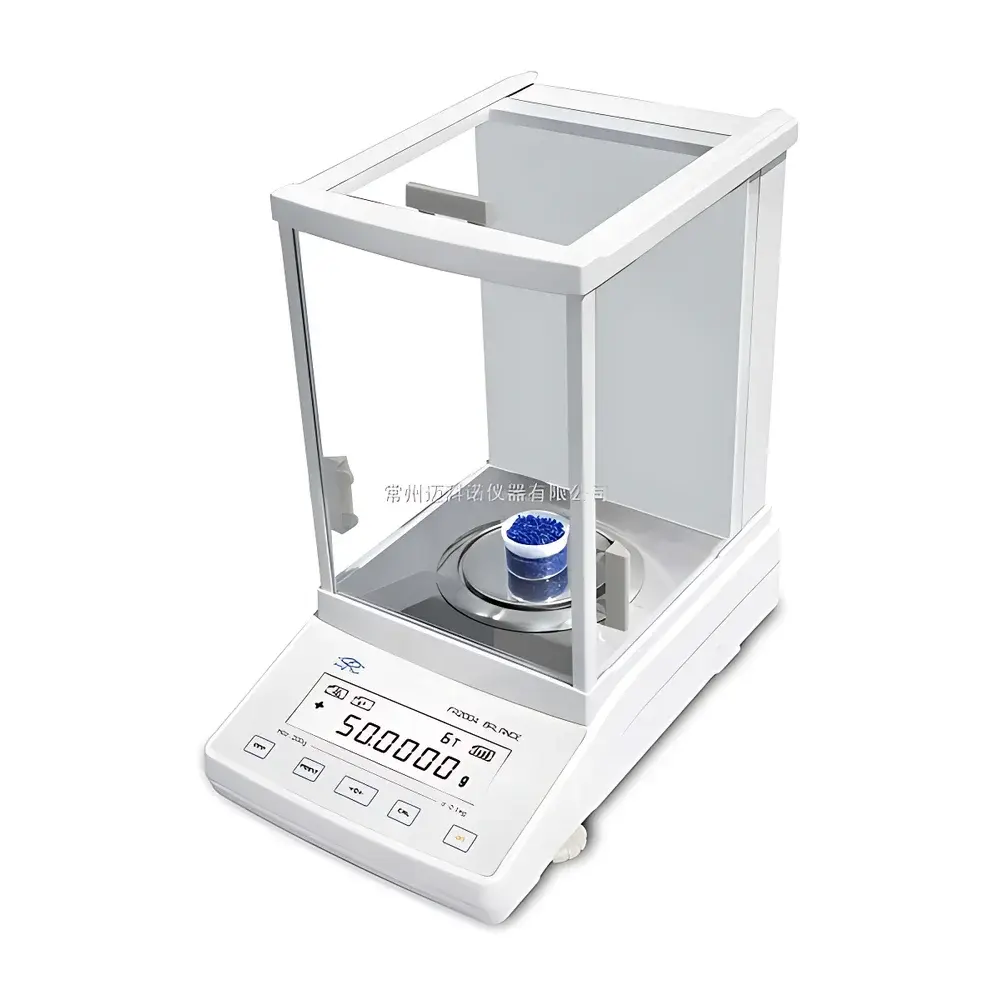
FA1004 Precision Analytical Balance
| Key | Capacity: 100 g |
|---|---|
| Readability | 0.1 mg (0.0001 g) |
| Repeatability | ±0.0001 g |
| Linearity Error | ±0.0003 g |
| Stabilization Time | ≤8 s |
| Minimum Weight (USP) | 0.0008 g |
| Sensitivity Drift | ±0.0005 g |
| Pan Diameter | Ø80 mm |
| Draft Shield | Sliding Triple-Door Glass Enclosure (240 × 190 × 265 mm) |
| Display | Backlit LCD with 0.1–0.4 s refresh rate selectable |
| Tare Range | 0–100 g |
| Calibration | Internal/External (100 g standard weight) |
| Operating Temperature | 17.0–25.5 °C |
| Power Supply | AC 220 V ±12 V, 50 Hz, 600 mA |
| Housing Material | Die-Cast Aluminum |
| Interface | RS232 (optional) |
| Dimensions (W×D×H) | 340 × 215 × 360 mm |
| Net Weight | 7.8 kg |
| Gross Weight | 11 kg |
| Compliance | ISO 9001, GLP-compliant data logging, USP <41> and <1251> compliant for minimum weight verification |
Overview
The FA1004 Precision Analytical Balance is an electromagnetic force compensation (EMFC) based laboratory balance engineered for high-reproducibility mass measurement in regulated and research environments. Operating on the principle of electromagnetic restoration—where sample-induced displacement of a precision lever system is counteracted by a controlled electromagnetic current—the FA1004 delivers stable, drift-resistant readings without mechanical wear. Its 100 g maximum capacity and 0.1 mg readability meet the performance requirements for quantitative gravimetric analysis, pharmaceutical formulation, reference standard preparation, and quality control testing per pharmacopoeial guidelines. Designed to operate within a tightly controlled thermal envelope (17.0–25.5 °C), the balance incorporates real-time environmental compensation algorithms to mitigate buoyancy and thermal drift effects. The integrated draft shield—featuring a triple-door sliding glass enclosure—ensures rapid airflow stabilization while maintaining optical accessibility and ergonomic sample handling.
Key Features
- Electromagnetic force compensation sensor architecture delivering zero-mechanical-hysteresis performance and long-term calibration stability
- Backlit LCD display with adjustable refresh rates (0.1–0.4 s) optimized for dynamic weighing tasks including differential and interval weighing
- Five-function keypad (ON/OFF, PRINT, CAL, →0←, TARE) supporting intuitive GLP-compliant operation without menu navigation overhead
- Draft shield dimensions (240 × 190 × 265 mm) engineered to minimize turbulence and maximize settling speed; fully removable for cleaning and calibration access
- Die-cast aluminum housing providing structural rigidity, EMI shielding, and thermal mass to dampen ambient vibration and temperature fluctuations
- Internal diagnostics including overload detection, sensor saturation alert, and automatic warm-up status reporting prior to first use
- Configurable unit conversion (g, oz, ct) and programmable auto-zero tracking for extended low-mass measurements
Sample Compatibility & Compliance
The FA1004 accommodates standard laboratory vessels—including weighing boats, crucibles, volumetric flasks, and vials—on its Ø80 mm stainless-steel pan. Its minimum weighable quantity (MWQ) of 0.0008 g satisfies USP criteria for analytical balance qualification when used with appropriate reference standards and environmental controls. The balance supports GLP and GMP workflows through audit-trail-capable event logging (when paired with optional RS232-connected software), including timestamped records of calibration, tare, print, and error events. It conforms to ISO 9001 manufacturing quality standards and is validated for compliance with ISO/IEC 17025 clause 5.5.2 (equipment verification) and ASTM E898–22 (standard specification for analytical balances). No internal battery or wireless components are present, ensuring electromagnetic compatibility in sensitive instrumentation suites.
Software & Data Management
While the FA1004 operates as a standalone instrument, its optional RS232 serial interface enables bidirectional communication with LIMS, ELN, or custom data acquisition platforms. When connected, the balance transmits ASCII-formatted data packets containing net weight, unit, date/time stamp, and operator ID (if preconfigured via external software). All transmitted data adhere to ASTM E1482–21 formatting conventions for analytical balance output. Internal memory retains the last 99 weighing results with timestamps—accessible via PRINT command—for immediate traceability during routine QC checks. Firmware supports user-defined calibration intervals and configurable auto-stabilization thresholds to align with SOP-defined decision rules.
Applications
- Pharmaceutical: Active pharmaceutical ingredient (API) dispensing, reference standard dilution, excipient ratio verification, and dissolution tablet weight uniformity testing
- Academic Research: Stoichiometric reagent preparation, catalyst mass loading, and nanomaterial yield quantification
- Materials Science: Ash content determination, polymer degradation residue analysis, and metal oxide purity assessment
- Environmental Testing: Filter membrane gravimetry for PM2.5/PM10 particulate mass concentration, soil moisture loss-on-ignition assays
- Food & Beverage: Nutrient fortification dosing, additive concentration validation, and packaging fill-weight audits
FAQ
What is the minimum weight that can be reliably measured on the FA1004 according to USP guidelines?
Per USP , the minimum weight is 0.0008 g when using calibrated reference weights and operating within specified environmental conditions (17.0–25.5 °C, <40% RH, no drafts).
Does the FA1004 support internal calibration?
No—it requires external calibration using a certified 100 g Class E2 or better weight; however, it features automated calibration mode initiation and step-by-step on-screen prompts.
Is the balance compatible with FDA 21 CFR Part 11 requirements?
The hardware itself does not provide electronic signature or audit trail functionality; full Part 11 compliance requires integration with validated third-party software and procedural controls.
Can the FA1004 be used in a fume hood?
Not recommended—drafts, temperature gradients, and solvent vapors compromise repeatability and may damage the EMFC sensor assembly.
What maintenance is required to ensure long-term accuracy?
Daily cleaning of the pan and draft shield with lint-free ethanol wipes; biannual verification using traceable standards; annual recalibration by an ISO/IEC 17025-accredited service provider.