
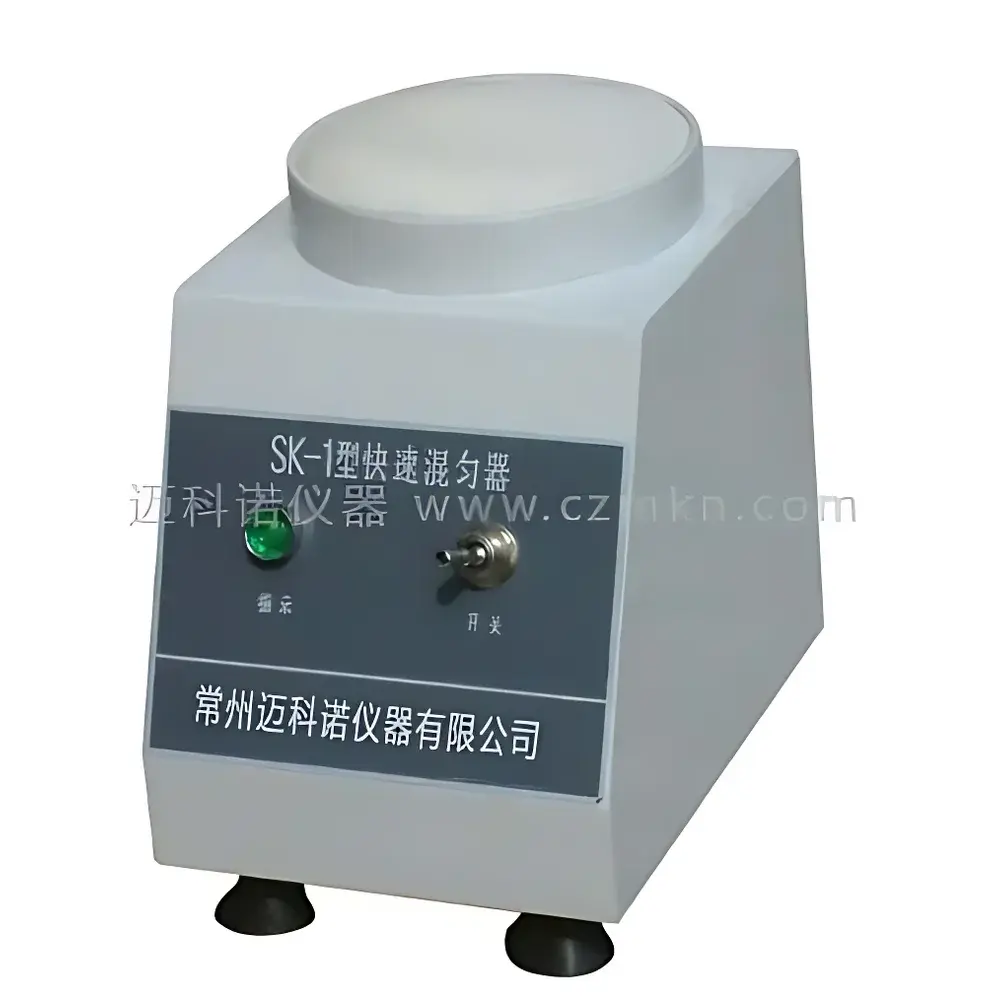
MKN SK-1 Rapid Vortex Mixer
| Brand | MKN |
|---|---|
| Model | SK-1 |
| Type | Vortex Mixer |
| Power Supply | AC 220 V ±10%, 50 Hz ±2% |
| Operating Frequency | 30–50 Hz |
| Power Consumption | 25 W |
| Origin | Jiangsu, China |
| Category | Benchtop Laboratory Vortex Mixer for Tube-Based Sample Homogenization |
Overview
The MKN SK-1 Rapid Vortex Mixer is a compact, benchtop laboratory instrument engineered for rapid and reproducible homogenization of small-volume liquid samples contained in standard laboratory tubes—including test tubes, cuvettes, centrifuge tubes (up to 15 mL), and small Erlenmeyer flasks (≤50 mL). It operates on the principle of orbital eccentric vibration: a motor-driven cam mechanism imparts controlled circular motion to the platform at variable frequencies, generating vigorous vortexing action without mechanical stirring elements or external probes. This design eliminates cross-contamination risks associated with immersion mixers and avoids shear-sensitive sample degradation common in high-speed rotor-based homogenizers. The SK-1 is optimized for applications requiring fast mixing kinetics—such as reagent resuspension, enzyme reaction initiation, immunoassay preparation, and nucleic acid dilution—where manual flicking or pipette-based mixing would introduce operator variability and inconsistent dispersion.
Key Features
- Stable eccentric drive system delivering consistent orbital motion across the full frequency range (30–50 Hz), ensuring repeatable mixing intensity without platform wobble or resonance-induced instability.
- Benchtop footprint (approx. 120 × 140 × 130 mm) designed for space-constrained biosafety cabinets, cold rooms, and modular lab workstations.
- No-load vibration amplitude calibrated to ≥3 mm peak-to-peak displacement—sufficient to induce turbulent vortex formation in ≤5 mL aqueous solutions within 2–5 seconds.
- Thermally stable ABS+PC housing with non-slip rubberized base, compliant with IEC 61010-1 safety standards for laboratory electrical equipment.
- Integrated thermal protection circuitry automatically deactivates the motor if internal temperature exceeds safe operational limits (≥70 °C), preventing coil burnout during extended use.
- Low electromagnetic interference (EMI) design ensures compatibility with adjacent sensitive instrumentation such as PCR cyclers, microplate readers, and analytical balances.
Sample Compatibility & Compliance
The SK-1 supports direct placement of conical-bottom and round-bottom tubes (diameters 10–16 mm), standard spectrophotometric cuvettes (12.5 × 12.5 mm cross-section), and small triangular flasks (≤50 mL capacity). It does not accommodate microcentrifuge tubes (<2 mL) or flat-bottom multiwell plates without optional adapters. All materials in contact with the platform surface are chemically resistant to common laboratory solvents (e.g., ethanol, isopropanol, 10% sodium hypochlorite) and withstand repeated wipe-down disinfection. While not certified to ISO/IEC 17025 or GLP-specific validation protocols, the device meets general-purpose performance criteria outlined in ASTM D4084 (Standard Practice for Determining Mixing Efficiency of Liquid Samples) when used with standardized viscosity reference fluids (e.g., 10–50 mPa·s glycerol–water blends). Its electrical architecture conforms to GB 4793.1–2019 (Chinese national adoption of IEC 61010-1).
Software & Data Management
The SK-1 is a manually operated analog device with no embedded firmware, digital interface, or data logging capability. Frequency selection is performed via a single rotary potentiometer; no software installation, driver configuration, or connectivity (USB/Bluetooth/Ethernet) is required or supported. This architecture ensures deterministic response time (<100 ms from knob adjustment to full-speed stabilization), zero firmware update dependencies, and immunity to cybersecurity vulnerabilities. For laboratories operating under FDA 21 CFR Part 11 or EU Annex 11 requirements, the absence of electronic records means the SK-1 falls outside the scope of computerized system validation—but must still be included in equipment qualification (IQ/OQ) documentation per organizational SOPs governing mixing step consistency in assay workflows.
Applications
- Rapid reconstitution of lyophilized reagents (e.g., antibodies, enzymes, calibration standards) in low-volume buffers prior to QC testing.
- Homogenization of cell lysates prior to centrifugation in proteomics and metabolomics sample prep pipelines.
- Equilibration of immunoassay diluents and conjugate solutions in ELISA and lateral flow assay development.
- Pre-mixing of PCR master mixes containing Taq polymerase, dNTPs, and primers to minimize pipetting error and thermal gradient effects.
- Dispersion of nanoparticle suspensions (e.g., gold colloids, liposomes) in stability studies where probe-based sonication may cause aggregation.
- Quality control verification of mixing uniformity in GMP-compliant raw material sampling procedures (e.g., API suspensions).
FAQ
What tube sizes are compatible with the SK-1 platform?
The standard platform accommodates tubes with outer diameters between 10 mm and 16 mm, including 13 × 100 mm test tubes, 16 × 100 mm culture tubes, and 15 mL conical centrifuge tubes. Adapters for microcentrifuge tubes (0.5–2 mL) are available upon request.
Can the SK-1 be used in cold rooms or refrigerated environments?
Yes—the device is rated for operation between 5 °C and 40 °C ambient temperature and relative humidity ≤80% non-condensing. Prolonged exposure below 5 °C may reduce motor torque and delay startup response.
Is calibration required before use?
No formal calibration is mandated; however, users should verify frequency output using a handheld tachometer or smartphone strobe app during initial setup and after any maintenance event. A deviation exceeding ±2 Hz from setpoint warrants service inspection.
Does the SK-1 meet CE or UL certification requirements?
It carries CCC (China Compulsory Certification) marking per GB 4793.1–2019. CE or UL listing is not applicable, as the device is intended for research-use-only (RUO) applications and not marketed for clinical diagnostic or industrial process control deployment.
What is the expected service life under typical lab usage?
With routine cleaning and avoidance of corrosive spills, the brush-type AC motor and mechanical linkage are rated for ≥10,000 hours of cumulative operation—equivalent to ~5 years of continuous daily use (8 h/day, 250 days/year).




